
_1770727924470.webp&w=828&q=75)
Difference Between FATCA and CRS Compliance
Read More
_1769499511.webp&w=3840&q=75)
Yes, NRIs can opt for a new tax regime while filing their ITR. The new tax regime offers relaxed tax rates with expanded slab limits. However, the new regime has removed some major tax exemptions and deductions.
In this blog, we will understand how the new tax regime impacts the taxable income of an NRI, including the benefits, tax treatment of NRI-specific income, and more.
The introduction of new tax regimes has simplified the tax rate and framework by providing expanded low tax rates while eliminating most tax exemptions.
For the current financial year, the slab rates under the new tax regime are as follows.
Another key feature of this regime is that it applies by default when you file your return. Meaning, unless you specifically choose the old tax regime, the new tax regime is automatically applied when filing the income tax return.
Lastly, the overall design of the new tax regime is all about promoting transparency and ease of compliance. Now that the complexity of multiple tax exemptions and deductions has also been eliminated, it is easier for NRIs to quickly evaluate their tax liability and decide whether to continue with the default option or switch to the old regime.
Stay compliant with expert support.
Under the new regime, any income earned through an NRO account, including rental income or other income sourced in India, will be taxable. The income from the NRO account will be taxed at the slab rate under the new tax regime.
Whereas the income in the NRE account remains tax-free under the Indian tax laws, irrespective of the tax regime the NRI taxpayer chooses. This is because, under Indian tax law, NRIs are taxed only on income earned or received in India.
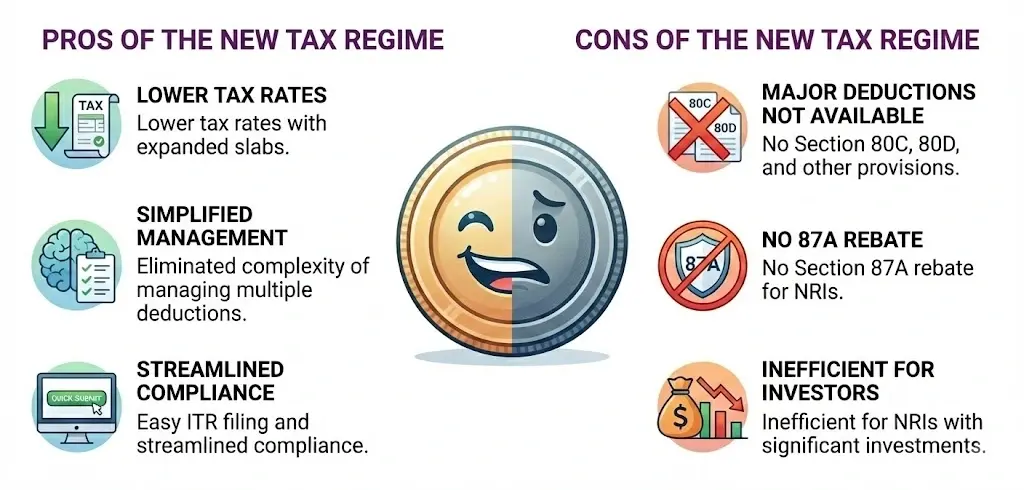
Every coin has two sides, and similar to the pros like expanded and low slab rate, the new tax regime also has cons.
Imagine Mr. A as an NRI with the following income streams in India.
The Tax Calculation For Old Regime
The Tax Calculation For New Regime
In this case, the new tax regime results in a lower tax liability even after there are no deductions to claim. However, this is to ensure that this result is situation-specific and does not apply to every situation, as the calculation may vary significantly depending on the scale of eligible deductions.
Plan better with Savetaxs expert support.
In a nutshell, yes, NRI can opt for the new tax regime. The new tax regime offers lower tax rates and a transparent tax framework. It was introduced in the financial year 2020-21 through the Finance Act 2020. Although the new tax regime has eliminated some major tax deductions and exemptions, it does offer a standard deduction of Rs 75,000.
NRIs, if you are still confused about the tax treatment, regime, tax rates, deductions, exemptions, rebates, refunds, and so on. Relax a little. Savetaxs is here to resuce your from this maze of NRI taxation. We have been helping NRIs from 90+ countries file their NRI ITRs in India, ensuring maximum refunds and minimum stress.
Our experts at Savetaxs provide end-to-end assistance throughout the tax filing process. Connect with us as we serve our clients 24/7 across all time zones.
Note: This guide is for information purposes only. The views expressed in this guide are personal and do not constitute the views of Savetaxs. Savetaxs or the author will not be responsible for any direct or indirect loss incurred by the reader for taking any decision based on the information or the contents. It is advisable to consult either a CA, CS, CPA or a professional tax expert from the Savetaxs team, as they are familiar with the current regulations and help you make accurate decisions and maintain accuracy throughout the whole process.

Mr Shaw brings 8 years of experience in auditing and taxation. He has a deep understanding of disciplinary regulations and delivers comprehensive auditing services to businesses and individuals. From financial auditing to tax planning, risk assessment, and financial reporting. Mr Shaw's expertise is impeccable.
Want to read more? Explore Blogs
_1770810988642.webp&w=828&q=75)
_1771224750019.webp&w=828&q=75)
_1771243586808.webp&w=828&q=75)
_1771243559271.webp&w=828&q=75)