Small Cap Funds for NRIs: All You Need to Know About
Read More
_1772455312884.webp&w=3840&q=75)
Yes, NRIs can invest in NFO (New Fund Offering) in India through NRE/NRO bank accounts.NFOs are introduced by an Asset Management Company to launch a new mutual fund scheme. It allows investors to purchase a newly launched mutual fund scheme at the base price, typically Rs. 10 per unit. The subscription period for an NFO is generally 10-15 days (up to 30). It can be launched as an open-ended, closed-ended, or interval scheme, and each NFO has a specific investment objective.
A wide range of investors invest in NFOs due to their affordability and also has potential to deliver higher returns. These are handled by professionals and may also help with portfolio diversification. Additionally, IPOs and NFOs are two different investment vehicles. NRIs can invest directly in the AMC, use online mutual fund websites, or even authorize a resident Indian to invest in NFOs. In this blog, we will cover everything you need to know about an NRI's investment in mutual funds (NFOs).
A new fund offering (NFO) is an initial subscription offered by an AMC to raise funds for a newly launched mutual fund scheme. Investors can buy units of the mutual fund at the offer price, typically Rs. 10. Generally, the offer period lasts for around 10 to 15 days (maximum 30), during which you can subscribe directly through the fund house.
NFOs allow investors to buy units of a newly launched mutual fund scheme at the base Net Asset Value (NAV). NFOs are launched to raise funds from investors before the scheme is made available for trading. Here is how NFO (New Fund Offer) works:
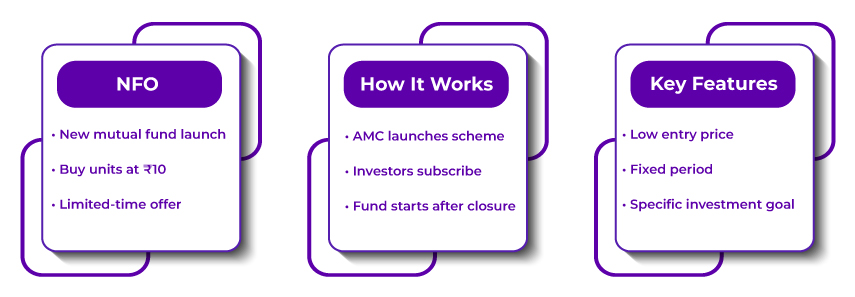
Here are some of the key features of investing in New Fund Offers (NFO):
NFOs and IPOs are not the same investment instruments. An IPO is a company that offers shares to the public for the first time to raise funds. On the other hand, an NFO is a mutual fund that launches new schemes to raise funds. The table below lists the key differences between an NFO and an IPO:
| Particulars | IPO | NFO |
|---|---|---|
| Full form | Initial Public Offering | New Fund Offering |
| Meaning | The issuance of new shares is known as an IPO. An IPO is where a company goes public by selling its shares and getting listed on the stock exchange. | NFO is introduced by an Asset Management Company (AMC)to launch a new mutual fund scheme. |
| Issuing Entity and Underlying Asset | Issued by a private company and issues the company's shares | Issued by an Asset Management Company (AMC) and issues mutual fund scheme units |
| Price Determination | Determined by the market demand via book building or a fixed price method | The price is fixed at the time of NFO |
| Risk | Generally higher risk | Depends on the asset type held in the mutual fund |
| Demat Account | Compulsory | Not Compulsory |
The following are the benefits that NRIs can enjoy after investing in NFOs:
NRIs/OCIs can invest in NFOs using their NRE/NRO accounts, either through a bank, broker, or AMC. Follow the steps below to invest in NFO as an NRI/OCI:
NRIs need to open an NRO/NRE account as mutual fund asset management companies in India don't accept investments in foreign currency.
Choose the NFO you wish to apply for and check its Scheme Information Document (SID) to check whether NRIs can invest in it or not. After that, verify whether the scheme complies with the Foreign Exchange Management Act (FEMA) regulations.
NRIs get various options to invest in NFOs, like:
Complete the form by submitting all the required details, like PAN card, a copy of your passport, etc. After that, pay the required amount using cheques/DD/online banking channels.
File your NRI taxes easily with Savetas
Here are some things that NRIs must consider before investing in NFO:
Investing in NFO as an NRi/OCI offers a unique opportunity and offers access to new emerging market trends. Investors can gain long-term returns by choosing the right fund that targets promising sectors or NFO themes. Apart from the affordability, high-return potential, and other benefits, NFOs carry some risks as well. Investors need to verify all the scheme documents to ensure the NFO aligns with their investment goals.
Additionally, to make a smart investment choice and ensure compliance with the FEMA regulations, consider seeking assistance from an expert at Savetaxs. At Savetaxs, we have an entire team of experts who have years of knowledge and expertise with NRI-related matters, including taxation, investment, repatriation, banking, finance, and more. They can help you make the smart and right investment decision that aligns best with your goals. Connect with us right away, as we are working 24/7 across all time zones.
Note: This guide is for information purposes only. The views expressed in this guide are personal and do not constitute the views of Savetaxs. Savetaxs or the author will not be responsible for any direct or indirect loss incurred by the reader for taking any decision based on the information or the contents. It is advisable to consult either a CA, CS, CPA or a professional tax expert from the Savetaxs team, as they are familiar with the current regulations and help you make accurate decisions and maintain accuracy throughout the whole process.

Mr. Ritesh has 20 years of experience in taxation, accounting, business planning, organizational structuring, international trade financing, acquisitions, legal and secretarial services, MIS development, and a host of other areas. Mr Jain is a powerhouse of all things taxation.
Want to read more? Explore Blogs