
NRI Purchasing Property In India From The USA - A Complete Guide
Read More
_1770382757472.webp&w=3840&q=75)
To generate passive income in India, NRIs prefer to invest in dividend-paying stocks. Although investing in stocks alone doesn't guarantee good returns, you also need to understand the dates associated with dividends, especially the ex-dividend date and the record date.
Understanding the ex-dividend date and record date is crucial to maximise your investment return. In this blog post, we will discuss them, including the key differences between ex-dividend and record dates, their meaning, and how these dates affect your dividends.
A set of important dates comes into play when a company declares its dividends, including the dividend date, declaration date, record date, ex-dividend date, and payment date. Of all the most critical dates, the declaration date, ex-dividend date, record date, and payment date are the most important.
Among NRI investors, the ex-dividend date and the record date are the most confusing. Hence, knowing the difference between the two dates is paramount for anyone seeking to receive dividends from their investments.
But before we get into the difference between ex-dividend and record date, let's review the key dividend dates for NRIs.
| Date | Meaning |
|---|---|
| Dividend | A dividend is a portion of a company's profits that the company distributes to its shareholders. You will be entitled to receive the dividend only if you hold the shares on the required dates. |
| Divident date | A dividend date is a specific day on which the company determines who will receive the dividend payout. |
| Declaration Date | The date when the company announces the dividend. |
| Record Date | The day when the company checks who has qualified for the payout. |
| Ex-Dividend Date | This is the first day the stock trades without any dividend rights. |
| The Payment Date | When the dividend is credited to all of its eligible shareholders. |
The ex-dividend date is the day on which a stock begins to trade without the value of its upcoming dividend payment. Meaning, as an investor, you will not be entitled to the next dividend if you happen to buy a stock on or after the ex-dividend date. Hence, the dividend will be credited to the shareholder, and, as the stock market requires a two-day settlement period (T+1), the dividend is paid to holders who own the shares on the record date or one business day before T+2.
In a nutshell, if you purchase the stock on or after the ex-dividend date, you will not receive the next dividend payment, and the seller will receive it. However, if you purchase the share before the ex-dividend date, you will receive the dividend.
Let us understand this with an example
Example 1:
Now, on March 2, 2026, the ABC company declares a dividend payable on March 17, 2026, to its shareholders. Additionally, ABC Company announces that shareholders of record on the company's books on or before March 16, 2026, will receive the dividends.
Now, in this example, the record date falls on a Monday. Excluding the holidays and weekends, the ex-dividend date would be set on the record date. Meaning any investor who buys the stock on Monday, March 16, 2026, or later will not receive the dividends. Investors who purchased the stock before the record date will receive the dividends.
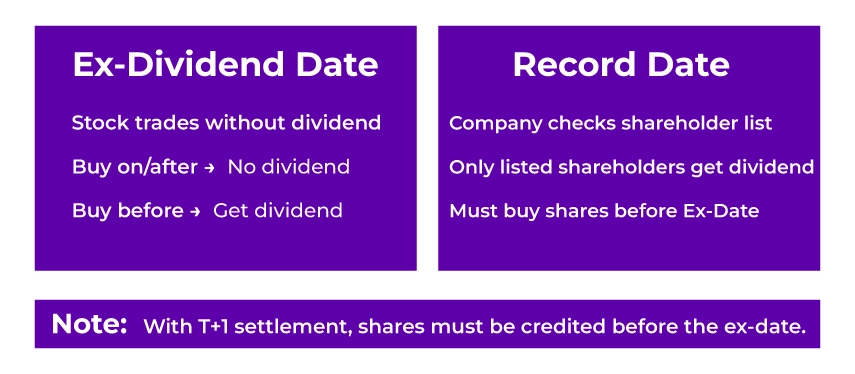
The record date is the day when the company checks the list of its official stockholders. Meaning it is the date set by the company to see which shareholders are eligible to receive the dividends.
Now, to be on the books of the company as a shareholder on the record date, you have to purchase the stock in the company before the ex-dividend date. The record date is usually set two to four business days after the declaration date, giving the company enough time to finalize the list of eligible shareholders.
As an investor, you will receive the dividends and will be included in the company's records only if you own the stocks on the record date. Because equities in today’s markets are settled on a T+1 basis, you must purchase the shares before the ex-dividend date to be recorded as a shareholder by the record date and be eligible for the dividends.
| Aspect | Ex-Dividend Date | Record Date |
|---|---|---|
| Defination | The ex-dividend date is the day on which the stock begins trading without the value of the upcoming dividend. It is also known as the cutoff day. | The record date is the day the company sorts through its records to determine the list of shareholders eligible to receive the payment. |
| Eligibility | You should buy the stock before the ex-dividend date to be eligible for the dividend. | To stand as an eligible investor to receive the dividends on this date, you have to be listed as a shareholder. |
| Timing | Generally, one working day before the date of the record. | On average, two business days after the ex-dividend day. |
| Impact on the buyers | As a buyer, you will not be eligible for the upcoming dividend if you purchase the stock on or after this date. | It established the final list of eligible stockholders who will receive the payout. |
| The Purpose | The purpose of this date is to identify the investors and the date by which dividend eligibility is calculated, depending on the time of the stock purchases. | It verifies the shareholder list to process dividend payments. |
| The relation to settlement | Associated with the T+1 settlement period, meaning that purchasing the stock before this date guarantees the purchase will be finalized by the record date. | This day reflected the shareholders' records for review that the corporation has conducted following the statements. |
Both dates are important for an NRI investor when deciding who receives the dividend.
Ex-Dividend Date: Any stock purchases made before this date will be eligible to receive the dividend. You will not receive the dividend if you have made purchases on it or after this date. For example, if the ex-dividend date is May 3, then you must purchase the share by May 2nd.
Record Date: The date on which the company goes through its shareholders to determine who is eligible for the dividend. To be on this list, you have to purchase the stock before the ex-dividend date.
NRIs need the following documents to receive dividends from Indian companies in which they have invested.
NRIs, please ensure you submit these documents before the dividend payouts to avoid any delays.
Get CA-approved NRI investment strategies tailored to your financial goals.
NRI market investors focusing on dividend earnings must understand the key difference between the ex-dividend date and the record date. When you strategically plan your stock purchases around these dates, you can qualify to receive the upcoming dividend.
Understanding these dividend dates not only helps you enhance your investment returns but also provides a clear insight into how the stock market operates. For any investor, proper timing is a key to maximising their financial gains through dividends.
However, if you are an NRI seeking professional assistance for NRI equity investments, Savetaxs is the name to trust. Our portfolio managers will help you understand the Indian equity market and help you maximize your financial gains. Our experts will create and manage investment strategies by researching and selecting assets to buy and sell, helping you meet your financial goals and achieve balanced risk and returns.
Connect with us as we serve our clients across all time zones.
Note: This guide is for information purposes only. The views expressed in this guide are personal and do not constitute the views of Savetaxs. Savetaxs or the author will not be responsible for any direct or indirect loss incurred by the reader for taking any decision based on the information or the contents. It is advisable to consult either a CA, CS, CPA or a professional tax expert from the Savetaxs team, as they are familiar with the current regulations and help you make accurate decisions and maintain accuracy throughout the whole process.

Mr. Ritesh has 20 years of experience in taxation, accounting, business planning, organizational structuring, international trade financing, acquisitions, legal and secretarial services, MIS development, and a host of other areas. Mr Jain is a powerhouse of all things taxation.
Want to read more? Explore Blogs