

Difference Between Federal and State Income Taxes
Read More
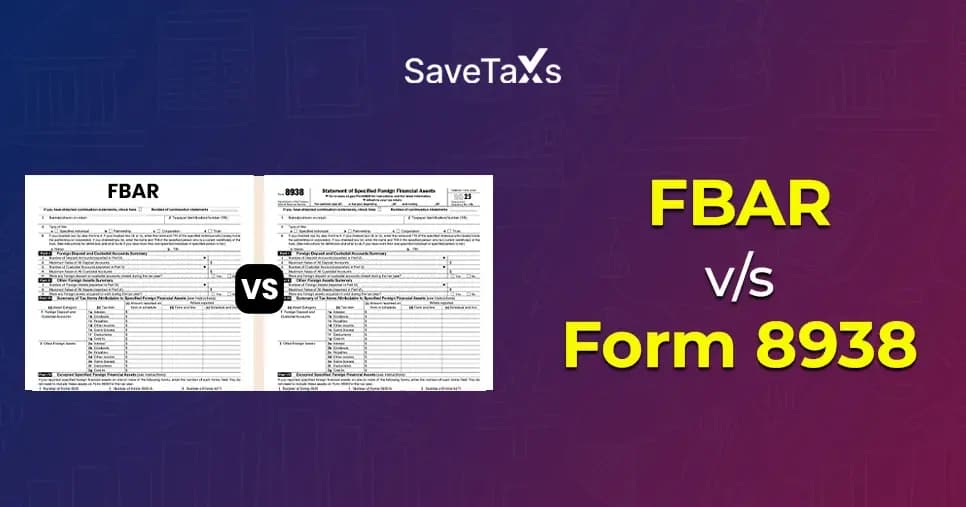
As a non-resident Indian living abroad, you may have financial assets in India. Assets such as mutual funds, shares, bank accounts, ULIPs, real estate, and more. Although these assets remain in India, the US tax authority mandates that you disclose these foreign assets entirely under two key reporting requirements.
1: FBAR (Foreign Bank Account Report - FinCEN Form 114)
2: Form 8938 (Statement of Specified Foreign Financial Assets - IRS Form)
Now, both forms relate to foreign asset reporting, but their purposes differ, and they are submitted to different authorities. Additionally, these forms have different compliance rules and thresholds.
In this blog, we will understand the FBAR vs Form 8938 differences in detail so you never confuse the two, stay compliant, and manage your cross-border NRI taxation without attracting penalties.
If you are an NRI living in the United States, you may need to file both FBAR and Form 8938 — not just one.
Many NRIs assume that filing one form is enough. However, these forms serve different purposes and are required under different regulations. In many cases, both filings are mandatory.
Failing to file either of them correctly can lead to significant penalties from the IRS or FinCEN.
Rahul, an NRI living in the USA, holds the following assets in India:
Since the total value of his foreign accounts exceeds $10,000, he must file an FBAR. Additionally, because his total foreign assets exceed IRS thresholds, he is also required to file Form 8938.
If Rahul files only FBAR and skips Form 8938, he may face IRS penalties despite partial compliance.
The full form of FBAR is Foreign Bank Account Report (FBAR). This form is not filed with the IRS but with FinCEN. US-based NRIs use this form to report foreign financial accounts if their combined value exceeds a set threshold.
Form 8938 is used to report foreign financial assets and is submitted along with your annual IRS tax return (Form 1040).
In simple terms, IRS Form 8938 is used by US taxpayers to report specified foreign financial assets if the total value exceeds certain thresholds.
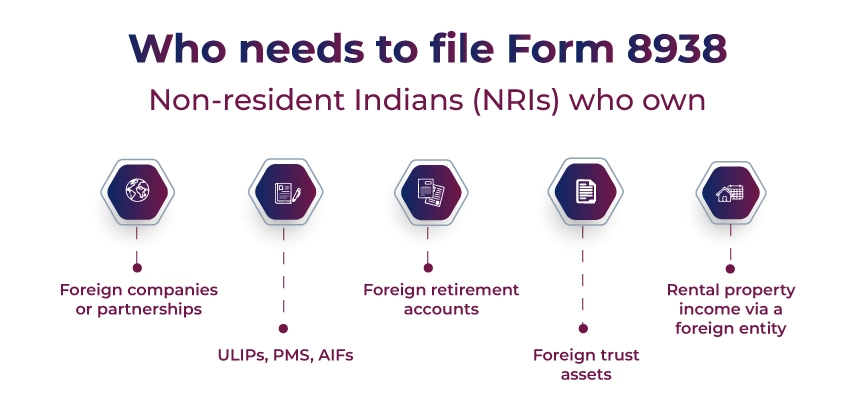
Thresholds vary by residency and filing status:
Deadline: April 15 (extensions align with Form 1040)
Filed With: IRS
| Particulars | FBAR (FinCEN Form 114) | Form 8938 |
| Reporting Threshold | $10,000 aggregate at any time | Varies based on residency & filing status |
| What is reported | Foreign financial accounts | Broader foreign financial assets |
| Filing authority | FinCEN | IRS |
| Due date | April 15 (Oct extension) | With tax return |
| Penalties | Up to 50% of account value | Up to $50,000 |
The United States taxes global income of its tax residents. Therefore, NRIs with financial assets in India must disclose these assets even if taxes are already paid in India.
Failure to comply can result in:
In a nutshell, FBAR is foreign financial accounts and signature submission, which was reported to FinCEN. Form 8938 is broader foreign assets and income interests and is reported to the IRS along with your US tax return.
To avoid last-minute tax complexities and remain compliant, it is advisable to seek professional guidance from a cross-border taxation expert. One such expert in NRI taxation is Savetaxs.
Our experts bring more than 30 years of combined experience in NRI taxation. We can provide you with high-end consultation on FBAR & Form 8938 Filing Services, NRI tax return filing in India and the United States, DTAA claims and cross-border structuring, and global mobility and asset reporting compliance.
Contact us today as we serve our clients 24/7 across all time zones.
Note: This guide is for information purposes only. The views expressed in this guide are personal and do not constitute the views of Savetaxs. Savetaxs or the author will not be responsible for any direct or indirect loss incurred by the reader for taking any decision based on the information or the contents. It is advisable to consult either a CA, CS, CPA or a professional tax expert from the Savetaxs team, as they are familiar with the current regulations and help you make accurate decisions and maintain accuracy throughout the whole process.

Mr Varun is a tax expert with over 13 years of experience in US taxation, accounting, bookkeeping, and payroll. Mr Gupta has not prepared and reviewed over 5000 individual and corporate tax returns for CPA firms and businesses.
Want to read more? Explore Blogs




FBAR, also known as FinCEN Form 114, is filed with the Financial Crimes Enforcement Network, whereas the Form 8938 (FATCA) is filed with the Internal Revenue Service (IRS) along with your US tax return (Form 1040).
However, both forms are used for reporting foreign final assets, but the filing thresholds and agencies differ.