
A Guide for NRI Buying Agricultural Land in India
Read More
Want to keep records of your deducted tax in India? This is one of the most common issues individuals, especially non-resident Indians (NRIs), face while managing finances overseas.
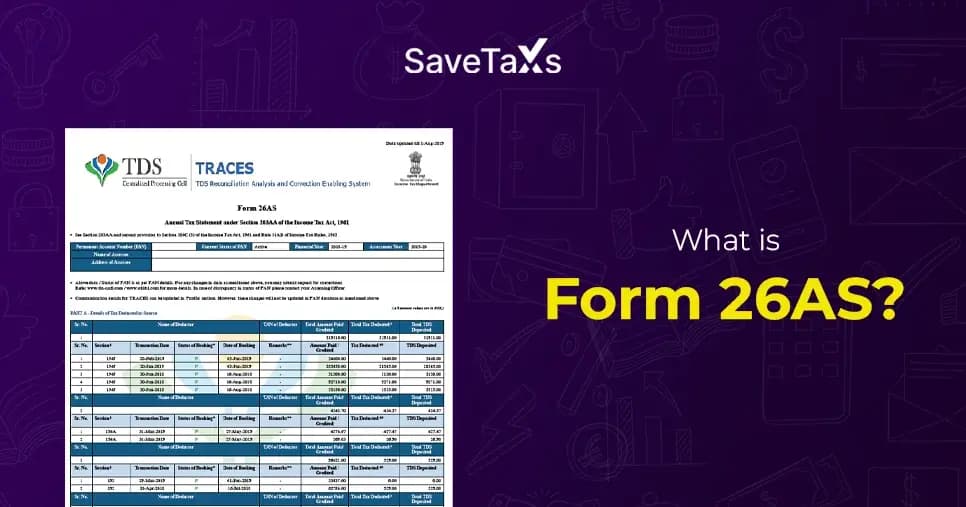
In this regard, Form 26AS serves as a consolidated tax document used by the Income Tax Department to keep records of tax-related transactions. It is a detailed statement showing any amount deducted as Tax Deducted at Source (TDS) or Tax Collected at Source (TCS), which can be used while filing income tax returns (ITR).
Form 26AS is a vital document containing information such as self-assessment tax payments, TDS deducted on the sale of immovable assets, advance tax payments, and certain specified financial transactions. Want to know more about why it matters for Indian residents and NRIs? Read this blog to understand it clearly.
Form 26AS is an annual tax statement provided by the Income Tax Department. It gives an overview of tax-related information and financial transactions mainly linked to tax credits.
If you are an Indian resident or NRI liable to pay tax in India, understanding this form is important because it works like a tax passbook. It provides a clear picture of your tax affairs in India.
The form also shows completed or pending tax demands, assessment proceedings, and refunds. The revised Form 26AS with expanded reporting was introduced from 1 June 2020. However, detailed financial transaction information is now mainly available in the Annual Information Statement (AIS), which is separate from Form 26AS.
The updated Form 26AS typically includes taxpayer details, TDS/TCS credits, tax payments, refunds, and certain transaction indicators. More detailed financial reporting, cross-border transactions, and expanded disclosures now appear mainly in AIS.
Form 26AS is a comprehensive tax credit document for residents and NRIs. It generally includes:
Additionally, the Annual Information Statement (AIS) introduced alongside the revised reporting framework from 1 June 2020, separately provides expanded information on financial transactions, refunds, demands, and other tax-related data.
Form 26AS under the Income Tax Act, 1961 contains multiple sections mainly related to tax credits.
In the Form 26AS, this section showcases the details of the deducted tax on your income by all individuals or entities who need to deduct tax at source. It consists of information like the name of the tax deductor, Tax Deduction Account Number (TAN), tax amount, credit or paid amount, and the time for which the tax deduction was made.
TDS Details for Form 15G/15H: Shows cases where TDS was not deducted because Form 15G/15H was submitted.
TDS Under Specific Sections:
Examples include:
If you get an income subject to TCS, this section in the form showcases the relevant details of it. It consists of the name and TAN of the individual or entity who collected the tax, the collected tax, the paid or credit amount, and the period.
This section of Form 26AS contains information on the taxes you paid directly, such as the advance tax and self-assessment tax that you paid during a fiscal year. This involves details of the paid amount and the payment date.
During the financial year, if you have received any kind of tax refunds, this section of the form will provide details of that refund amount and that financial year.
This section of the Form 26AS consists of the information on high-value financial transactions, such as mutual funds, shares, and other specific financial assets. Through this detail, the tax officials monitor transactions for non-compliance and tax evasion.
This section contains the TDS information when you deduct and deposit your liable tax. For instance, while purchasing a property, making payments to professionals or contractors, or paying rent.
After completing TDS returns, if any discrepancies or defaults are found in the tax deducted amount, the details of these are mentioned in this section of the form.
Under the Goods and Services Tax (GST), taxpayers who are registered, details of turnover mentioned in GSTR-3B are also stated in the revised Form 26AS.
This was all about the structure and parts of Form 26AS. Moving further, let's go through the process to download and use the form for filing the ITR.
After accessing the online Income Tax Department platform, downloading Form 26AS is an easy process that is vital for filing the income tax return. Through this form, one can claim all tax credits that are eligible during the ITR process. Moving ahead, here are the steps that you need to follow to download the form from the portal:
Steps to Download Form 26AS
This form shows tax deducted, collected, or paid in India including advance tax, TDS, and self-assessment tax.
For NRIs, reviewing Form 26AS is essential for claiming correct tax credits, refunds, and DTAA benefits where applicable.
Note: Some financial details are now primarily shown in AIS, which complements Form 26AS.
NRIs can access Form 26AS the same way as resident taxpayers through the Income Tax e-filing portal or TRACES website. No separate NRI portal is required.
You simply need:
Steps:
These steps remain the same if you use the TRACES website. This is how you can access your Form 26AS outside India. Now, moving further, let's know the benefits of Form 26AS.
Download Form 26AS format for FY 2024-25 (AY 2025-26)
As mentioned above, many times, Form 26AS is a vital document for both NRI and resident Indian taxpayers. It is a strong statement that consists of a summary of all the information on taxes available from the IT Department. Form 26A is essential and provides several benefits to taxpayers in India. Want to know what they are? Read the points below and get your answers.
These are the benefits that Form 26AS offers to taxpayers while filing the ITR in India. Moving further, now, let's know the difference between Form 26AS and TDS certificate (Form 16/ 16A).
Form 26AS and TDS certificate (Form 16/16A) are both vital tax documents in India for taxpayers that are associated with Tax Deducted at Source (TDS). Although both forms help taxpayers in claiming tax benefits, but have different purposes and consist of different details. Want to know more about them? Here, the table below showcases the difference between these forms. So read on and get a clear overview of them.
| Basis | Form 26AS | Form 16 | Form 16A |
|---|---|---|---|
| Purpose | A comprehensive tax statement that consists of details of all paid taxes | TDS certificate is provided for the salary income of employees by the employer | TDS certificate for non-salary income |
| Issued By | Record of the Income Tax Department (via the TRACES website) | Employer | Deductor (for instance, company, bank) |
| Issued To | Taxpayer (For instance, an individual, whether a resident Indian, NRI, a company, or more) | Employee | Deductee (For instance, company, individual, and more) |
| Contains |
|
|
Deducted TDS |
| Period | Annual, up-to-date | Annual | Quarterly |
| Availability | Available on the Income Tax website and the TRACES website | Issued by the employer | Issued by the deductor |
| Usage |
|
|
|
| Reconciliation | For discrepancies compared with Form 16/16A | Matched with Form 26AS | Matched with Form 26AS |
This is the key difference between the TDS certificate (Form 16/16A) and Form 26AS. Now, moving further, let's know the things to check in the TDS certificate along with Form 26AS.
Before submission, Form 26AS should be verified with both the TDS certificates, i.e., Form 16 (available for salaried individuals) and Form 16A (for NRIs and non-salaried individuals), to certify that the deducted TDS from the income of the payee is correct and deposited to the income tax department. Moving ahead, here are the things you need to check in your Form 26AS and TDS certificate:
These are the things that you need to verify in both, TDS certificate and Form 26AS.
Understanding Form 26AS is important for both resident Indians and NRIs. Reviewing it regularly helps confirm accuracy of tax paid, deducted, and deposited.
This ensures your income is properly reflected and prevents issues during ITR filing. Since filing for FY 2024-25 has already begun, professional assistance can help simplify compliance.
You may connect with SaveTaxs experts for smoother tax filing and compliance support.
Note: This guide is for information purposes only. The views expressed in this guide are personal and do not constitute the views of Savetaxs. Savetaxs or the author will not be responsible for any direct or indirect loss incurred by the reader for taking any decision based on the information or the contents. It is advisable to consult either a CA, CS, CPA or a professional tax expert from the Savetaxs team, as they are familiar with the current regulations and help you make accurate decisions and maintain accuracy throughout the whole process.

Mr Manish is a financial professional with over 10 years of experience in strategic financial planning, performance analysis, and compliance across different sectors, including Agriculture, Pharma, Manufacturing, & Oil and Gas. Mr Prajapati has a knack for managing financial accounts, driving business growth by optimizing cost efficiency and regulatory compliance. Additionally, he has expertise in developing financial models, preparing detailed cash flow statements, and closing the balance sheets.
Want to read more? Explore Blogs