
_1768304909.webp&w=828&q=75)
ITR PDF Password - What Is It & How To Open ITR PDF File?
Read More
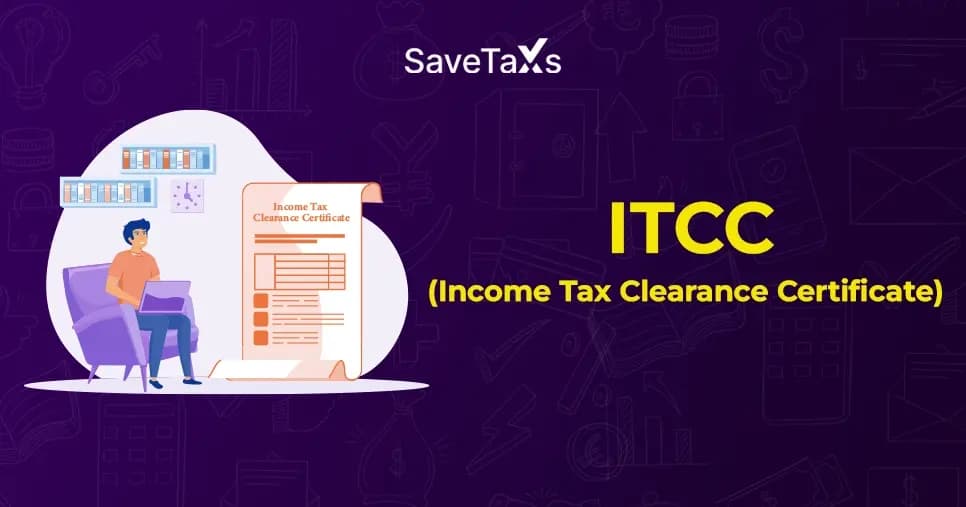
For a long time, an income tax certificate has been a crucial document used in various transactions, including registering real estate purchases, bidding for government projects, renewing an export and import license, or obtaining a shipping license.
However, after the PAN card has been issued, the use of the Income Tax Clearance Certificate has become limited. Still, there are specific situations where this certificate is required.
In this blog, we will explore all aspects of the ITCC, from its definition to the process of obtaining one, the required documents, and more.
An Income Tax Clearance Certificate (ITCC) is a document confirming that a person has fulfilled all income-tax obligations under the Income Tax Act up to a specified date.
It indicates that there are no outstanding income-tax liabilities based on available records.
The Income Tax Department of India (Central Government) issues the ITCC. It confirms that an individual or company has complied with tax obligations as of the date mentioned in the certificate.
Anyone meeting certain conditions may be asked to obtain a Tax Clearance Certificate, particularly when leaving India permanently or in specific compliance situations.
Typical scenarios include:
In simple terms, certain non-residents earning income in India, especially those departing permanently or under tax scrutiny, may need this certificate.
An Income Tax Clearance Certificate generally relates only to income-tax compliance under the Income Tax Act.
It does not cover other taxes such as sales tax, unemployment tax, or other state levies.
After assessing all information, if the income tax officer is satisfied, an ITCC is issued in Form 30B to the applicant.
This document may also mention the certificate’s validity, if applicable.
Usually, residents travelling abroad do not need an ITCC. A PAN card and travel details are generally sufficient.
However, if authorities detect financial irregularities or significant pending tax matters, they may request an Income Tax Clearance Certificate.
The Central Board of Direct Taxes (CBDT) has clarified under Section 230 that obtaining an ITCC is generally not mandatory for residents leaving India.
This applies unless there are serious tax arrears, investigations, or compliance concerns.
Individuals not residing in India but earning income from Indian sources may be required to obtain an Income Tax Clearance Certificate in specific situations.
This usually applies when leaving India permanently or when directed by tax authorities.
Typical conditions include:
Indian citizens normally do not need ITCC unless specifically instructed by the Income Tax Department.
To obtain an Income Tax Clearance Certificate, an applicant submits an undertaking to the Income Tax Department.
Non-resident individuals generally submit this undertaking in Form 30A.
Sometimes, the employer or income payer in India may also confirm responsibility for future tax liabilities, if applicable.
If the tax officer is satisfied with the information provided, the certificate may be issued in Form 30B.
Prepare the following documents before applying:
Application Form 30A
Ensure all details are accurate and complete.
Passport Copy
Required for identification and travel verification.
Proof of Tax Payment
Provide evidence of tax payments, including recent ITR acknowledgements where applicable.
PAN Card Copy
Required for tax identification and record verification.
Other Financial Documents
Depending on the case, documents such as salary slips, bank statements, or investment proof may also be requested.
For individuals not domiciled in India, a slightly different compliance process may apply.
The applicant and employer or income payer may submit Form 30A confirming tax compliance obligations.
After review, the Income Tax Department may issue a No Objection Certificate (NOC), also known as a Tax Clearance Certificate, in Form 30B.
This confirms tax compliance up to the date of departure.
Indian residents usually do not need ITCC when travelling abroad, and a PAN card is typically sufficient.
However, in specific cases, authorities may request Form 30C detailing travel purpose and duration.
When can residents be asked to obtain ITCC?
Common situations include:
In general, residents are not required to obtain ITCC unless directed by tax authorities.
For routine temporary travel, residents usually do not need to submit Form 30C.
It may only be required in specific compliance situations where authorities request travel information.
The Income Tax Department under the Central Government of India issues the Income Tax Clearance Certificate to eligible individuals or entities.
An ITCC helps demonstrate tax compliance in certain situations.
Business Transactions
Government tenders or regulatory processes may require proof of tax compliance.
Loan Applications
Financial institutions sometimes request tax compliance confirmation.
Tender Participation
Government or large contracts may require tax clearance documentation.
Property Transactions
High-value transactions may involve tax compliance verification.
Legal Proceedings
Financial settlements or compliance checks may require proof of tax clearance.
An income tax clearance certificate is required to clear a person's tax liability. However, Indian residents don't need to obtain one, but non-residents do. And anyone who has applied for it will only get it after they have cleared their due taxes and have submitted all the necessary documents. If you haven't applied for an Income Tax Clearance Certificate online yet, this is the sign to apply for an ITCC online.
Note: This guide is for information purposes only. The views expressed in this guide are personal and do not constitute the views of Savetaxs. Savetaxs or the author will not be responsible for any direct or indirect loss incurred by the reader for taking any decision based on the information or the contents. It is advisable to consult either a CA, CS, CPA or a professional tax expert from the Savetaxs team, as they are familiar with the current regulations and help you make accurate decisions and maintain accuracy throughout the whole process.

Mr Varun is a tax expert with over 13 years of experience in US taxation, accounting, bookkeeping, and payroll. Mr Gupta has not prepared and reviewed over 5000 individual and corporate tax returns for CPA firms and businesses.
Want to read more? Explore Blogs
_1768471286.webp&w=828&q=75)
_1768807342.webp&w=828&q=75)
_1768808777.webp&w=828&q=75)