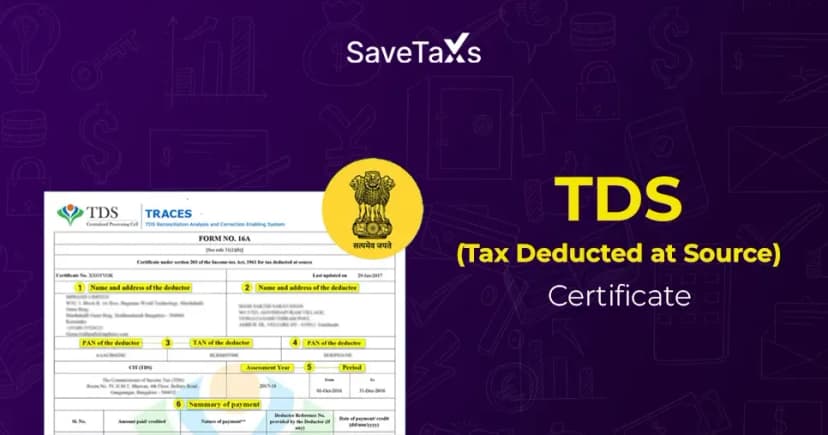
Understanding TDS Certificate and How To Download It Online
Read More
_1770281161795.webp&w=3840&q=75)
The new tax regime is now the default, offering significant tax relaxations in the slab rates for FY 2025-26, while the income tax slabs for the old tax regime remain unchanged.
In this blog post, we will discuss the income tax slabs for FY 2025-26 under the new and old rate regimes, and the tax-free income under both regimes for NRIs and Indian residents.
The following table showcases the features of the old and the new tax regimes:
| Particulars | New Tax Regime | Old Tax Regime |
|---|---|---|
| Basic Exemption Limit | Rs 4 Lakh | Rs 2.5 Lakh |
| Maximum Tax Rate | 30% (exceeding the threshold of Rs 24 Lakhs) | 30% (exceeding Rs 10 lakhs) |
| Rebate | Rs 60,000 | Rs 12,500 |
| Zero Tax Salary | Rs 12.75 lakh | Rs 5.5 lakh |
| Zero Tax Income | Rs 12 Lakh | Rs 5 Lakh |
The 2025 budget has provided major relaxations to the tax slabs under the new tax regime. The following are the new tax slab rates under the new tax regime for FY 2025-26.
| Income Tax Slabs For The FY 2025-26 ( AY 2026-27) | The Income Tax Slab Rates For FY 2025-26 ( AY 2026-27 ) |
|---|---|
| Up to Rs 4 Lakh | Nil |
| Rs 4 Lakh to Rs 8 Lakh | 5% |
| Rs 8 Lakh to Rs 12 Lakh | 10% |
| Rs 12 Lakh to Rs 16 Lakh | 15% |
| Rs 16 Lakh to Rs 20 Lakh | 20% |
| Rs 20 Lakh to Rs 24 Lakh | 25% |
| Above Rs 24 Lakh | 30% |
From the 2023-24 financial year, the old tax regime has become optional. The slab rate for the old tax regime is as follows
| Income Tax Slab For FY 2025-26 | Income Tax Rate |
|---|---|
| Up to 2,50,000 | Nil |
| 2,50,001 - 5 Lakh | 5% |
| 5 Lakh - 10 Lakh | 20% |
| Above 10 Lakh | 30% |
The following are the popular tax deductions allowed under the old tax regime
The following are the income tax slabs in the old tax regime for senior citizens aged 60 to 80 years.
| Income Tax Slab | Income Tax Slab Rate |
|---|---|
| Up to Rs 3 Lakh | Nil |
| Up to Rs 3 Lakh - Rs 5 Lakh | 5% |
| Rs 5 Lakh - Rs 10 Lakh | 20% |
| Above 10 Lakh | 30% |
For super senior citizens aged 80 years and above under the old tax regime, the basic exemption limit is increased to Rs 5 Lakh.
| Income Tax Slabs (Rs) | Income Tax Rates (Rs) |
|---|---|
| Up to 5 Lakh | Nil |
| Rs 5 Lakh - 10 Lakh | 20% |
| Above Rs 10 Lakh | 30% |
Taxpayers must note that the income tax slabs under the old tax regime have not changed over many years.
Under both the old and the new tax regimes, the income tax slab rates in India are the same for NRIs and resident individuals. NRIs are taxed in India according to the applicable slab rates based on their total taxable income.
However, the income tax slab rates remain the same; the availability of basic exemptions and tax deductions differs for NRIs. For example, NRIs are not eligible to claim the higher basic exemption limit that is available to Indian resident senior and super senior citizens, even if the NRI's age qualifies.
Furthermore, certain tax deductions and allowances generally available to Indian resident taxpayers are not applicable to NRIs. Henceforth, NRIs must not assume that their tax liability will be the same as that of an Indian resident solely on the basis of applicable tax rates, and should carefully evaluate their eligibility for tax exemptions and deductions before choosing the right tax regime.
Income that is taxable for NRIs is only that which is earned in India, received in India, or deemed to be received in India. Furthermore, income that is earned or received outside India is not taxable in India for NRIs.
In India, the following income types are taxable for NRIs
For NRIs, understanding their taxable income is crucial, as incorrect reporting can lead to excess taxation and compliance issues when filing an Income Tax return in India.
For Indian Residents
For Non-Resident Indians
We help NRIs to file their ITR in India error-free.
Which tax regime is most beneficial depends on individuals' finances and the number of tax deductions or exemptions they can claim.
For a taxpayer with many tax-saving deductions to claim, opting for the old tax regime is more beneficial.
For taxpayers with limited tax-saving deductions or middle-class income earners, the new tax regime is more beneficial.
Below is a table showing break-even points for different income levels. If the taxpayer has a tax deduction above the break-even range, the old tax regime would be beneficial; otherwise, choose the new tax regime.
| Gross Income In Rs | Break-Even Deduction |
|---|---|
| Up to Rs 5 Lakhs | Both regimes are beneficial |
| Rs 7 Lakh | Rs 1,50,000 |
| Rs 10 Lakh | Rs 4.50,000 |
| Rs 11 Lakh | Rs 5,50,000 |
| Rs 12 Lakh | Rs 6,50,000 |
| Rs 13 Lakh | Rs 6,87,500 |
| Rs 14 Lakh | Rs 5,18,750 |
| Rs 15 Lakh | Rs 5,43,750 |
| Rs 16 Lakh | Rs 5,68,750 |
| Rs 17 Lakh | Rs 6,08,330 |
| Rs 18 Lakh | Rs 6,41,670 |
| Rs 19 Lakh | Rs 6,75,000 |
| Rs 20 Lakh | Rs 7,08,330 |
| Rs 22 Lakh | Rs 7,54,170 |
| Rs 24 Lakh | Rs 7,87,500 |
| Rs 25 Lakh | Rs 8 Lakh |
Taxpayers must plan ahead and choose their tax regime at the beginning of the financial year.
Taxpayers can assess and estimate their total income, consolidate all deductions, and then calculate their taxable income and total tax payable under both tax regimes to determine which regime is most beneficial.
The table below shows which income tax regime is most beneficial for a deduction expense of Rs 4.5 lakh.
| The Gross Income | The New Tax Regime | The Old Tax Regime |
|---|---|---|
| Up to Rs 5 Lakh | Yes | Yes |
| Rs 7 Lakh | No | Yes |
| Rs 10 Lakh | No | Yes |
| Rs 11 Lakh | Yes | No |
| Rs 12 Lakh | Yes | No |
| Rs 13 Lakh | Yes | No |
| Rs 14 Lakh | Yes | No |
| Rs 15 Lakh | Yes | No |
| Rs 16 Lakh | Yes | No |
| Rs 17 Lakh | Yes | No |
| Rs 18 Lakh | Yes | No |
| Rs 19 Lakh | Yes | No |
| Rs 20 Lakh | Yes | No |
| Rs 22 Lakh | Yes | No |
| Rs 24 Lakh | Yes | No |
| Rs 25 Lakh | Yes | No |
Example 1
Mr Arjun earns a salary of Rs 12 Lakhs. From his salary, he invested Rs 1.5 lakh in a PPF account and paid another Rs 30,000 towards his spouse's, his children's, and his own health insurance.
For FY 2025-26, Mr Arjun will have no tax liability under the new regime, as his income will be less than Rs 12 Lakh. Moreover, he will be eligible to claim a rebate under section 87A.
Now, if we see the same income and tax deduction combination under the old tax regime, then Mr. Arjun's total income tax liability will be Rs 1,10,760.
But under the new tax regime, the income up to 12 Lakhs is tax-free for FY 2025-26.
Example 2
Mr Shri has a salary of Rs 25 lakhs for FY 2025-26. He lives in a rented house, pays Rs 45,000 per annum in rent, and has claimed Rs 4 Lakh as HRA exemption.
He also owns a house in his village, for which he pays the EMI. Furthermore, he has deductions of Rs 1.5 lakh under section 80C, Rs 50,000 under section 80D, and Rs 50,000 under section 80CCD(1B).
For FY 2025-26 (AY 2026-27), Mr Shri's tax liability will be as follows:
Now that Mr Shri's tax liability under the old tax regime was lower, he chose to file his ITR under that regime and save Rs 15,600 in taxes. This happened because Mr Shri could have claimed a massive deduction of Rs 9 lakh. If there were no deductions, choosing the new tax regime would have benefited Mr Shri.
In a nutshell, choosing the tool to reome can be beneficial if you have sufficient tax deductions to claim. The new tax regime is appropriate for taxpayers with few or no deductions to claim.
For the 2026 budget, considerable slab relaxations are in place, and the tax benefits for this year appear less likely. Because the 2025 budget already provided significant relief to middle-class income earners by introducing relaxed tax slabs and an increased tax-free limit.
The following table showcases the tax savings under the new tax regime. In the table, the income in the first column is taxable income, after deducting all eligible deductions and exemptions under the new regime.
| Taxable Income Level | The Tax Savings For FY 2025-26 |
|---|---|
| Rs 7 lakh | 0 |
| Rs 8 Lakh | Rs 31,200 |
| Rs 10 Lakh | Rs 52,000 |
| Rs 12 Lakh | Rs 83,200 |
| Rs 15 Lakh | Rs 36,400 |
| Rs 18 Lakh | Rs 72,800 |
| Rs 20 Lakh | Rs 93,600 |
| Rs 25 Lakh | Rs 1,14,400 |
| Rs 50 Lakh | Rs 1,14,400 |
The surcharge refers to tax on the tax. Meaning this tax is levied on a small percentage of income, not on income itself. When an individual's total taxable income exceeds Rs 50 Lakh, the surcharge applies.
The table below provides a clear picture of the surcharge rates for different income groups.
| The Income Limit | Surcharge For The Old Regime | Surcharge For The New Regime |
|---|---|---|
| Up to Rs 50 Lakhs | Nil | Nil |
| Rs 50 Lakh to Rs 1 Cr | 5% | 5% |
| Rs 1 Cr to Rs 2 Cr | 15% | 15% |
| Rs 2 cr to Rs 5 crore | 25% | 25% |
| More than Rs 5 Crore | 37% | 25% |
For dividends and capital gains income under sections 111A, 112A, and 112, the surcharge amount is capped at 15%, even if the income exceeds the Rs 2 crore threshold.
On the total tax liability, in addition to the income tax and the surcharge, a health and education cess of 4% is levied in all cases. However, the Cess applies whenever income tax is payable.
As a taxpayer, if your total income is below a certain threshold, the rebate helps reduce your tax liability to zero.
For taxpayers, the rebate depends on the tax regime they chose for the current year.
Under the new tax regime, the marginal relief on rebate is available, unlike the old tax regime.
However, taxpayers, please note that, with effect from financial year 2025-26, the rebate is not available on special tax income, such as capital gains, online gaming income, etc. Additionally, NRI taxpayers cannot claim the rebate benefits.
Below is a table showing the rebate applicability for fiscal year 2025-26 under the new and old tax regimes.
| Regime | The Maximum Rebate | The Income Within Which the Rebate is Allowed |
|---|---|---|
| New | Rs 60,000 | Rs 12 Lakh |
| Old | Rs 12,500 | Rs 5 Lakh |
Our NRI taxation experts help NRIs file ITR in India and reap the maximum refunds.
NRIs and Indian residents, the best tax rate for you depends on your individual income, deductions, and exemptions. A taxpayer who has a high tax deduction to claim can opt for the old tax regime, whereas taxpayers with less tax deduction can opt for the new tax regime.
Therefore, it is important that you understand the aspects of both the tax regimes correctly.
However, as an NRI, if you are seeking professional income tax filing services, then Savetaxs is the name to trust. We have been helping NRIs from 90+ countries file their taxes in India, ensuring they are filed in compliance, on time, and error-free.
Our NRI income tax consultants and experts will provide end-to-end assistance throughout the process, including tax advisory services and more.
Connect with us as we serve our clients 24/7 across all time zones.
Note: This guide is for information purposes only. The views expressed in this guide are personal and do not constitute the views of Savetaxs. Savetaxs or the author will not be responsible for any direct or indirect loss incurred by the reader for taking any decision based on the information or the contents. It is advisable to consult either a CA, CS, CPA or a professional tax expert from the Savetaxs team, as they are familiar with the current regulations and help you make accurate decisions and maintain accuracy throughout the whole process.

Mr Shaw brings 8 years of experience in auditing and taxation. He has a deep understanding of disciplinary regulations and delivers comprehensive auditing services to businesses and individuals. From financial auditing to tax planning, risk assessment, and financial reporting. Mr Shaw's expertise is impeccable.
Want to read more? Explore Blogs
_1754046271.webp&w=828&q=75)