
_1767789828.png&w=828&q=75)
Why NRIs Must Invest in Child Plans in India for Best Returns?
Read More
_1771419038394.webp&w=3840&q=75)
Luxury real estate refers to premium properties with distinct features, characterized by prime locations, superior amenities, and high capital appreciation. These assets offer NRI investors significant long-term capital appreciation, superior rental yields, and portfolio diversification. It is perfect for NRIs who want a steady income, long-term growth, and ownership of a physical asset. Traditional investment avenues aim to generate superior returns in the short run, especially during a bull market when asset prices rise.
It includes investing in stocks, bonds, and mutual funds. These assets offer high liquidity to NRI investors and offer quick access to cash. It is ideal for NRIs who seek flexibility, liquidity, and low maintenance. Keep reading further to know more about luxury real estate and traditional investment.
Luxury real estate means premium properties that have unique features, a prime location, and huge market value. Such properties offer higher returns, long-term wealth, and maximum rental yield to investors. Here are some reasons why luxury real estate can be considered an attractive investment:
Since luxury real estate can be perceived and controlled by the investors, it provides a sense of security to them, unlike other asset classes like stocks or bonds. Also, when compared to other investment modes, there are fewer chances that it loses its value as the luxury real estate's investment value is less prone to the financial market's uncertainty.
Since premium real estate's performance likely correlates less with the movements of stock market prices, you can risk diversification by adding it to your investment basket.
Luxury properties perform well when there is uncertainty in the market because high-net-worth investors seek to recieve safe and stable returns on their investments.
Premium properties specially those located in the common areas, have a long-term trend of steady value appreciation over time. Additionally, urban areas, coastal regions, and cities that have a solid economic growth curve tend to offer the best returns over time.
Premium real estate can take advantage of the limited supply of land, growing demand, and uniqueness, unlike other investment avenues. Hence, it results in a steady increase in prices.
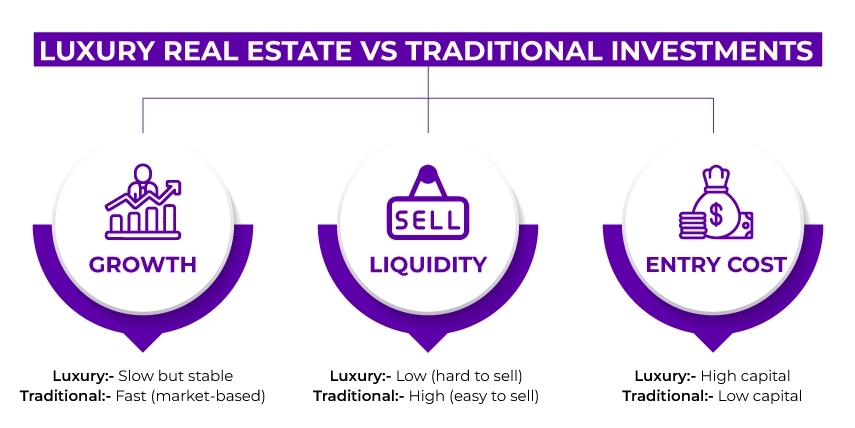
If you are an investor concerned about wealth, you must make a choice between different asset classes. Here are some differences between luxury real estate and traditional investments:
| Particulars | Luxury Real Estate | Traditional Investments |
|---|---|---|
| Capital Growth |
It offers long-term and consistent capital growth, mainly in prime locations that have higher demand. However, if compared to other liquid investment tools, like stocks, the overall return on investment (ROI) may be slower. |
A traditional investment instrument offers better returns in the short run, particularly when there is a bull market. It includes stocks, bonds, and mutual funds. Bonds offer stable gains at lower rates while stocks provide swift growth. |
| Liquidity |
Real estate is inherently liquid, which means selling a property might take significant time, particularly a premium one. It depends on the buyer's performance and market conditions. However, such property can be rented out to earn a stable income, although the asset will remain tied up and cannot be converted to cash easily. |
These investments offer high liquidity and offer quick access to cash if required, as stocks, mutual funds, and bonds can be easily purchased or sold. Hence, a traditional investment avenue is ideal for those who may need cash urgently. |
| Entry Restrictions |
Luxury real estate investment generally needs a high capital investment and may be less accessible for small investors. Since the entry restrictions are higher, it's more ideal for high-net-worth investors. |
These investments are more easily accessible as it has lower entry barriers. It's ideal for investors who have differing budget levels, as you can start your investment journey by investing in stocks or mutual funds with a small corpus. |
Investing needs proper and careful planning, so here are some factors to consider when choosing between luxury real estate and traditional investments:
Here are some points for NRIs to make the right choice between luxury real estate and traditional investment:
Both luxury real estate and traditional investment offer various benefits for NRI investors. The best choice between these two depends on an individual's risk tolerance capacity, investment aim, and duration. A mix of both investment modes might be the perfect choice to build a diversified and balanced portfolio.
Additionally, for expert assistance regarding NRI taxation, investment, repatriation, banking, and more, reach out to Savetaxs. We have a team of experts who can offer personalised guidance by considering various factors that may differ from one person to another. They will help you make the best choice and get huge returns on your investments. Connect with us right away as we are actively working 24/7 to serve our clients across the globe.
Note: This guide is for information purposes only. The views expressed in this guide are personal and do not constitute the views of Savetaxs. Savetaxs or the author will not be responsible for any direct or indirect loss incurred by the reader for taking any decision based on the information or the contents. It is advisable to consult either a CA, CS, CPA or a professional tax expert from the Savetaxs team, as they are familiar with the current regulations and help you make accurate decisions and maintain accuracy throughout the whole process.

Mr. Ritesh has 20 years of experience in taxation, accounting, business planning, organizational structuring, international trade financing, acquisitions, legal and secretarial services, MIS development, and a host of other areas. Mr Jain is a powerhouse of all things taxation.
Want to read more? Explore Blogs


_1767955810.png&w=828&q=75)