Investment & Financial Planning

NPS Vatsalya Scheme for NRI- Your Complete Guide

  • April 2, 2026
  • 17 mins
  • 10.9K Views
National Pension Scheme

For millions of Indians, the National Pension System (NPS) has been a preferred tool for retirement planning. Considering this, with the introduction of the NPS Vatsalya Scheme on 18 September 2024, NRIs can now participate in a retirement plan and plan a stable financial future for their children in India. This scheme is available to all minor children. Additionally, once the child turns 18, the amount can be withdrawn or transferred to an NPS account, subject to conditions. 

Further, want to know more about the NPS Vatsalya scheme? Read the blog and get all the information about the scheme and its eligibility, benefits, opening process, and more. 

Key Takeaways
  • The NPS Vatsalya scheme is backed by the government for all minor children (under 18), including NRIs/ OCIs with PRAN issued in the name of the child. 
  • With no maximum contribution limit, a minimum amount of INR 1000 is required per year. 
  • Investment options involve equity up to 75% default, government securities, and corporate bonds, offering flexibility. 
  • The account is operated by the child's parents or guardian until the child turns 18.
  • Partial withdrawal is allowed after three years for specific reasons only, including education, disabilit or illness, for a maximum of three times before the age of 18. 

What Is the NPS Vatsalya Scheme? 

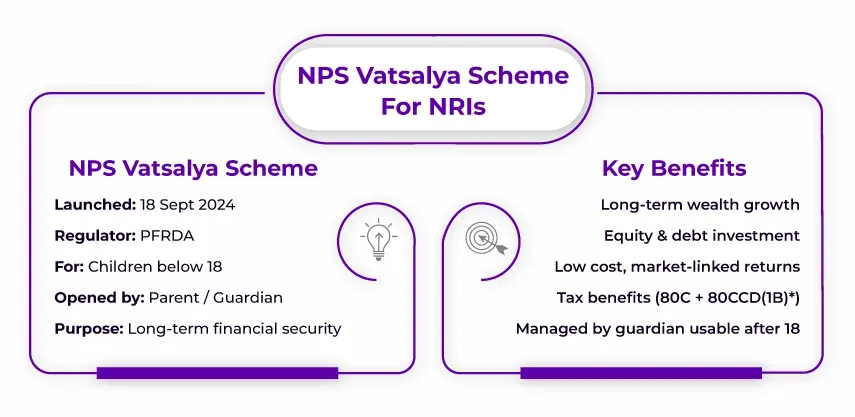
NPS Vatsalya Scheme was launched on 18 September 2024 under the National Pension System (NPS). It is a specifically designed pension scheme that allows parents and guardians to open an account for minors. This scheme is administered and regulated by the Pension Fund Regulatory Authority of India (PFRDA). 

With this scheme, NRIs can contribute towards the future of their children. It provides a disciplined investment method to investors that leads to the accumulation of significant wealth over time. 

Further, let's know the key highlights of the NPS Vatsalya Scheme.

Particulars Details
Scheme NPS Vatsalya Scheme is a subset of NPS and is regulated by PFRDA.
Eligibility All minor Indian citizens under 18 years of age are eligible for this scheme.
Account Operator Only parents have permission to open, deposit, or withdraw funds from the accounts.
Account Beneficiary Only minor children can be the beneficiary.
Minimum Contribution Limit

The minimum contribution limit for account opening is INR 1,000 p.a.

Maximum Contribution Limit There is no maximum contribution limit in the NPS Vatsalya scheme. 
Interest Rate The interest rate of NPS is between 9.5% to 10%.
Tax Benefits
  • Under section 80C of the Income Tax Act, 1961, you can claim up to INR 1,50,000.
  • Under section 80CCD(1B), you can claim up to INR 50,000 as a deduction. 

NPS vatsalya schema for NRIs

This was all about the NPS Vatsalya scheme. Moving ahead, let' whether NRIs can invest in this scheme or not. 

Can NRIs Invest in NPS Vatsalya?

Yes, NRIs can invest in the NPS Vatsalya scheme; however, for this, they need to fulfill certain conditions. These are as follows:

  • The child of an NRI should be a citizen of India.
  • He/she holds a valid Aadhaar card and a Permanent Account Number (PAN) card.

Further, the parent or legal guardian of the children, whether living in India or overseas, on behalf of the children, can open an NPS Vatsalya scheme. Several platforms allow NRIs to open and manage their NPS Vatsalya accounts from anywhere in the world at anytime. 

So, yes, from the above information, it is clear that NRIs can invest in the NPS Vatsalya scheme. Moving further, let's know the features of the NPS Vatsalya scheme. 

NPS Vatsalya Scheme Features

The following are the features of the NPS Vatsalya scheme:

  • In the NPS Vatsalya scheme, the Central Recordkeeping Agency (CRA), in the name of the minor, issues a unique Pension Retirement Account Number (PRAN).
  • When the minor turns 18 years of age, a fresh KYC will be conducted. It should be done within three months of attaining the majority.
  • After the KYC completion, once the minor attains the majority, he/she can operate the NPS Vatsalya account.
  • NPS Vatsalaya scheme provides a partial withdrawal and exit option to its investors. 
  • Based on risk preference, it offers several investment choices across asset classes. 
  • Account opening is available at POPs (banks, India Post) and online via eNPS. 

These were the key features of the NPS Vatsalya scheme. Moving ahead, let's know the eligibility criteria for the NPS Vatsalya scheme. 

Eligibility Criteria for NPS Vatsalya Scheme

The following people are eligible for the NPS Vatsalya scheme:

  • Indian citizens below 18 years of age.
  • NRIs and overseas citizenship of India (OCI) individuals below 18 years also qualify for the NPS Vatsalya scheme.
  • On behalf of the child, parents or guardians can open and operate the NPS Vatsalya account.
  • Under the NPS Vatsalya scheme, parents or guardians will be nominees, and the child will be the sole beneficiary of the funds from the scheme. 

These were the eligibility criteria that you need to consider before applying for the NPS Vatsalya scheme. Moving ahead, let's now look at the documents required for NRI/ OCIs for this scheme. 

Required Documents for NRI/ OCIs

Here is the list of documents required to open an NPS Vatsalya Scheme:

  • KYC of the guardian, such as Aadhaar card, driving license, passport, voter ID card, NREGA job card, or National Population Register documents.
  • Date of birth proof of the minor, such as a matriculation certificate, PAN card, birth certificate, passport, or school leaving certificate.
  • PAN of the guardian
  • Signature of the guardian
  • Scanned photocopy of passport, in case of NRI subscribers
  • Scanned photocopy of foreign address proof, in case of OCI subscribers
  • In case of NRI/ OCI subscribers, the NRE/ NRO bank account of the minor

These are the documents required for NRI/ OCIs to open an NPS Vatsalya scheme. Moving further, how to open an NPS Vatsalya account. 

How to Open an NPS Vatsalya Account?

Using the eNPS website or through Points of Presence (POPs), which include major banks, India Post, Pension Funds, etc, parents and guardians can open the NPS Vatsalya scheme. Here are the steps that you need to follow:

  • Step1: Visit the official eNPS website.
  • Step 2: Scroll down and under the "NPS Vatsalya (Minors)" tab, click on the "Register Now" option.
  • Step 3: Mention the date of birth, PAN card number, mobile number, and email of the guardian, and click on the "Begin Registration" option.
  • Step 4: Enter the OTP you received on the email and the contact number of your guardian.
  • Step 5: Once you verified the OTP, you will get an acknowledgment number. Click on the "continue" option.
  • Step 6: Mention the details of the minor and the guardian, upload the requested documents, and click on the "confirm" option. 
  • Step 7: Make the initial contribution of INR 1,000.
  • Step 8: Complete the e-Sign or dual OTP authentication.
  • Step 9: The PRAN will be generated, and in the name of the minor, the NPS Vatsalya account will be opened. 

So this is how you can open an NPS Vatsalya scheme. Moving ahead, let's know the contribution, withdrawal, and exit rules of the NPS Vatsalya scheme. 

Contribution, Withdrawal, and Exit Rules

NPS Vatsalya Scheme, before the child turns 18 years old, offers partial withdrawal. Here are the following conditions under which you can apply for a partial withdrawal from the NPS Vatsalya account:

  • After three years of joining NPS, parents or guardians can make a withdrawal.
  • They are allowed up to 25% of the contributed amount.
  • Till the child turns 18, you can withdraw only three times.
  • You can withdraw the amount from the NPS Vatsalya scheme for education, treatment of specified illness, disability of more than 75%, etc as stated by the PFRDA.

Once the child turns 18, you can convert the NPS Vatsalya scheme into a regular NPS account, which the child can manage independently. However, after turning 18, the child within 3 months needs to do a fresh KYC. The accrued contribution amount stated in the NPS Vatsalya account will be transferred to the standard NPS account.

Additionally, the child can also opt for exit from the NPS Vatsalya scheme instead of converting it to a Standard NPS account when they turn 18. Further, in case of an unfortunate death, the rules of the NPS Vatsalya scheme are as follows:

  • Death of the Subscriber (minor): The complete corpus amount will be returned to the guardian, i.e., the nominee.
  • Death of Guardian: Through fresh KYC, under the NPS scheme, registration of another guardian can be done.
  • Death of Both Parents: The NPS scheme can continue with the legal guardian of the child without any contribution till the child turns 18.

These were the contribution, withdrawal, and exit rules of the NPS Vatsalya Scheme. Moving further, now let's know about the benefits of this scheme for NRIs.

Benefits of NPS Vatsalya for NRIs

Here are some of the key benefits of the NPS Vatsalya scheme for NRIs:

  • Long-Term Wealth Accumulation: Under NPS Vatsalaya, in wealth accumulation, the compounding power plays an essential role. Since for a long period, investments are made, even small contributions can grow into a significant amount for the future financial needs of the children.
  • Flexible Investment Options: Under the NPS Vatsalya scheme, NRIs can opt for different investment choices. It includes corporate bonds (C), equity (E), and government securities (G). With an auto-choice investment option, based on age, funds are dynamically allocated, ensuring balanced risk exposure.
  • Low Cost & High Returns: In India, NPS is popular for being one of the lowest-cost pension products in India. Additionally, the fund management charges are minimal for long-term investments, allowing maximum returns. 
  • Tax Benefits for NRIs: Although based on the residence country of the NRI, the tax laws vary. However, in India, under sections 80C and 80CCD (1B) of the Income Tax Act, enjoy the tax deduction from the NPS Vatsalya scheme. 
  • Withdrawal & Maturity Benefits: Once the child turns 18, the funds invested in the NPS scheme can be utilised. You can withdraw the invested amount for education, marriage, or other future needs. Upon maturity, as a lump sum youy can withdraw a portion, while for a steady income, you can convert the remaining amount into an annuity.
  • Nomination Facility: Parents or legal guardians have the right to nominate a beneficiary for the NPS Vatsalya account. It further ensures that, in case of unforseen even, the chosen nominee gets the investment amount.

These were the key benefits of the NPS Vatsalya scheme for NRIs and how it helps them in growing their income for fulfilling future financial needs of their children.

Final Thoughts

Lastly, to secure the future of their child, the NPS Vatsalya scheme for NRIs is an excellent investment opportunity. This scheme is a tax-efficient and disciplined investment approach.

Further, with Savetaxs, the NPS Vatsalya scheme process becomes seamless, certifying a well-planned financial future for your children. So, if you are an NRI who wants to build a secure financial foundation for your child in India, connect with us and choose the right investment option as per your investment goals, time horizon, and risk appetite. 

Note: This guide is for information purposes only. The views expressed in this guide are personal and do not constitute the views of Savetaxs. Savetaxs or the author will not be responsible for any direct or indirect loss incurred by the reader for taking any decision based on the information or the contents. It is advisable to consult either a CA, CS, CPA or a professional tax expert from the Savetaxs team, as they are familiar with the current regulations and help you make accurate decisions and maintain accuracy throughout the whole process.

Pankaj Shaw
Pankaj Shaw(Tax Expert)

Mr Shaw brings 8 years of experience in auditing and taxation. He has a deep understanding of disciplinary regulations and delivers comprehensive auditing services to businesses and individuals. From financial auditing to tax planning, risk assessment, and financial reporting. Mr Shaw's expertise is impeccable.

Recent Post

Want to read more? Explore Blogs

Frequently Asked Questions

Once the child turns 18, the NPS Vatsalya account is converted into a regular NPS account in the name of the child. Then, the child becomes the account holder, and he/she can continue investing independently.

Yes, NRIs are eligible for tax benefits under the NPS Vatsalya scheme, under the applicable tax provisions of the Income Tax Act, subject to eligibility and prevailing tax rules.

To open an NPS Vatsalya account, NRIs need the birth certificate of the child, the PAN card, passport, overseas address proof, and bank account details (NRE/ NRO) of the guardian. Additionally, it is mandatory for the guardian and the child to complete the KYC.

Under the NPS Vatsalya scheme, an NRI parent or legal guardian can act as a guardian under the NPS Vatsalya scheme for NRIs. In this scheme, the guardian will be accountable for making contributions and managing the investment account on behalf of the minor.

Yes, NRIs can open an NPS Vatsalya account for their children who are below 18. The account is opened in the name of the child and operated by the parents or legal guardian of the child till he/she turns 18.