
_1766561286.webp&w=828&q=75)
NRI Purchasing Property In USA: Process & Tax Implication
Read More
Owning a property in India while living abroad presents its own challenges for NRIs. These challenges can feel overwhelming when they stem primarily from property disputes and legal complications.
NRIs often face property-related disputes, including title disputes, inheritance conflicts, title fraud, and challenges in managing property from abroad.
In this blog, we will discuss how NRIs can handle common property disputes inIndia, the legal provisions that govern their property, and how they can resolve these disputes through proactive measures.
An NRI property dispute can arise for various reasons, and each situation requires a specific legal approach. The following are some of the most common types of property disputes that NRIs generally face.
This happens a lot because NRIs live abroad, and that's when their properties become vulnerable to unauthorized encroachment or to tenants refusing to vacate.
Squatters take advantage of the property owner's absences, leading to prolonged legal battles over the property's eviction.
Legal Recourse For The Dispute
Under the Transfer of Property Act, 1882, NRIs can file for eviction, and under the Specific Relief Act, 1963, they can reclaim their property. The latter provides the right to seek an injunction to remove any illegal occupants from the property.
NRIs are generally the target of fraudulent property transactions. Unscrupulous individuals can easily forge documents or impersonate the property owner to illegally sell or transfer the property.
This type of fraud happens in both rural and urban areas.
Legal Recourse For The Dispute
Under the Indian Penal Code (IPC), 1860, impersonation and the forgery of documents are criminal offences, and NRIs have the right to lodge an FIR with their local police station under Sections 464 (forgery) and 416 (cheating by impersonation).
When NRis inherits property from their daily members, disputes usually arise over the rightful ownership of the property. Such NRIpoepery disputes often involve challenges or disagreements over the division of the property among the heirs.
Legal Recourse For The Dispute
Inheritance disputes can be resolved through civil suits filed under the Indian Succession Act, 1925. Furthermore, to claim their rightful share of the property, the NRI can obtain probate of the will or file a partition suit.
NRIs usually invest in under-construction properties, but over te time they start facing delays in possession, substandard construction, or even projects that just never get completed. Such property concerns relate to disputes with property developers and builders.
Legal Recourse For The Dispute
NRIs usually file a complaint under the Real Estate (Regulation & Development) Act, 2016. This act amends the timely possession and sets quality standards for the real estate developers. Additionally, RERA empowers NRIs to seek refunds or compensation for delayed or incomplete projects.
Another NRI property dispute, which is quite common. Ancestral property issues usually arise when multiple family members claim ownership of the property, with no clear demarcation of property rights over generations.
Legal Recourse For The Dispute
Depending on the religious background of the NRI, an NRI can file a partition suit under the Hindu Succession Act 1956, or Muslim Personal Law to claim their rightful share of ancestral property.
NRI file your taxes on time. Expert-led, Accurate & Seamless.
There is an array of laws in India that provide legal protection and resources for resolving disputes regarding NRI property. Understanding these disputes can help NRIs make informed decisions when navigating property issues.
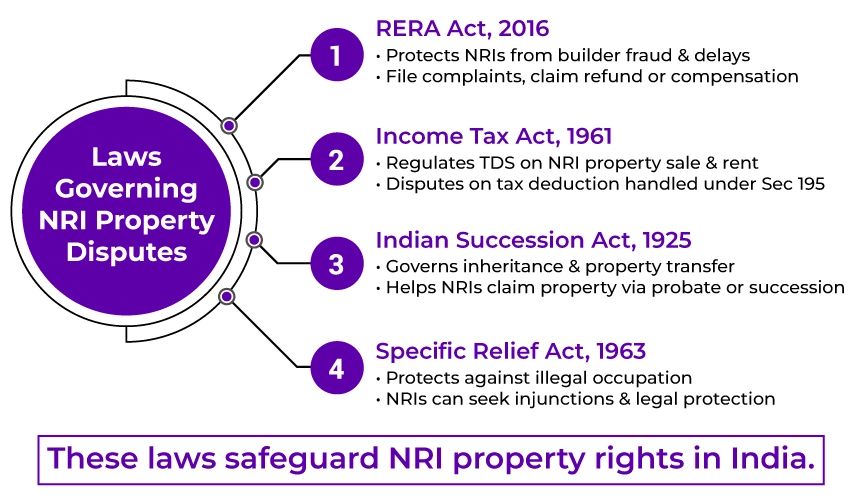
The Real Estate (Regulation and Development) Act, 2016 (RERA), is a major piece of legislation designed to protect the rights of home buyers in India, including NRIs, from unethical practices by builders.
RERA has made it mandatory for real estate developers to register their projects with the state regulatory authority and provide clear timelines for possession.
The Income-tax Act, 1961, regulates the taxation of the sale of property and NRI rental income from properties owned by NRIs. NRIs must know the key highlights of their law when calculating taxes on capital gains from the sale of a property in India or on rental income.
Property disputes among NRIs are common, especially when it concerns the inheritance of a property where multiple family members are co-owners. The Indian Succession Act 1925 provides a legal framework for the distribution of the property to its legal heirs. NRIs can also file probate cases or initiate partition suits under the Indian Succession Act to resolve inheritance disputes as they arise.
The Specific Relief Act 1963 provides NRIs with a legal remedy when they face illegal occupation or property disputes arising from contractual obligations. It also allows NRIs to seek an injunction to prevent third parties from occupying their property.
The following are key steps for NRIs to resolve a property dispute efficiently.
Savetaxs NRI investment experts will file the investment portfolio to your goals and help you strategize better.
The following preventive measures NRIs must take.
Yes, property disputes and legal complications can be overwhelming, but being proactive and well-informed can reduce the risk. As an NRI, you can hire a good legal support, maintain proper documentation, and leverage the property management services effectively to help you manage your property from abroad.
In a nutshell, remember that proactive measures and timely action are key to preventing minor issues from escalating into major disputes.
However, if you are an NRI planning to invest in the Indian real estate market, Savetaxs is the name to trust. We have been helping NRIs purchase, manage, and sell residential and commercial properties in India. Our experts also manage the property's financial, legal, and tax implications.
Connect with us as we serve our clients 24/7 across all time zones.
Note: This guide is for information purposes only. The views expressed in this guide are personal and do not constitute the views of Savetaxs. Savetaxs or the author will not be responsible for any direct or indirect loss incurred by the reader for taking any decision based on the information or the contents. It is advisable to consult either a CA, CS, CPA or a professional tax expert from the Savetaxs team, as they are familiar with the current regulations and help you make accurate decisions and maintain accuracy throughout the whole process.

Mr Manish is a financial professional with over 10 years of experience in strategic financial planning, performance analysis, and compliance across different sectors, including Agriculture, Pharma, Manufacturing, & Oil and Gas. Mr Prajapati has a knack for managing financial accounts, driving business growth by optimizing cost efficiency and regulatory compliance. Additionally, he has expertise in developing financial models, preparing detailed cash flow statements, and closing the balance sheets.
Want to read more? Explore Blogs
_1766561266.webp&w=828&q=75)
_1766730933.webp&w=828&q=75)
_1766742512.webp&w=828&q=75)