

Your Detailed Guide for Gift City Funds for NRIs
Read More
_1770454629732.webp&w=3840&q=75)
Yes, NRI and OCI cardholders are legally permitted to sell an inherited property in India, subject to FEMA requirements.
Inheriting a property for an NRI is emotionally overwhelming and legally confusing. Many NRIs tend to inherit property unexpectedly from their grandparents, parents, or close relatives, but what they do realize later is that selling inherited property as an NRI in India involves a lot more than just finding buyers.
Compliances around property title clarity, tax treatment, succession documents, TDS, and repatriation usually delay the transactions. In this blog, we will discuss how NRIs can legally and safely sell inherited property in India, the required documents, potential risks, taxation, and more.
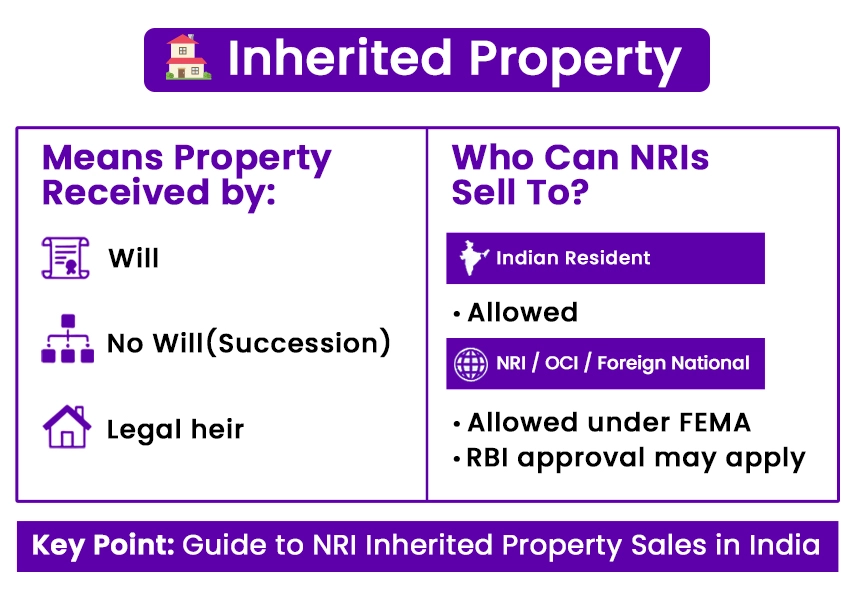
For an NRI, inherited property refers to property acquired either:
The following are the NRI eligibility criteria to sell an inherited property in India.
NRIs are permitted to sell an inherited property in India to Indian residents without any specific restrictions. The process usually follows the same procedures and regulations set by the local authorities.
NRIs can sell inherited property to resident Indians, NRIs, and OCI holders in accordance with FEMA regulations.
This framework includes obtaining the necessary RBI permissions and following the guidelines to ensure a seamless selling process.
Now that we have the answer to NRI's one of the most frequently asked questions: can NRI sell inherited property in India? Let us understand the legal procedures for NRIs to sell inherited property in India.
The following is the process for selling property in India as an NRI (inherited property):
Inherited property in India can be legally sold by transferring the property title from the deceased to their potential heir. For this, obtaining a legal heir certificate is important, and ensuring that all documents related to the property are clear and up to date.
A legal heir certificate is needed to prove who the deceased owner's rightful heirs are. This certificate can be obtained from the local court or revenue authorities, as required by state law.
Before selling the property, the NRI must ensure that the property title is clear to avoid any last-minute complications. This involves reviewing ownership records, transaction history, and whether the property has any encumbrances.
In addition to these legal procedures, the following are key legal points that an NRI must understand:
Depending on how inheritance has happened following are the required documents an NRI needs:
In case there are multiple potential heirs addtional documents may be required:
For many NRIs, the process of selling inherited property is often delayed because the documents are outdated, scattered, or never formally registered. Hence, it is advisable for NRIs to keep all documents in order before initiating the sale process, as incomplete documentation can render the property legally unseelable, even if the inheritance is genuine.
As an NRI, travelling back to India to manage NRI inherited property sale is not always possible; therefore, there are some legal procedures an NRI can follow to sell the property without coming to India.
The best way to execute a PoA in India is to either rely on a trusted person in India or seek professional assistance from experts who help NRIs manage their properties in India.
The PoA documents must be carefully drafted; it is better if you seek help from a real estate professional. Ensure that the documents are signed, notarized, and attested at the Indian Consulate/Embassy in your country if residing there.
Then the document must be registered in India, and after registration, your representative there can legally sign the sale deeds, invoices, and agreements and handle the entire property-selling process.
The following are the tax implications of capital gains: Short-term vs. long-term.
The capital gains tax is imposed on profits from the transfer of inherited property in India. The holding period for inherited property is calculated from the date the previous owner acquired the property, not from the date of inheritance.
| Holding Period | Capital Gain Type | Tax on inherited property for NRIs |
|---|---|---|
| Less than 2 years | Short-term capital gain ( STCG ) | As per the slab rates |
| 2 years or more | Long-term capital gain ( LTCG ) |
20% with indexation. |
Under the RBI's regulatory framework, NRIs are permitted to repatriate up to USD 1 million in any financial year from the transfer of inherited property in India.
However, for repatriating funds abroad, For repatriation within USD 1 million per financial year, RBI approval is not required; only a CA certificate and relevant tax forms are needed.
Maximum Repatriation Limit: As aforementioned, NRIs can repatriate up to USD 1 million per financial year from the sale of property in India.
Eligible Property: For NRIs repatriating the sale proceeds of residential and commercial properties sold in India are allowed. Sale proceeds of agricultural land, plantation property, and farmhouses are generally not permitted to be repatriated outside India.
Tax Compliance: NRIs must ensure that, before repatriating sale proceeds abroad, all capital gains tax and TDS are paid in full, as banks will require proof of tax clearance before initiating the transfer of funds.
Selling an inherited property in India as an NRI can be legally confusing at times and comes with some common challenges, such as
Family Disputes: One of the most common challenges is conflict among co-heirs. This can delay or even block the selling process.
Incomplete Documents: Missing wills, title deeds, or succession certificates can cause verification issues.
Pending Taxes or Dues: The property's unpaid utility bills and taxes can also delay the property-selling process.
Encroachment: This means when unoccupied properties are illegally occupied by others.
Tax & Regulatory Compliance: When an NRI sells inherited property in India, they must comply with complex FEMA rules, different TDS rates, and the applicable capital gains tax rate.
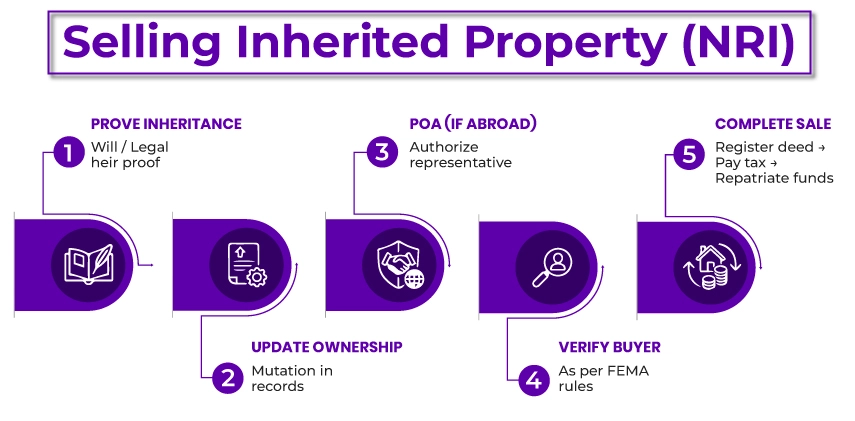
The following is a step-by-step process for an NRI to sell inherited property in India.
1: Establishing Legal Inheritance: The first step in the NRI inherited property sale is to prove that the property was inherited. This can be done by obtaining documents such as the succession certificate, legal heir certificate, registered will, or probate (if applicable). Because if you do not have any clear proof of inheritance, the property cannot be sold.
2: Update the Ownership or Mutation Records: The mutations update the government and the municipal records to reflect that the NRI is the current owner. The NRI property mutation process is essential for paying the property tax, completing registration, and ultimately avoiding ownership disputes.
3: Appoint Power Of Attorney ( If Needed): As an NRI, if you cannot visit India, grant a PoA to someone you trust to represent you in the best interests. Just ensure that the PoA is clearly drafted, notarised abroad, and registered in India to be legally valid for all property transactions.
4: Verify the Eligibility Of The Buyer: As an NRI seller, you have to be extra cautious in the market. Before finalizing the property sale, please ensure that the buyer is eligible under the FEMA rules.
5: Execute the Sale Agreement: Curate a legal sale agreement that includes all the payment terms and timelines written clearly. This sale agreement protects both parties and is a prerequisite for registration. Ensure to register the sale deed.
After executing the sale agreement, pay the applicable taxes, complying with TDS, and once the tax is cleared, you can repatriate the funds abroad in accordance with RBI rules.
The following are some practical tips for NRIs to sell an inherited property in India seamlessly.
Keep all important documents in order: Before engaging in any selling process, NRIs must keep all relevant documents handy, such as title certificates, tax records, proof of identity, property deeds, and so on. This way, you can easily speed up the legal and official formalities.
Seek Expert Assistance Wherever Essential: NRIs planning to sell their inherited property in India should seek professional advice from experts with a thorough understanding of Indian law and tax legislation to ensure 100% compliance.
Understand the current market situation: As an NRI, you must be aware of what is happening in the market. Meaning you must have a knack for all the trends, get constant updates from market studies, have discussions with real estate agencies, and so on.
Plan Fund Repatriation In Advance: As an NRI, when you are trying to repatriate funds from sale proceeds, it is important to follow the Reserve Bank of India. This includes understanding all applicable taxes, obtaining necessary certificates in a timely manner, and using the designated NRI bank account for smooth, easy repatriation.
Get CA-approved support for selling, managing, and repatriating inherited property in India.
The answer to one of the most common question that "can NRI sell inherited property in India"? The answer is yes. However, an NRI must be well aware that transferring inherited property in India involves practical, tax, and legal challenges. Well, there is no denying that the laws governing NRIs can seem complicated, but with the right guidance on NRI real estate taxation, they are manageable.
And when we talk about NRI taxation guidance, we also talk about Savetaxs. Savetaxs has been helping NRIs in 90+ countries manage their inheritance matters for residential properties, ensuring they are handled effectively and in compliance with Indian law.
Connect with us as we serve our clients 24/7 across all time zones.
Note: This guide is for information purposes only. The views expressed in this guide are personal and do not constitute the views of Savetaxs. Savetaxs or the author will not be responsible for any direct or indirect loss incurred by the reader for taking any decision based on the information or the contents. It is advisable to consult either a CA, CS, CPA or a professional tax expert from the Savetaxs team, as they are familiar with the current regulations and help you make accurate decisions and maintain accuracy throughout the whole process.

Mr. Ritesh has 20 years of experience in taxation, accounting, business planning, organizational structuring, international trade financing, acquisitions, legal and secretarial services, MIS development, and a host of other areas. Mr Jain is a powerhouse of all things taxation.
Want to read more? Explore Blogs
_1767955810.png&w=828&q=75)
_1768221427.webp&w=828&q=75)
_1768307231.webp&w=828&q=75)