What is House Rent Allowance: HRA Exemption, Tax Deduction, Rules & Regulations
Read More
Many Indian and NRI taxpayers often come across the "Restricted Refund" status in the bank account section of their profile dashboard on the Income Tax Portal. This status typically occurs when the name on your bank account and the name on your PAN card differ.
Hence, to correct this, you must ensure that the records remain consistent across both to avoid such issues.
In this blog, we will discuss all aspects of restricted refunds for NRIs and potential solutions to address the issue.
Many taxpayers, whether NRIs or Indian citizens, observe their ITR refund status as "Restricted Refund" in the bank account section of the income tax e-filing portal (Dashboard → My Profile → Bank Account).
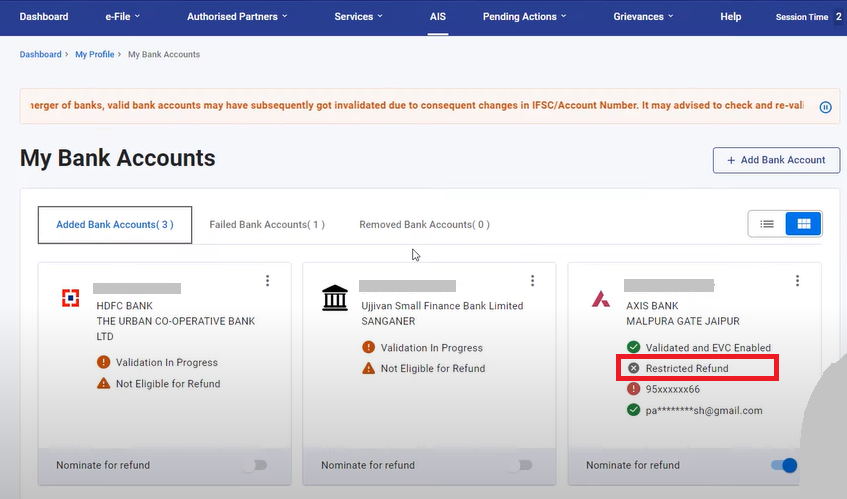
To understand the reason for the restricted refund status, click the three dots below the bank account entry and select "View Bank Account Details."
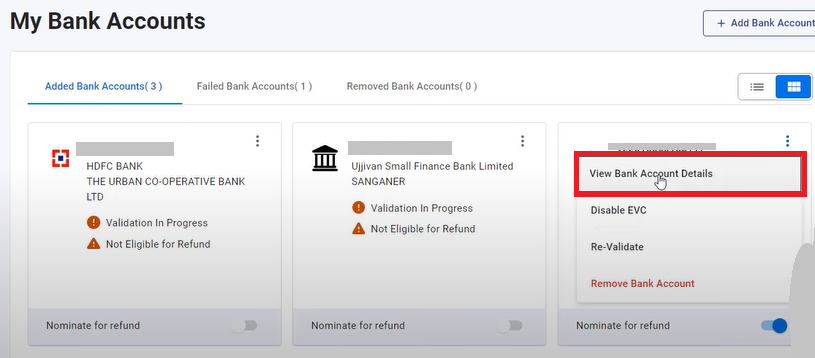
Now, refer to the Remarks section. There you can see the reason for the restricted refund status.
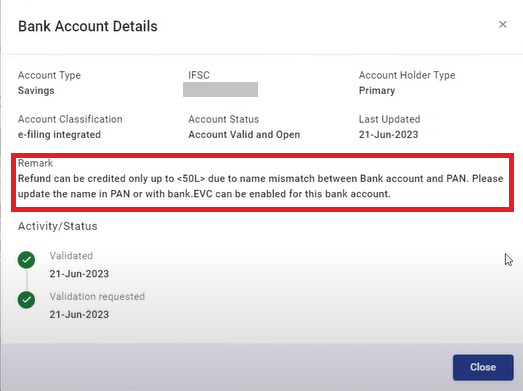
In many cases, the status appears due to a name mismatch between the bank and PAN records of the individual. Ensure that the name on both documents matches exactly, as even a slight spelling difference can trigger the restricted refund status.
To resolve this, you must either update your PAN name or the bank account name. Updating your name in bank records is usually faster than updating it on the PAN card.
The following table lists common bank account validation errors, their reasons, and potential solutions.
| Error | Reasons | Solution |
|---|---|---|
| Restricted Refund | Name mismatch between your bank account and your PAN | Update either your name on the PAN or the bank records (updating bank account name details is usually faster than PAN name correction). |
| PAN - Bank Account - IFSC linkage failed | PAN not available with your bank |
Contact your bank branch to link your PAN with your bank account or update your KYC. Then submit a re-validation request. |
| Account number does not exist | Incorrect account number entered |
Click re-validate, enter the correct account number, and submit the re-validation request. |
| Invalid IFSC | IFSC code may change due to bank mergers or branch updates |
Click re-validate, enter the correct IFSC code, and submit the re-validation request. |
|
Bank account closed or inactive |
Zero balance/inactive account, litigated account, frozen or blocked account | Click re-validate and try adding a different active bank account. |
NRIs should note that restricted refunds are common due to high TDS deducted on NRO income such as capital gains, interest, and rent, which often results in refund claims. Issues such as an unvalidated NRO bank account, incorrect residential status while filing an ITR, or pending tax demands can also trigger the restricted refund stage.
Hence, NRIs must ensure that their NRO bank account is validated and all compliance requirements are fulfilled to avoid delays.
While pre-validating your bank account, you must submit a pre-validation request. Once submitted, your contact details along with your PAN are verified against the bank’s records.
Your bank account gets validated once the bank verifies your details. If your PAN is not found in the bank’s records, you may see the error “PAN–Bank Account–IFSC Linkage Failed.”
For example, if you open a bank account using only Aadhaar during the e-KYC process without providing your PAN details, your PAN will not be verified by the bank. In such cases, you must update your KYC with the bank, provide PAN details, and then revalidate your bank account on the income tax portal.
From expert guidance to hassle-free compliance and maximized returns, Savetaxs helps you file NRI ITR in minutes.
Unless your bank validation process is completed, the refund will not be transferred to your bank account. Bank validations often happen quickly on the income tax portal, but delays may occur depending on the bank, especially with smaller or cooperative banks.
On the other hand, validation through integrated banks is usually faster. You may consider adding a bank account from integrated banks such as:
File your ITR online and plan your taxes better with Savetaxs.
Small errors such as misspelling a name or entering the wrong account number can trigger the restricted refund status. Once restricted, it may delay your income tax refund for weeks or sometimes longer depending on correction timelines and processing.
Hence, one has to be careful and proactive throughout the process. Furthermore, if you need expert help processing your income tax refund as an NRI and ensuring it is verified in a timely manner, then Savetaxs is the name to trust.
We have been helping NRIs across 90+ countries file their ITRs and ensure seamless processing. With the best practical research and framework, our experts are experienced and skilled in NRI taxation, helping you save time and money.
Connect with us as we serve our clients 24/7 across all time zones.
Note: This guide is for information purposes only. The views expressed in this guide are personal and do not constitute the views of Savetaxs. Savetaxs or the author will not be responsible for any direct or indirect loss incurred by the reader for taking any decision based on the information or the contents. It is advisable to consult either a CA, CS, CPA or a professional tax expert from the Savetaxs team, as they are familiar with the current regulations and help you make accurate decisions and maintain accuracy throughout the whole process.

Mr Shaw brings 8 years of experience in auditing and taxation. He has a deep understanding of disciplinary regulations and delivers comprehensive auditing services to businesses and individuals. From financial auditing to tax planning, risk assessment, and financial reporting. Mr Shaw's expertise is impeccable.
Want to read more? Explore Blogs