
Section 194I - TDS on Rent
Read More
_1770631091866.png&w=3840&q=75)
For many NRIs residing outside India, owning a property back home is an emotional and financial goal. It showcases a solid investment for the future and a connection to their roots. Considering this, often through home loans, they invest in Indian property. However, unlike residents, the income tax deductions on home loan repayments for NRIs are significantly different.
Further, under section 80C, they can claim a deduction of up to INR 1,50,000 on principal repayment. Additionally, under section 24(b), they can claim a tax deduction of up to INR 2,00,000 on interest payments.
Want to know more about this in detail? Read the blog and get to know more about several provisions, rules, and regulations NRIs apply while investing in real estate.
According to the income tax definition, if you are an NRI and file tax returns in India, you are eligible to claim home loan tax deductions. Considering this, as per the Income Tax Act, 1961, you are considered an NRI for a financial year if you do not meet any of the following conditions:
If you do not meet any of these conditions, you are considered an NRI.
Additionally, you should have a taxable income in India. It is because you can claim the tax deduction only against your taxable income. Considering this, for most NRIs who have property in India, the common source of taxable income is:
Also, you must file an income tax return (ITR) in India. Apart from this, you must be the owner of the property and borrower on the loan to be eligible for a tax deduction under section 80C and section 24(b). This means on the title deed of the property, your name should be mentioned as the owner or co-owner, and on the loan agreement as a borrower or co-borrower.
Further, in case there are co-owners and co-borrowers, the tax benefits will be divided among all co-borrowers in the same ratio as their share in the home loan. Considering this, each co-borrower can independently claim their deduction share against their taxable income in India up to the prescribed limit.
This was all about who is eligible to claim home loan tax deductions. Moving ahead, let's know the interest deduction on home loan under section 24(b).
Fulfill your tax obligations on time with complete accuracy.
Through section 24(b) of the Income Tax Act, 1961, NRIs who have bought property through a home loan in India can claim tax deductions. This section specifically applies to a tax deduction on the interest paid on housing loans. Under this:
Further, section 24(b) tax deduction on home loan repayments for NRIs is applicable on:
Additionally, the interest deduction on borrowed capital can be up to INR 30,000, if:
This was all about interest deduction on home loan under section 24(b) of the Income Tax Act, 1961. Moving further, now let's know about the principal repayment deduction under section 80C.
Principal repayment tax deduction available under section 80C of the Income Tax Act is as follows:
Additionally, if you sell the house property within five years of its purchase, all the availed tax benefits under section 80C will be reversed. Also, the amount will be counted as your income for the year in which you sell it. Apart from this, under the new tax regime, you cannot claim tax deduction on principal repayments.
So this was all about the principal repayment deduction available under section 80C of the Income Tax Act. Moving ahead, let's know the other tax deductions available to NRIs in India.
Apart from tax deductions on home loan repayments, NRIs can also claim all the deductions available to a resident parent's insurance from income from an Indian house property. They can claim a deduction towards paid property taxes and interest on home loans.
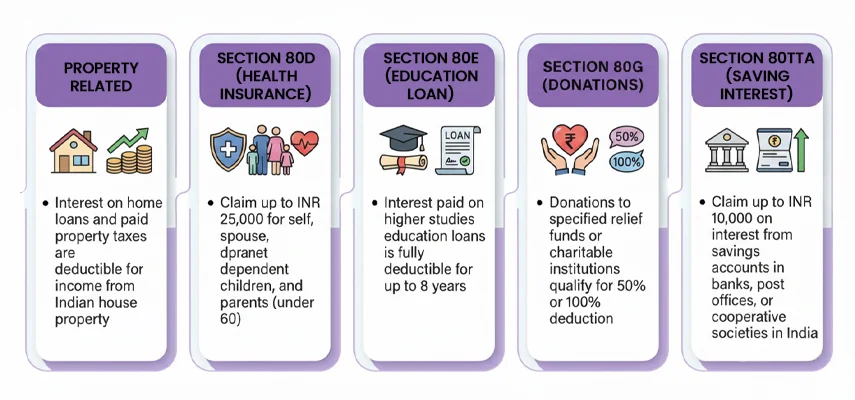
Additionally, for both Indian residents and NRIs, the Indian government offers an extra benefit when you purchase a second house through a loan. Considering this, if you bought your first home through a loan and now you are planning to purchase a second home also on loan, you can avail of additional tax benefits.
Further, with no specific cap on it, on your entire payable interest amount, you can claim tax benefits. While you need to pay tax on the income that your earned from your second home, for instance, rental income. However, by showing it as self-occupied, you can claim the tax exemptions.
These are the other tax deductions available for NRIs under different sections. Moving further, let's know how NRIs can save on tax home loan interest when filing ITR.
Here is how NRIs can save tax on home loan interest:
For claiming tax benefits, it is vital to have proper documentation by your side. Considering this, before starting to file your ITR, make sure you have the following documents:
Once you get your loan certificate from where you obtain the home loan, calculate your total paid interest and principal amount during the financial year. Considering this:
To determine your total tax deduction for that financial year, add the eligible amounts.
To claim the tax deduction successfully, it is vital to file the correct ITR form. NRIs who have income from house property in India can apply for ITR-2 and ITR-3 forms. The ITR-2 form is applicable for NRIs who do not have business income, and the ITR-3 form is for NRIs who have business income.
Additionally, in your ITR form, fill in your rental income accurately (if any) under the "Income from House Property" schedule, and then under section 24(b), claim the tax deduction. Apart from this, the principal repayment should be stated in the relevant schedule for Chapter VI-A deductions. Further, you can file the ITR online using the income tax e-filing portal.
This is how NRIs can save tax on their home loan interest in India. Moving ahead, let's know the key points NRIs should keep in mind when claiming tax deductions on home loans.
NRIs should consider the following things when claiming tax deductions on loan repayment in India:
These are some of the key points NRIs should keep in mind when claiming tax deductions on home loans in India.
Plan better tax filing and maximize your tax refunds.
Lastly, tax deductions on home loan repayment for NRIs are a powerful tool to reduce their tax burden. However, to claim these tax benefits, it is vital to have taxable income, you should be both owner and borrower, and you must file ITR in India. Considering this, on interest payment under section 24(b), you can claim up to INR 2,00,000, and under section 80C, you can claim up to INR 1,50,000 on your principal repayment.
Further, if you are facing issues in fulfilling your tax obligations in India, connect with Savetaxs. Our team of financial experts will resolve all your tax issues and help you file your taxes in India on time with complete accuracy.
Note: This guide is for information purposes only. The views expressed in this guide are personal and do not constitute the views of Savetaxs. Savetaxs or the author will not be responsible for any direct or indirect loss incurred by the reader for taking any decision based on the information or the contents. It is advisable to consult either a CA, CS, CPA or a professional tax expert from the Savetaxs team, as they are familiar with the current regulations and help you make accurate decisions and maintain accuracy throughout the whole process.

Mr Shaw brings 8 years of experience in auditing and taxation. He has a deep understanding of disciplinary regulations and delivers comprehensive auditing services to businesses and individuals. From financial auditing to tax planning, risk assessment, and financial reporting. Mr Shaw's expertise is impeccable.
Want to read more? Explore Blogs