

NRIs Returning from Canada to India- A Comprehensive Guide
Read More
For an individual returning to India with rental income in the USA, understanding the taxation of foreign income in India is essential. Upon returning to India and after attaining Resident and Ordinarily Resident (ROR) status, your global income becomes taxable in India, including your rental income from properties in the United States.
Yes, after becoming an ROR, if you are still earning income from the USA, Indian taxation also applies to it.
Many NRIs who return to India continue to own rental properties in the United States. Once their residential status in India changes to Resident and Ordinarily Resident (ROR), the Income Tax Act requires them to report their worldwide income, including US rental income, while filing their Indian Income Tax Return (ITR).
In this blog, we will discuss how your US rental income is taxed in India, how you must disclose it while filing your ITR, how to claim Foreign Tax Credit (FTC) under the DTAA between India and the USA, and more.
We will break the topic into smaller sections to help you better understand the concept.
As an NRI returning to India who qualifies as a Resident and Ordinarily Resident (ROR), your global income becomes taxable in India, including income from foreign sources such as rental properties in the United States.
As a returning individual with ROR status, if you are filing an income tax return in India, you must disclose all your foreign assets and income using Schedule FA and Schedule FSI.
Yes, as an individual with ROR residential status, rental income from a property in the USA is entirely taxable in India under the head Income from House Property (Sections 22–27 of the Income Tax Act).
As an ROR, if you have foreign rental income, you are required to complete the following schedules and forms in your ITR.
To correctly report US rental income in your Indian Income Tax Return:
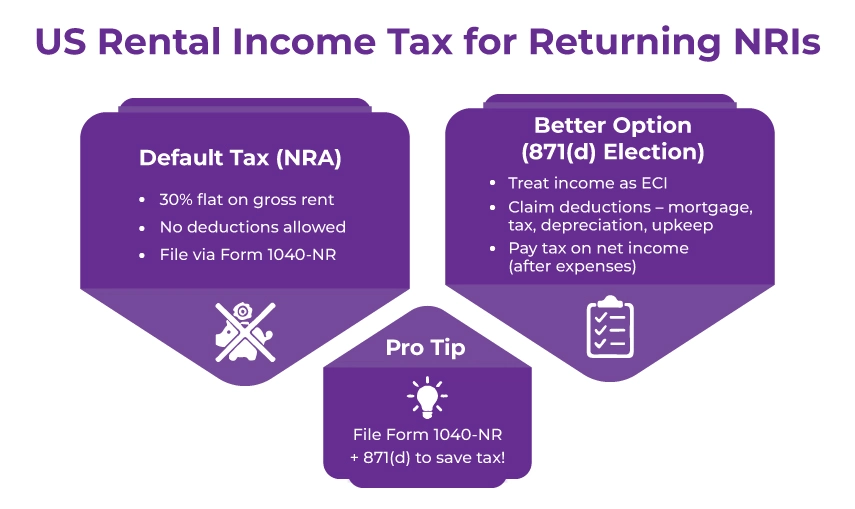
If you are categorized as a Non-Resident Alien (NRA) under United States taxation law:
A 30% flat tax applies to the gross rental income.
File Form 1040-NR with the Section 871(d) election.
Under this option:
You declare the rental income as Effectively Connected Income (ECI).
This allows you to deduct expenses such as:
After deductions, tax is paid on net rental income instead of gross income, which can significantly reduce the tax liability.
India and the United States have signed a Double Taxation Avoidance Agreement (DTAA).
The benefits under DTAA:
To claim the Foreign Tax Credit (FTC) in India:
You must file Form 67 before or along with your income tax return.
Here is a table outlining the actionable steps you must take to stay compliant as an ROR earning rental income from the USA.
| Actionable Step | Mandatory To Do | Where To Report |
|---|---|---|
| Determine Residential Status | Yes | Indian Income Tax Return, Form 10E. |
| Report USA Rental Income | Yes | Schedule FSI |
| Disclose The USA Property | Yes | Schedule FA. |
| Claim US Tax Credit | Yes | Form 67 |
| Elect 871(d) for IRS Tax Benefits | This is Optional | Form 1040-NR |
| Maintain all the required documents in order. | Yes | For both the IRS and the Indian Income Tax |
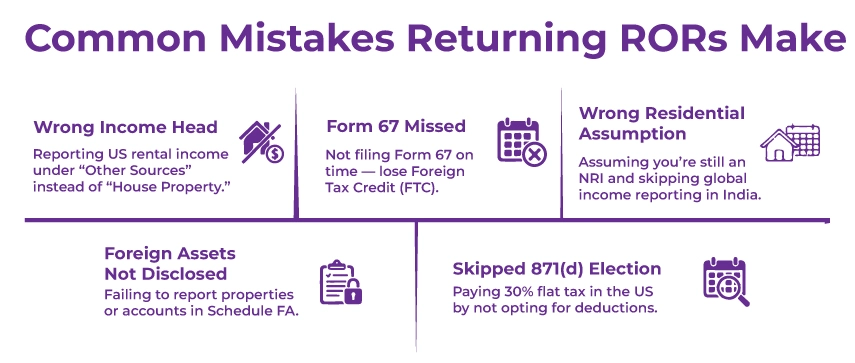
Here are some common mistakes individuals returning to India with ROR status make that you should be mindful of.
Understanding the taxation implications as an individual returning to India with rental income in the United States is essential. Right from the India–US DTAA to benefits under the tax treaty and the 871(d) election, understanding these details is crucial so that you do not end up paying taxes twice.
For individuals returning to India with foreign rental income, proper tax planning under the India–US DTAA, correct ITR disclosure, and claiming Foreign Tax Credit (FTC) can significantly reduce the risk of double taxation.
To cut a long story short, what smart individuals returning to India with foreign income do is seek professional guidance from experts experienced in NRI taxation and cross-border compliance.
One such professional is SaveTaxs, which helps RORs and NRIs file accurate ITRs using Schedule FSI and FA. Our experts also assist with Form 67 tax credit submissions, DTAA interpretation, US tax return filing, and the Section 871(d) election.
SaveTaxs has been serving NRIs and returning residents for years, and our expertise speaks through the results we deliver. Connect with us today and let us handle your cross-border rental income taxation issues after returning to India.
Note: This guide is for information purposes only. The views expressed in this guide are personal and do not constitute the views of Savetaxs. Savetaxs or the author will not be responsible for any direct or indirect loss incurred by the reader for taking any decision based on the information or the contents. It is advisable to consult either a CA, CS, CPA or a professional tax expert from the Savetaxs team, as they are familiar with the current regulations and help you make accurate decisions and maintain accuracy throughout the whole process.

Mr Shaw brings 8 years of experience in auditing and taxation. He has a deep understanding of disciplinary regulations and delivers comprehensive auditing services to businesses and individuals. From financial auditing to tax planning, risk assessment, and financial reporting. Mr Shaw's expertise is impeccable.
Want to read more? Explore Blogs




You will need: