

The Hidden Tax Burden of Investing in US Stocks for Indian Investors
Read More

For investors, returns from mutual funds or other schemes have always been a basic benchmark. It showcases how much you gained or lost during a specific investment duration. XIRR, or Extended Internal Rate of Return, is a tool that helps you determine how much money you have grown from your investments, considering your investments or withdrawals at different times. It is an easy way to know your returns when there is irregular cash flow.
Want to know more about XIRR in mutual funds? Read the blog and get all the information about it, from its meaning to its calculation and more.
XIRR stands for Extended Internal Rate of Return. XIRR in mutual funds or any investment is a tool that helps you calculate the true profit in terms of your investment percentage, where different transactions are happening at different times.
Further, through Systematic Investment Plans (SIPs), people often invest in mutual funds. Every month, they put a small amount of money or add lump sums and withdraw some money later. Here, XIRR helps you know the growth of your invested money over time, considering all these irregular outflows and inflows.
Confused? Let's better understand this with an example. Let's assume Mr. A invested in a mutual fund scheme.
Here, Mr. A does not invest his money all at once, and from INR 15,000, the investment value grew to INR 18,000. To calculate XIRR, use the XIRR function available in MS Excel and Google Sheets. The formula for it is "=XIRR(Values, Dates,[Guess])." Here, XIRR is the rate you need to find, values are the cash inflows and outflows for all investments, and dates denote the dates when all investments were made. After the calculation, the XIRR that came out is 9.13% per year. This means Mr. A's money grew 9.13% annually on average.
This was all about XIRR in mutual funds. Moving forward, let's look at how it works in mutual fund investments.
With expert guidance, Savetaxs ensures the timely and accurate filing of NRI taxes.
Here is how XIRR works in mutual fund investments:
This is how XIRR works in mutual fund investments. It is specifically helpful where withdrawals and investments occur at several intervals. Moving further, let's know how to calculate XIRR.
Using MS Excel and Google Sheets, you can simply calculate XIRR. This function is built into MS Excel to determine the XIRR. Here is how you can calculate it:
Confused? Let’s better understand with an illustration. For instance, you invested in a six-month SIP.
Here, the table below showcases the cash flows:
| Investment Date | Amount Invested |
|---|---|
| January 1, 2018 | INR 5,000 |
| February 1, 2018 | INR 5,000 |
| March 1, 2018 | INR 5,000 |
| April 1, 2018 | INR 5,000 |
| May 1, 2018 | INR 5,000 |
| June 1, 2018 | INR 5,000 |
| July 1, 2018 | INR 31,000 |
| - | 11.92429 |
The table above states the occurring cash flow at irregular intervals. Here to know you return for these cashflow, use the XIRR function. Additionally, when mentioning invested money, use the minus sign.
Further, open an Excel sheet and follow these steps:
So, this is how XIRR is calculated. Moving ahead, let’s know how to use XIRR for SIP and multiple transactions.
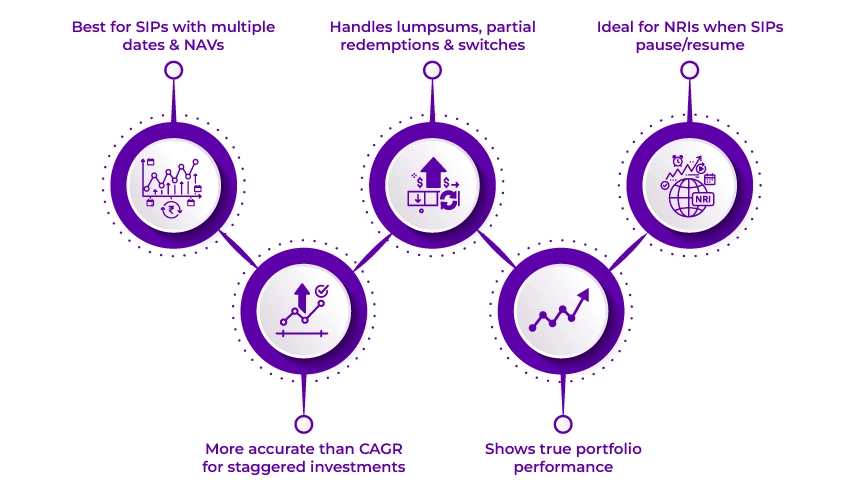
Systematic Investment Plans (SIPs) are the most common investments that use XIRR. Since each installment of SIP is invested on a different date, and NAV, using CAGR to calculate returns, becomes inaccurate. In this scenario, XIRR resolves this issue by evaluating the installment independently.
The same thing applies to portfolios, including partial redemptions, lump-sum investments, switches between schemes, or dividend reinvestments. All these movements are consolidated by XIRR into a single, intelligible return figure.
Moreover, for NRIs, due to residency changes, regulatory requirements, or banking updates, SIPs may pause and resume. In such disruptions, XIRR remains unaffected and continues to showcase the true performance of the investment portfolio over time.
This was all about the role of XIRR for SIP and multiple transactions. Moving further, let’s know the importance of XIRR in mutual funds for NRIs.
For non-resident Indians (NRIs), XIRR in mutual funds is more than a performance indicator; it plays a key role in decision-making. For NRIs, investment in India often involves staggered inflows, tax implications tied to residency status, and different exchange rates. Here, without being impacted by these issues, the investment outcome is determined by the XIRR.
Additionally, NRIs investing through NRO accounts often face TDS on fund redemption, while subject to FEMA rules, NRE-based investments are tax-free. Although XIRR does not help in reducing taxes. However, it helps NRIs in knowing pre-tax performance across different strategies and funds.
Apart from this, when comparing investments made through a residential property and after becoming an NRI, XIRR plays a vital role. It offers a benchmark to assess whether you should continue your investment or reallocate it to another investment.
So, this is how XIRR in mutual funds helps in making financial decisions and determining investment value. Now, moving ahead, let’s know the key difference between XIRR and CAGR.
The table below showcases the key differences between XIRR and CAGR and which option is better for NRIs.
| Particulars | XIRR | CAGR |
|---|---|---|
| Nature | Indicates the average interest rate earned by you on your cash flow during a period. | Shows the annual mutual fund investment growth over time. |
| Multiple Cash Flows | XIRR manages multiple cash flows at irregular intervals. | CAGR only calculates a single initial investment and final value. |
| Return | Only annualised return | Measures absolute return |
| Use | Through SWP and SIP, measures returns from mutual funds. | Helpful in determining the returns from lump-sum investments in mutual funds. |
| Application | XIRR is ideal for SIPs and investments with multiple exit/ entry points. | CAGR is perfect for lump-sum investments kept for a specific duration. |
| Time Sensitivity | XIRR considers the exact time and date when each transaction occurred. | CAGR accounts for the starting and ending dates of the investment. |
| Complexity | XIRR uses a complex formula that needs iterative calculation that generally performed by software, i.e., MS Excel, Google Sheets. | CAGR have simple formula that can be manually calculated. |
These were the differences between XIRR and CAGR. It completely depends on NRIs which formula they use to calculate their returns, as each of them have their own perks and drawbacks. With this, moving further, let’s know how NRIs should interpret XIRR results.
Connect with Savetaxs and plan better with expert support by understanding your financial goals and risk appetite.
Understanding how NRIs can interpret XIRR returns helps them in taking the right investment decisions that align with their financial goals and risk appetite. Further, to help you out, here are some key tips that you can use:
So, this is how using the above-mentioned tips, NRIs can interpret XIRR results.
Lastly, XIRR in mutual funds is the best option to understand your returns and make informed decisions. Considering this, whether you are investing via SIPs, intermittently withdrawing funds, or making a lump-sum contribution, XIRR captures the complete picture of the performance of your investment.
Furthermore, if you need more guidance on NRI investment, connect with Savetaxs. The financial experts in our team will resolve all your doubts and assist you in choosing the right investment as per your financial goals.
Note: This guide is for information purposes only. The views expressed in this guide are personal and do not constitute the views of Savetaxs. Savetaxs or the author will not be responsible for any direct or indirect loss incurred by the reader for taking any decision based on the information or the contents. It is advisable to consult either a CA, CS, CPA or a professional tax expert from the Savetaxs team, as they are familiar with the current regulations and help you make accurate decisions and maintain accuracy throughout the whole process.

Mr. Ritesh has 20 years of experience in taxation, accounting, business planning, organizational structuring, international trade financing, acquisitions, legal and secretarial services, MIS development, and a host of other areas. Mr Jain is a powerhouse of all things taxation.
Want to read more? Explore Blogs