TDS on Sale of Property by NRIs in India
Read More
A clarification is issued by the Income Tax Department of India regarding the emails sent under the Advance Tax e-Campaign emails for AY 2026-27 (FY 2025-26). It has been reported that some taxpayers, including NRIs, have received these emails. This is because, due to data mismatches or incorrect third-party reporting, which can result in inaccurate transaction data. Often, these emails mention large financial figures such as GST purchases, partnership income, business receipts, and more. However, it causes concern for NRIs who do not operate a business in India.
Further, being an NRI, if you also get an email, without having an income in India, it is generally an automated information alert from the Indian government. Additionally, it is not a tax notice or demand.
Confused? This blog explains the Advance Tax e-Campaign emails and why NRIs are receiving them. So read on and clear all your doubts.
The Advance Tax e-Campaign is a digital initiative by the Income Tax Department of India to encourage voluntary tax compliance in the country. Considering this, the income tax department, through its INSIGHT data analytics, periodically runs e-campaigns. This system gathers information from different reporting sources, such as:
As per this data, the tax department identifies high-value transactions and additional income of taxpayers linked to their PAN that could need advance tax payment online/ offline. The purpose behind this campaign is to encourage taxpayers to check their tax obligations and, if required, pay tax in advance before the deadline (generally March 15).
In some cases, the Advance Tax e-Campaign emails may reflect incorrect or mismatched data due to reliance on third-party reporting.
This was all about the Advance Tax e-Campaign. Moving ahead, let's know who should pay the advance tax.
Advance tax imposes to individuals (residents/ NRIs) and entities whose total tax liability is more than INR 10,000 during a financial year. Considering this, taxpayers required to pay advance tax include:
For instance, an NRI freelancer earning income from several customers without sufficient TDS deduction may need to pay advance tax.
So these are the individuals and entities that generally need to pay advance tax. Moving further, let's see why NRIs often receive these emails even without having a business income in India.
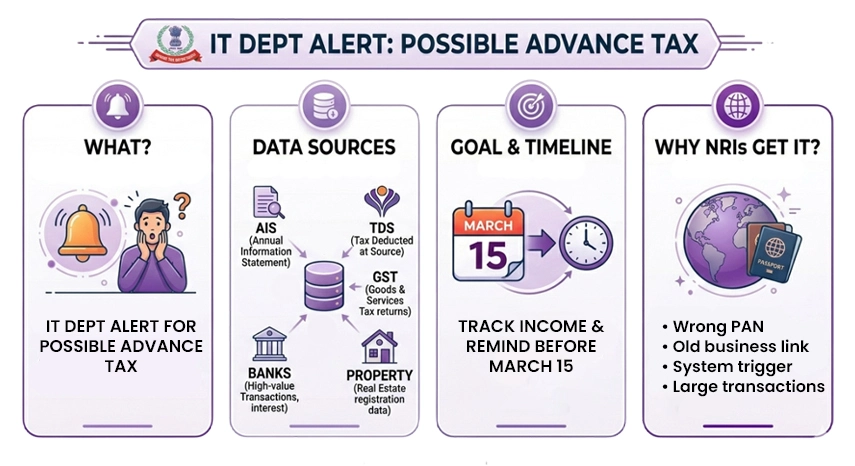
NRIs often receive Advance Tax e-Campaign emails even when they do not have business income in India. It happens because the system heavily depends on third-party data reporting. Considering this, some of the common reasons receive such communication are as follows:
These are the common reasons that may result in receiving an Advance Tax e-Campaign email for NRIs, even though the income is capital gains and is subject to TDS. Additionally, it is advisable for NRIs to do advance tax planning of their Indian income sources to stay compliant with the tax laws of the country.
Now, moving forward, let's know what NRIs should do in this situation.
With the expert guidance of Savetaxs, fulfill your tax obligations on time with complete accuracy.
If you receive an Advance Tax e-Campaign email from the Income Tax Department, you should follow the steps below:
So, this is what NRIs should do when they receive an Advance Tax e-Campaign. Moving ahead, let's discuss why NRIs should still check their compliance portal.
Even though the emails are sent for informational alerts and generally do not need any action. However, it is advisable for NRIs to periodically review their Compliance Portal. It helps in ensuring:
Furthermore, for NRIs, monitoring the compliance portal is vital to maintain their tax compliance in India while living overseas.
Moving further, let's know whether an Advance Tax e-Campaign Email is a tax notice or not.
No, an Advance Tax e-Campaign Email is not a tax notice under the Income Tax Act. It is simply an awareness notification sent to the taxpayer by the income tax department to encourage voluntary tax compliance. Considering this, a formal income tax notice is generally issued under provisions such as:
Further, these notices with response deadlines appear directly in the income tax portal.
Connect with Savetaxs and let our expert handle your tax filing.
Lastly, the Advance Tax e-Campaign emails for NRIs are sent to encourage voluntary tax compliance rather than initiate enforcement action. Considering this, NRIs who receive these emails should check their income information, verify their tax obligations, and, if required, ensure that they pay the advance tax. Additionally, proper tax filing and filing your income tax returns on time helps in avoiding penalties, compliance risk, and interest.
Furthermore, if you need assistance in calculating your advance tax, filing your tax returns in India, and reviewing AIS data, connect with Savetaxs. Our experienced financial experts help NRIs to accurately manage their taxes and stay compliant with the latest Indian tax regulations.
Note: This guide is for information purposes only. The views expressed in this guide are personal and do not constitute the views of Savetaxs. Savetaxs or the author will not be responsible for any direct or indirect loss incurred by the reader for taking any decision based on the information or the contents. It is advisable to consult either a CA, CS, CPA or a professional tax expert from the Savetaxs team, as they are familiar with the current regulations and help you make accurate decisions and maintain accuracy throughout the whole process.

Mr Varun is a tax expert with over 13 years of experience in US taxation, accounting, bookkeeping, and payroll. Mr Gupta has not prepared and reviewed over 5000 individual and corporate tax returns for CPA firms and businesses.
Want to read more? Explore Blogs
_1752921287.webp&w=828&q=75)