
Everything You Need to Know About Form 15CA and 15CB of Income Tax
Read More
For NRIs living in the UK, USA, Australia, Canada, UAE, and Europe, the term audit often creates anxiety. Many Indians living overseas believe that the audit is only levied upon businesses, not on property income and salary. Additionally, if the TDS is imposed, then an audit is not required. However, in reality, tax audits are triggered based on prescribed thresholds and conditions under the Income Tax Act. In India, just like residents, NRIs are subject to the audit provision. But the sudden trigger of it often surprises NRIs.
Considering this, generally, an audit is needed when there is a sudden increase in income, a notice is received from tax officials, or during the redevelopment or sale of property.
Confused about the audit requirements for NRIs in India? Read the blog and know when an audit becomes necessary, what incomes are covered in it, and how NRIs can avoid it.
According to Indian Law, a tax audit can be defined as a detailed examination of accounts by a Chartered Accountant under a specific provision of the Income Tax Act. The purpose behind conducting auditing is to:
Further, it is not a penalty. A tax audit is a statutory compliance requirement that is imposed when thresholds are crossed.
This was all about a tax audit under Indian law. Moving ahead, let's know when audit requirements for NRIs apply in India.
Connect with Savetaxs and fulfill your tax obligations with a clear compliance solution from experts.
An NRI is needed to tax audit their income in India if the income is more than the prescribed limits under a specific head. It generally arises from:
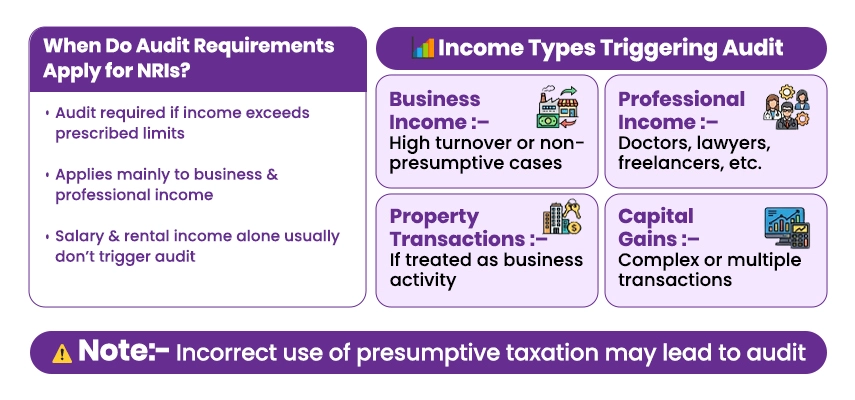
Moreover, basic property or salary income usually does not trigger an audit. However, often mixed income profiles result in auditing. Further, let's know the different types of income included in auditing.
If an NRI has business income in India, then auditing becomes necessary once the turnover of the business is more than the prescribed limits. Additionally, some presumptive schemes alter the applicability of auditing. General NRI scenarios involve:
Often, after moving abroad, when NRIs continue their businesses frequently underestimate audit exposure.
NRIs having professional income in India may also receive audit obligations. It generally applies to:
Once their income exceeds the specified threshold or they do not opt for presumptive taxation provisions, auditing becomes mandatory.
Generally, a tax audit is not triggered by property ownership. Rental income alone generally does not trigger a tax audit unless it is treated as business income or combined with business or professional income exceeding the prescribed limits. However, the risk of it arises when:
NRIs beyond ownership who are part of real estate activities should carefully reassess audit exposure.
Capital gains generally do not need auditing. However, there are certain scenarios like:
The above-mentioned circumstances, even if auditing is not mandatory, attract scrutiny. NRIs often get confused with scrutiny and auditing, while they are not even the same.
Audit burden can be reduced through presumptive taxation schemes. However, not all schemes are available for NRIs. Additionally, the incorrect use of these schemes can lead to penalties or an audit. Considering this, many NRIs depend on outdated advice and later, due to ineligibility, face a tax audit.
These are some of the incomes that attract auditing. Moving further, let's know the common scenarios where NRIs face audit requirements.
In India, NRIs engage in several economic activities. Considering this, certain situations generally lead to the audit requirements. Such as:
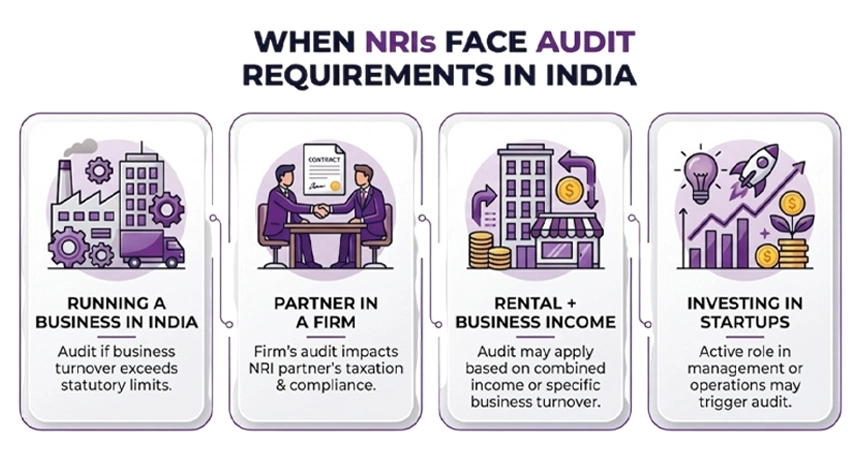
While living overseas, many NRIs operate businesses in India. The businesses may include consulting firms, technology startups, manufacturing enterprises, and e-commerce companies. When the turnover of the business is more than the statutory limit, the audit requirements for NRIs apply. Considering this, their financial statements are then audited by a CA. This further ensures accurate reporting of tax obligations and business transactions.
NRIs often participate as active partners or investors in Indian partnership firms. If the turnover of the firm for a year is more than the prescribed limit, the firm needs to face tax audit obligations. Here, the firm is accountable for compliance. However, the financial outcome of it directly impacts the tax filing and income reporting of an NRI.
In India, many NRIs invest in commercial as well as residential properties. Generally, the audit requirement is not triggered by the rental income.
However, along with property income, if an NRI also has a business or professional practice in India, it results in audit requirements for NRIs. Here, for accurate tax reporting, it is vital to have proper recordkeeping of rental receipts and expenses related to property.
NRIs frequently invest in co-found startups in India. In this, if they are a director or partner actively involved in the business activities, then they also face audit requirements.
Although under the corporate law, companies have mandatory statutory audits. However, depending on the role of NRIs in the business and their income, they may also face audit requirements.
These are some of the common scenarios where NRIs may face audit requirements in India. Moving forward, let's know the different types of audits relevant to NRIs
Under the Income Tax Act, 1961, and the Foreign Exchange Management Act (FEMA), NRIs with assets and income in India are subject to specific audit requirements. These audits are generally triggered by high-value transactions, business income, or specific service fees.
A tax audit can be defined as the examination of the tax returns of an organization or individual by the state tax authority or the Internal Revenue Service (IRS). In India, for certain categories of taxpayers, the Income Tax Act, 1961, mandates tax auditing. Considering this, according to section 44AB of the Indian Tax Act, 1961, if the annual income of your business is more than INR 1 crore or if you have professional income exceeding INR 50,00,00, tax audit is mandatory for you.
The purpose behind this is to ensure books or accounts are properly maintained. Additionally, they showcase the taxable income of the assessee. The auditing is conducted by a CA. Apart from this, the auditor needs to issue Form 3CA/CB (as may be applicable) & 3CD.
Also, by the due date prescribed under the Income Tax Act of the year following the previous fiscal year, submit the tax audit report in the stated format. In case you fail to do so, ot result with a fine that amounts 0.5% of your turnover.
A statutory audit can be defined as the legally required review of the accuracy of the financial records of an institution or a company. In India, this auditing type is managed under several laws, like the Companies Act, 2013. Additionally, to ensure that the financial transactions provided by the company are fair and true as per its financial position, it is carried out by an independent auditor.
The key purpose of conducting statutory auditing is to check that the financial statements of the business match the necessary accounting standards, legal framework, and regulatory requirements. The auditor checks the balance sheet, cash flow statement, and profit and loss account of the business. Apart from this, also review any errors, discrepancies, or potential fraud.
A transfer pricing audit is a review conducted by tax officials to ensure that pricing transactions between related two or more associates. It is examined whether the pricing transactions are done under market conditions and survive the scrutiny of the other tax officials.
Considering this, under section 92 of the Income Tax Act, 1961, all Indian compnaies in respect to the Transfer Pricing Regulation required to analyze their global transactions. Additionally, adhere to it by maintaining proper documents and transaction records. By means of any international transaction, all income acquired by the company shall be calculated at arm's length price.
Further, there are several methods stated by the Central Board of Direct Taxes, generally known as the "Board." Some of them include the cost plus method, transactional net margin method, resale price method, and comparable uncontrolled price method.
At the end of a financial year, any group or person included in an international transaction under the guidance of a CA should submit the report of it in Form 3CEB. This form needs to be filled out before filing the tax returns for the same period.
This was all about the different types of tax audits relevant to NRIs. Moving ahead, let's know the documents required for NRI audit compliance in India.
For meeting the audit requirements for NRIs, it is vital to maintain accurate documents. Considering this, some commonly required documents include:
Moreover, well-maintained financial records make the audit process efficient. Additionally, during verification, reduce the likelihood of discrepancies.
Now, moving further, let's know the consequences of ignoring audit requirements.
For certain businesses, section 44AB of the Income Tax Act, 1961 mandates a tax audit. Considering this, non-compliance with it results in the following:
These are the key consequences of ignoring audit requirements. Moving forward, let's know the best practices for NRIs to manage audit compliance.
With Savetaxs, get expert assistance in setting up your business in India and fulfill your dream.
The best practices for NRIs to manage audit compliance are as follows:
Further, by anticipating early, NRIs can simply manage the audit risk.
Lastly, understanding audit requirements for NRIs is vital to staying compliant with the tax rules of India. For NRIs, most audit issues arise because of a change of residential status, evolving income patterns, and non-compliance. Considering this early clarity prevents stress and penalties.
Further, being an NRI, if you are facing issues in navigating your Indian tax obligations, connect with Savetaxs. We are a team of professional tax experts who help you in navigating your tax obligations with proper awareness, confidence, and structure.
Note: This guide is for information purposes only. The views expressed in this guide are personal and do not constitute the views of Savetaxs. Savetaxs or the author will not be responsible for any direct or indirect loss incurred by the reader for taking any decision based on the information or the contents. It is advisable to consult either a CA, CS, CPA or a professional tax expert from the Savetaxs team, as they are familiar with the current regulations and help you make accurate decisions and maintain accuracy throughout the whole process.

Mr Shaw brings 8 years of experience in auditing and taxation. He has a deep understanding of disciplinary regulations and delivers comprehensive auditing services to businesses and individuals. From financial auditing to tax planning, risk assessment, and financial reporting. Mr Shaw's expertise is impeccable.
Want to read more? Explore Blogs


_1752921287.webp&w=828&q=75)