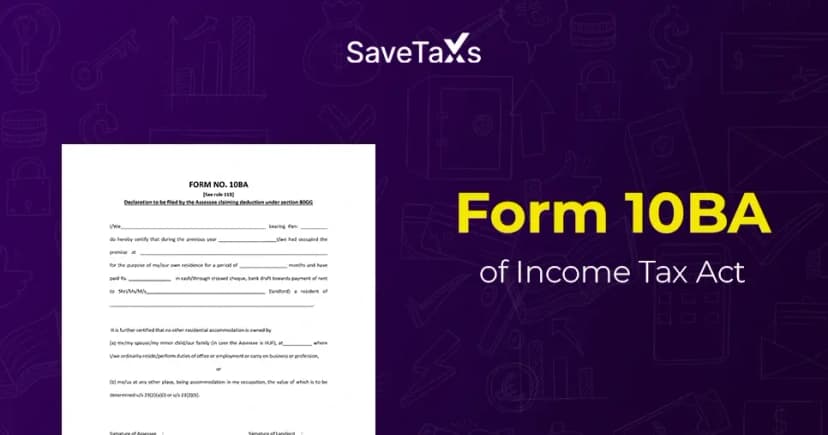
Form 10BA of Income Tax Act: Due Date, Applicability, How to File and Download
Read More
For NRIs and Indian residents, the usual due date for filing an Income Tax Return for the financial year 2024–2025 (AY 2025–2026) is 31 July 2025 unless extended by the Income Tax Department.
Filing income tax returns is generally required if your total income exceeds the basic exemption limit, ₹2.5 lakh under the old tax regime and ₹3 lakh under the new tax regime, though filing may still be mandatory in certain situations even below these limits.
Delaying the filing of an ITR can result in penalties, and mistakes while filing may lead to delays, notices, or additional tax liabilities.
In this blog, we discuss 10 common mistakes made by NRIs and Indian residents while filing their ITR and how to avoid them.
Below are the top 5 mistakes NRIs make while filing an ITR.
Although this is the starting point, it is also where many NRIs go wrong. Residential status under the Income Tax Act determines whether your global income is taxable in India. It is not based on where you live alone, but primarily on the number of days spent in India during a financial year.
Common Misconceptions:
However, this is not exactly how it works. Residential status is generally determined by physical presence:
Also, individuals may fall into the RNOR (Resident but Not Ordinarily Resident) category, which has different tax implications. A miscalculation of even a single day can change your residential status.
How to Avoid This Mistake:
One of the most common mistakes NRIs make is choosing the wrong ITR form. Many select ITR-1 (Sahaj), but this form is meant only for resident individuals with limited income sources.
If you file the wrong form, your return may become defective or invalid, and you may receive a notice from the Income Tax Department.
How to Avoid:
Common applicability:
India has Double Taxation Avoidance Agreements (DTAA) with many countries to reduce double taxation. These agreements typically provide tax credit or relief rather than complete exemption in all cases.
NRIs usually need to file Form 67 before filing their income tax return to claim Foreign Tax Credit (FTC). However, there have been cases where delayed filing was accepted based on judicial rulings, so professional guidance is advisable.
Common Errors:
How to Avoid:
NRIs sometimes assume foreign income never needs reporting in India. Generally, foreign income earned and received outside India by a non-resident is not taxable in India, but reporting requirements vary based on residential status and nature of income.
Clarification:
NRIs are taxable in India on income earned or received in India.
This includes:
Interest earned on an FCNR or NRE account is exempt from tax in India, but for an NRO account, you must report it.
Below are five common mistakes Indian Residents make while filing ITR
Whenever an individual files the ITR, they may incorrectly select the wrong assessment year, resulting in double taxation and unnecessary penalties.
How to Avoid: Whenever you choose an assessment year, ensure it is correct. For example, for the financial year 2025-2026, the accurate assessment year is 2026-2027.
It usually happens when a taxpayer changes jobs; they often end up with different Form 16s from each employer while filing their income tax return. When an individual files their income tax return with multiple Form 16s, it can be tricky, and one may not know how to do it correctly. And these are the cases where taxpayers have to aggregate their income from both employers under their income from salary.
How to Avoid: If an individual is unsure about how to file their income tax return with multiple Form 16s correctly, they should seek professional assistance from an expert.
There are certain deductions available to individuals filing tax returns, including expenses, donations, and certain types of income. Such deductions help the taxpayer lessen the burden of their tax liability by reducing their total tax liability. People often miss such deductions because of a lack of proper knowledge and guidance.
How to Avoid: Figuring out how much can be claimed from a particular source is tedious, and hence, one needs the guidance of an expert to determine all the possible deductions the taxpayer can claim.
Taxpayers often ignore legal notices and communications from he income tax department, which leads to heavy penalties and legal action taken against the concerned person.
How to Avoid: Respond to every communication or legal action promptly and take all necessary corrections if there are any additional taxes to be paid or discrepancies.
According to the Income Tax Act of 1961, primarily resident Indians and ordinarily resident Indians are required to report their foreign assets, accounts, income, and shares in Schedule FA of the ITR in a specified format. The taxpayer believes that if the income is not taxable in India, then they should not have to report it; however, this is where the mistake is made.
How to Avoid: Regardless of whether the income is taxable in India, the taxpayer must report their foreign income, accounts, shares, assets, and other relevant details to the relevant authorities. In the ITR, there is a schedule for Foreign Assets (FA), which requires the taxpayer to enter all details of foreign shares, mutual funds, employee stock options (ESOPs) of foreign companies, and other relevant information.
ITR filing for NRIs in India can feel overwhelming because the Indian tax law might feel like a maze, which is tough to escape, and this is why, due to a lack of knowledge and guidance, taxpayers are prone to make mistakes while filing ITR, which results in penalties and notices, but not anymore. Experts at Savetaxs are here to rescue from the ocean of penalties, mistakes, and stressful ITR filing sessions.
Savetaxs is that one mate every NRI deserves because let us be honest, there are more important things to do rather than stressing over an ITR form. You focus on what's important, and we handle all the mundane tasks with unmatched expertise.
Note: This guide is for information purposes only. The views expressed in this guide are personal and do not constitute the views of Savetaxs. Savetaxs or the author will not be responsible for any direct or indirect loss incurred by the reader for taking any decision based on the information or the contents. It is advisable to consult either a CA, CS, CPA or a professional tax expert from the Savetaxs team, as they are familiar with the current regulations and help you make accurate decisions and maintain accuracy throughout the whole process.

Mr. Ritesh has 20 years of experience in taxation, accounting, business planning, organizational structuring, international trade financing, acquisitions, legal and secretarial services, MIS development, and a host of other areas. Mr Jain is a powerhouse of all things taxation.
Want to read more? Explore Blogs