
_1768307231.webp&w=828&q=75)
Understanding the Difference: NRE vs. NRO Demat Accounts for NRI Investments
Read More
_1770208542933.webp&w=3840&q=75)
SIP (Systematic Investment Plans) is an ideal investment method for consistent investment, compounding returns, and achieving long-term financial goals. When we talk about investing in SIPs, most investors are familiar with monthly SIPs; however, daily SIPs are gaining ground, especially among investors seeking to maximize average returns.
In this blog, we will explore the differences between monthly and daily SIPs, which is better, and the SIP plans available to NRIs.
SIP stands for systematic investment plan, which is a way to invest a fixed amount consistently in a mutual fund. With SIP, you invest a small amount periodically rather than a large sum at once. This helps you build your wealth gradually over time and encourages consistent savings.
You can invest in SIP at various frequencies: daily, weekly, monthly, and quarterly. However, among all frequencies, monthly SIPs are the most common; but now, daily SIPs are also gaining popularity, and seasoned/active investors are finding them lucrative.
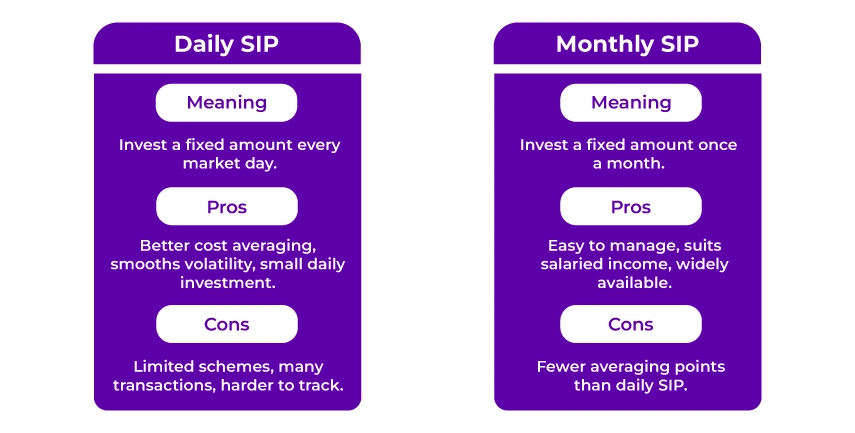
As the name suggests, a daily SIP is a SIP frequency in which investors invest a fixed amount every day the market is open in the mutual fund. Unlike monthly SIP, daily SIP spreads your investment across multiple days, which ultimately reduces the impact of unpredictable market fluctuations.
As in daily SIP, the investor invests a small amount every month, making it easier to manage cash flow while gradually building the wealth corpus. In a nutshell, a daily SIP is ideal for an investor seeking better risk management and gradual wealth growth over the period.
As the name suggests, a monthly SIP is an investment plan in which a fixed amount is invested in a mutual fund each month. This SIP frequency is very convenient for salired iniduviduasls and those with a monthly budget to invest consistently without worrying about market timing.
Similar to a daily SIP, a monthly SIP helps you build your wealth gradually, maintain a consistent saving habit, encourage financial discipline, and stay on track with your long-term financial goals. Compared with daily SIPs, monthly SIPs require fewer transactions and are easier to manage, ultimately benefiting from compounding over the long run.
Both Monty and daily SIP help investors invest in mutual funds consistently. However, they differ in cash flow management, convenience, and frequency.
| Feature | Daily SIP | Monthly SIP |
|---|---|---|
| The investment frequency | A small chunk of a fixed amount is invested in mutual funds every day. | A fixed amount is invested in mutual funds every month. |
| Cash Flow requirement | Requires daily contributions | Requires a monthly contribution |
| Impact of the market | Helps you smooth out the market volatility. | Higher exposure to the market timings on the day of investment. |
| Convenience. | A daily SIP is best for a gradual increase in income or cash flow. | Best for individuals with a salary or on a monthly budget. |
| Suitability. | Great fit for investors looking for a disciplined daily investing. | A great fit for investors who prefer fewer transactions and an easier SIP management experience. |
| Compounding and growth | Steady accumulation with daily averaging. | Steady accumulation with monthly averaging. |
When NRIs invest in SIPs, choosing the right SIP plan becomes even more crucial, as they deal with currency conversion, international remittances, cross-border taxation, and other complexities. Hence, choosing the right SIP frequency is crucial.
In either case, NRIs are advised to consult a qualified SIP consultant or SIP advisor with expertise in handling cross-border international investment portfolios.
File your NRI ITR with confidence through Savetaxs and maximize your savings.
Choosing the SIP frequency depends entirely on your financial habits, income cycle, investment goals, and ability to manage complexity.
However, it is better to go for a monthly SIP, as there is no need to regularly check your bank account to confirm that funds are available to invest in mutual funds. Because if your bank does not have sufficient funds to invest, charges will be deducted due to the SIP failure.
But always ensure that you prioritize the quality of the mutual fund over the frequency of SIP. Because a high-performing mutual fund with a strong track record will easily outperform a less suitable mutual fund, no matter how frequently you invest in it.
NRIs, if you are seeking a seasoned NRI SIP consultant or an SIP expert to help you tailor your investments in India, Savetaxs is the name to trust. We help build investment portfolios for NRIs from over 90 countries, ensuring 100% compliance, easier tax filing, and alignment with long-term financial goals.
So, connect with us as we serve our clients 24/7 across all time zones and invest smart.
Note: This guide is for information purposes only. The views expressed in this guide are personal and do not constitute the views of Savetaxs. Savetaxs or the author will not be responsible for any direct or indirect loss incurred by the reader for taking any decision based on the information or the contents. It is advisable to consult either a CA, CS, CPA or a professional tax expert from the Savetaxs team, as they are familiar with the current regulations and help you make accurate decisions and maintain accuracy throughout the whole process.

Mr Shaw brings 8 years of experience in auditing and taxation. He has a deep understanding of disciplinary regulations and delivers comprehensive auditing services to businesses and individuals. From financial auditing to tax planning, risk assessment, and financial reporting. Mr Shaw's expertise is impeccable.
Want to read more? Explore Blogs


_1769861757488.webp&w=828&q=75)
_1770022119096.webp&w=828&q=75)