
All You Need to Know About a W-2 Form
Read More
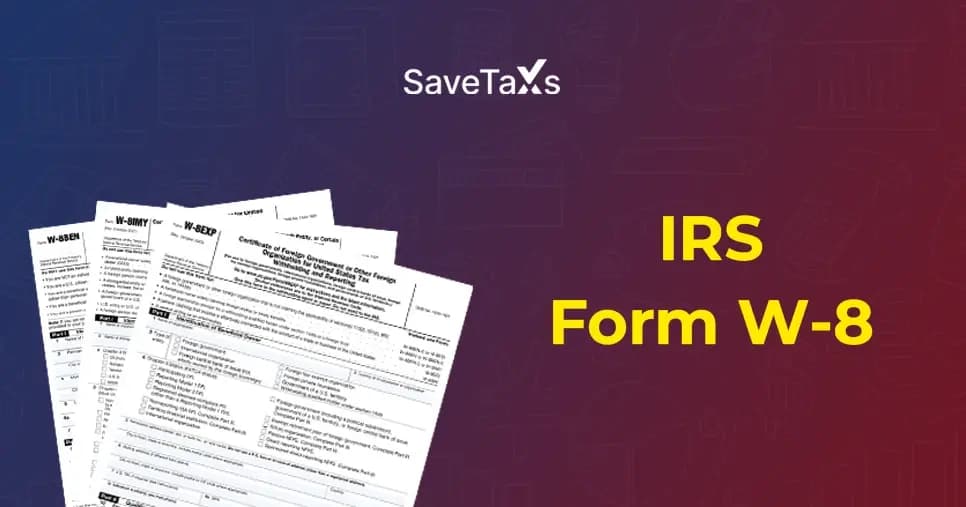
A W-8 form allows a non-U.S. individual or business to certify that they are not U.S. taxpayers. It is issued by the IRS (Internal Revenue Service) and comes in multiple variations, each serving a different purpose.
In this guide, we explain what W-8 forms are, who needs them, their types, and how they help reduce U.S. tax withholding.
W-8 forms are IRS documents used by foreign individuals and businesses to confirm their non-U.S. status and country of tax residency.
These forms help determine whether a person or entity is eligible for:
Important:
W-8 forms are not submitted to the IRS. Instead, they are provided to the payer or withholding agent.
If you fail to submit a W-8 form when required, a default withholding tax of 30% may apply to your U.S.-source income.
W-8 forms are designed for:
Examples include:
U.S. citizens and resident aliens do not file W-8 forms.
Foreign individuals and businesses earning certain types of U.S. income are typically subject to a 30% withholding tax.
W-8 forms help:
W-8 forms:
Validity Period:
A W-8 form is valid for:
The year it is signed + next 3 full calendar years
Example:
Signed on Feb 24, 2025 → Valid until Dec 31, 2028
The five types of W-8 forms cater to different circumstances regarding who should use them:
Form W-8BEN, known as the “Certificate of Foreign Status of Beneficial Owner for United States Tax Withholding and Reporting,” must be submitted by foreign individuals receiving certain types of income in the U.S.
It establishes that the individual is a foreign person and the beneficial owner of the income.
Generally, foreign individuals are subject to a 30% tax rate on certain U.S.-source income, including:
The form helps claim a reduction or exemption under an applicable tax treaty.
Foreign individuals must submit Form W-8BEN to the payer or withholding agent if they are the beneficial owner of income subject to withholding.
These requirements apply even if no reduced withholding is claimed.
Individuals must submit this form before receiving any income or credits. Failure to submit Form W-8BEN may result in:
Quick Fact
Form W-8BEN is used by foreign individuals, whereas Form W-8BEN-E is used by foreign entities.
Form W-8BEN-E is also referred to as the “Certificate of Foreign Status of Beneficial Owner for United States Tax Withholding and Reporting.”
This form is filed by foreign entities (not individuals).
When foreign entities receive certain types of U.S.-source income, a 30% withholding tax applies. However, tax treaties may allow reduced rates.
Foreign businesses must submit Form W-8BEN-E for income similar to what individuals report using Form W-8BEN.
Failure to provide a valid W-8BEN-E may result in full withholding at 30%.
Form W-8ECI, known as the “Certificate of Foreign Person’s Claim That Income Is Effectively Connected With the Conduct of a Trade or Business in the United States,” is used by foreign individuals or entities earning effectively connected income (ECI).
ECI is income connected to a U.S. trade or business.
Unlike passive income, ECI is:
Examples include:
However, trading securities through a U.S. broker alone does not qualify as a U.S. trade or business.
Form W-8EXP is the “Certificate of Foreign Government or Other Foreign Organization for United States Tax Withholding and Reporting.”
It is used by:
These entities may claim exemption or reduced withholding under IRS provisions such as Sections 115(2), 501(c), 892, 895, or 1443(b).
Failure to submit this form may result in:
Form W-8IMY (previously incorrect as W-81MY) is the “Certificate of Foreign Intermediary, Foreign Flow-Through Entity, or Certain U.S. Branches.”
This form is used by:
It certifies that income is received on behalf of another entity or person.
It must not be used by beneficial owners.
Entities required to file Form W-8IMY include:
Supporting documents must be submitted along with the form.
IRS W-8 forms are available in five types and are used by foreign individuals and entities to certify their tax status.
While each form serves a different purpose, common details required include:
These forms are submitted to the payer or withholding agent, not the IRS.
By understanding the correct W-8 form, you can ensure compliance and avoid unnecessary withholding taxes.
Moreover, if you still face issues understanding these forms or need assistance with filing, you should contact the experts at SaveTaxs.
We have a team of specialized experts in U.S. taxation who can resolve all your queries related to taxation, form filing, claiming deductions, and compliance.
Don’t wait—connect with us today and get the best-quality service.
Note: This guide is for information purposes only. The views expressed in this guide are personal and do not constitute the views of Savetaxs. Savetaxs or the author will not be responsible for any direct or indirect loss incurred by the reader for taking any decision based on the information or the contents. It is advisable to consult either a CA, CS, CPA or a professional tax expert from the Savetaxs team, as they are familiar with the current regulations and help you make accurate decisions and maintain accuracy throughout the whole process.

Mr Shaw brings 8 years of experience in auditing and taxation. He has a deep understanding of disciplinary regulations and delivers comprehensive auditing services to businesses and individuals. From financial auditing to tax planning, risk assessment, and financial reporting. Mr Shaw's expertise is impeccable.
Want to read more? Explore Blogs
_1759750925.webp&w=828&q=75)
The key difference between W-8BEN and W-8BEN-E is as follows;