

What are the SBI SWIFT Code?
Read More

An NRE account serves as an essential financial tool for non-resident Indians, PIOs, and OCIs, allowing them to manage their earnings in India from abroad. However, the concept of taxing an NRE account in India can be complex, and this blog aims to simplify it.
In this blog, we will explore NRE account taxation for NRIs, with a clear understanding of how taxes are applied to income deposited in a Non-resident external (NRE) account.
Under the Indian Income Tax Act, NRIs are liable to pay income tax only on income that has accrued or arisen in India. An NRE account holds the income earned overseas; henceforth, it is exempt from income tax in India.
Additionally, the interest earned on both NRE savings accounts and NRE fixed deposit accounts is not subject to taxation as per the provision outlined in Section 10(4)(ii) of the Income Tax Act 1961.
The tax exemption on NRE income from indian income tax makes the NRE account an attractive investment option for NRIs to deposit their foreign earnings in India.
The interest earned on the NRE savings account and/or NRE fixed depseites accoy us exemoted from the income tax in India under the provision os Section 10(4)(ii) of the Income TaxAct 1961.
Additionally, NRIs must note that their tax treatment in India is governed by the provisions of the Foreign Exchange Management Act (FEMA).
An NRE account stands for Non-Resident External Account, which is a type of NRI-designated bank account. An NRE account can be either in the form of savings, current, recurring, or fixed deposits. Additionally, the foreign currency that an NRI deposits into his NRE account is converted into indian ruppes at the time of deposition.
Open an NRI bank account accurately in India with Savetaxs Expert Support.
An NRE account offers benefits for both foreign citizens and non-resident Indians. Out of many, here are some of the key advantages of an NRE account:
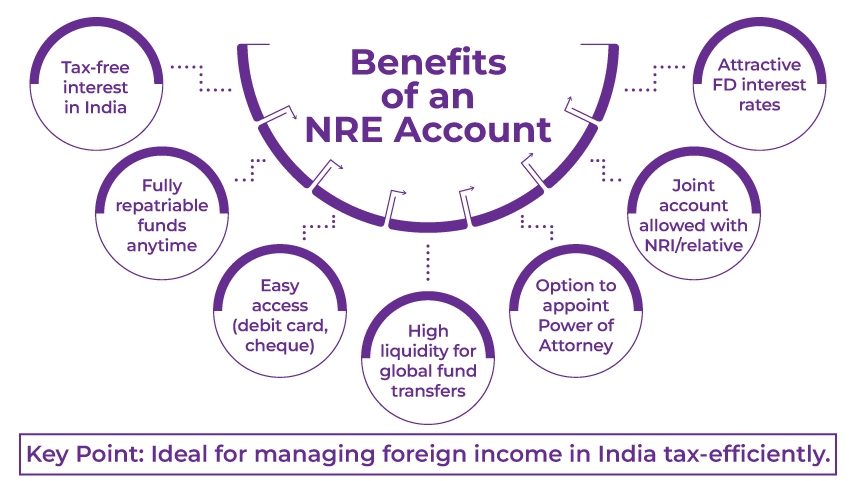
One of the primary benefits of an NRE account is the NRE income taxation in India. Meaning the interest earned on an NRE account is exempted from indian income tax. This tax-free status allows NRIs and foreign individuals to hold their savings in India without incurring any tax liability.
Funds held by an NRI in their NRE account are completely repatriable without any restrictions. Meaning an NRI can easily transfer their money back to any other foreign account fully. This benefit lets NRIs manage their finances seamlessly across borders.
NRE accounts offer easy access to your fund through cheques, debit cards, or electronic transfers. This convenience lets NRIs and foreign citizens manage their finances in India effectively from abroad.
One of the most significant benefits of an NRE account is its high liquidity, allowing easy transfers of funds from India to the NRI's country of residence without the hassle of currency conversion.
As an NRI, you can appoint an Indian resident to manage your NRE account in India on your behalf by granting them the Power of Attorney. Except for the initial opening and closing of the NRE account, the rest of the account operations can be handled by the authorized PoA, such as forwarding funds and ensuring smooth account management in your absence.
NRIs can open an NRE joint account with another NRI or with an Indian resident who is their close relative on a "former or survivor" basis.
NRE fixed deposits are known for offering high interest rates, letting NRIs earn a good return on their deposits.
In a nutshell, an NRE account offers NRIs and foreign citizens a convenient and tax-effective way to manage their foreign earnings in India while residing abroad.
To open an NRI account, you have to stand firm on the eligibility criteria for it, that is:
An individual's residence status plays an important role in determining the tax treatment of income deposited in NRE accounts.
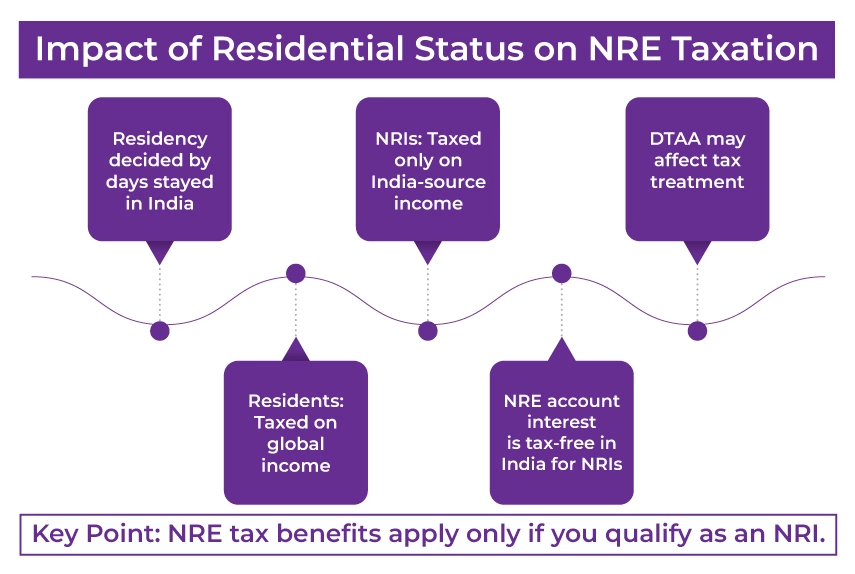
The Indian Income Tax Act,1961, highlights the factors used to ascertain an Indian's residential status.
The following are the tax implications for different residential statuses.
DTAA, or the Double Taxation Avoidance Agreement, is a tax treaty signed between India and other countries to prevent NRIs from being taxed on the same income twice, once in India and again in their country of residence. DTAA can:
Savetaxs ensures timely and accurate NRI ITR filings in India.
In a nutshell, NRE income for foreign citizens and NRIs is not taxable in India for NRIs. Both the principal amount and the interest earned on it are fully exempt from income tax in India, making the NRE account a tax-effective option for NRIs to deposit their foreign earnings. Additionally, funds deposited in the NRE account are freely repatriable, and the account is exempt from any gift or wealth tax in India.
As an NRI, if you are seeking professional assistance to help you open an NRE account in India, then Savetaxs is the name to trust. We have been helping NRIs from 90+ countries open their NRI-designated accounts in India. Our experts provide end-to-end guidance on everything from RBI regulation to documentation and ensuring online onboarding. We also help NRIs with PAN card procurement, notarization of documents, and a smooth account-opening experience.
Connect with us as we serve our clients 24/7 across all time zones.
Note: This guide is for information purposes only. The views expressed in this guide are personal and do not constitute the views of Savetaxs. Savetaxs or the author will not be responsible for any direct or indirect loss incurred by the reader for taking any decision based on the information or the contents. It is advisable to consult either a CA, CS, CPA or a professional tax expert from the Savetaxs team, as they are familiar with the current regulations and help you make accurate decisions and maintain accuracy throughout the whole process.

Mr Manish is a financial professional with over 10 years of experience in strategic financial planning, performance analysis, and compliance across different sectors, including Agriculture, Pharma, Manufacturing, & Oil and Gas. Mr Prajapati has a knack for managing financial accounts, driving business growth by optimizing cost efficiency and regulatory compliance. Additionally, he has expertise in developing financial models, preparing detailed cash flow statements, and closing the balance sheets.
Want to read more? Explore Blogs
_1769758257.webp&w=828&q=75)