
_1772110430603.webp&w=828&q=75)
Will vs Trust for NRIs
Read More

NRIs can invest in Indian startups to diversify their portfolios, recieve good returns, and enjoy various tax benefits. Its legal framework is governed by various key regulations and bodies like FEMA, RBI, and SEBI. The DPIIT also plays a vital role in NRI startup investments by issuing combined FDI policies that specify the regulatory environment and guidelines regarding NRI investment in Indian startups.
An NRI can invest in Indian startups through various routes like equity shares, angel investment platforms, foreign direct investment, and convertible instruments. Instead of investing directly through foreign personal accounts, NRIs must use special NRI bank accounts to invest, such as NRE accounts, NRO accounts, and FCNR accounts. Additionally, the income earned from Indian startup investments is subject to taxation. In this blog, we will cover everything that you must know as an NRI investing in Indian startups.
Due to their innovative solutions, rapid growth, and greater engagement in their technology, Indian startups have secured worldwide recognition. Here are some key reasons why an NRI must invest in Indian startups:
Many Indian startups have become unicorns** due to their rapid growth. Investing early in promising startups may provide high returns, especially if the business grows successfully.
**Unicorn Status: A privately held startup company that is valued at over $1 billion.
India has a population of over 1.4 billion people. The middle class is growing, and so is the usage of the internet. This creates a huge customer base for startups dealing in sectors like e-commerce, health tech platforms, and fintech, helping in increasing the chances of startups' success.
The Department of Industrial Policy and Promotion (DIPP) under the Ministry of Commerce and Industry, Government of India, launched the Startup India initiative. It offered tax benefits and made it easier for entrepreneurs to set up and grow their businesses.
These are some benefits that an NRI can avail by investing in an Indian startup. However, you must also understand some legal framework before investing to ensure compliance with Indian regulations.
File your NRI taxes easily with Savetaxs
For NRIs investing in India, the legal framework is governed by various key regulations and bodies. It includes the Foreign Exchange Management Act (FEMA), the Reserve Bank of India (RBI), and the Securities and Exchange Board of India (SEBI). Here are the legal frameworks that NRIs must consider to ensure compliance and security with their investments:
The SEBI governs securities markets in India to maintain transparency and safeguard the investors' interests. When taking part in venture capital funds or investing in publicly traded startups, NRIs must comply with the SEBI regulations, especially those related to disclosure policies and reporting requirements.
The FEMA states the routes and conditions under which an NRI can invest in Indian startups. Investments can either be made via the automatic route, where prior approval is not needed, or through the government route, where prior approval is required.
Sector-specific caps and conditions are often applicable, mainly in sensitive areas like telecommunications and defence.
The DPIIT also plays an important role in regulating foreign investments under the Ministry of Commerce and Industry. It issues consolidated FDI policies that specify the regulatory environment and guidelines related to NRIs investing in Indian startups.
An NRI can invest in Indian startups via various structured routes, which are as follows:

NRIs can obtain equity shares allotted by startups at the fair market value decided as per the specified valuation guidelines.
For early-stage startups, NRI investors get the option to invest collectively under SEBI-registered Angel networks.
Non-residents invest foreign funds directly in Indian companies under the FDI route. It's the automatic route where no prior government approval is required that permits up 100% FDI in most startup sectors.
Some convertible instruments are commonly used to invest in startups, including CCPS (Compulsorily Convertible Preference Share) and CCD (Compulsorily Convertible Debentures).
NRIs must understand the banking requirements, repatriation rules, and the applicable tax regulations when investing in Indian startups. It is because these factors ensure that investment is legal and financially beneficial. Let's understand each one of these factors in detail:
NRIs must use special NRI bank accounts in India to invest instead of investing directly using foreign personal accounts. The main types of accounts include the following:
NRE accounts are used to invest foreign income in India and permit full repatriability. It means both the investment amount and profits can be transferred abroad without any restrictions. It is mainly used for investing in startups on a repatriation basis.
It is used to manage the income earned in India, like rent, dividends, or business income. Repatration from an NRO account is allowed but is limited to 1 million USD per financial year after paying the applicable taxes.
FCNR accounts allow NRIs to hold funds in foreign currency and safeguard against exchange rate fluctuations. However, instead of direct startup investments, it's generally used for deposits.
Choosing the correct bank account for investing as an NRI helps ensure compliance with Reserve Bank of India (RBI) and FEMA regulations.
Repatriation refers to transferring the proceeds acquired from the sale or profits acquired from investments in India to the NRI's country of residence. The following funds can be repatriated by an NRI:
Now, if you invested using an NRE Account, the entire amount can be repatriated. If the investment was made through an NRO account, repatriation is allowed but limited to 1 million USD per financial year, subject to certain documentation and tax compliance.
You may need proper documentation for fund repatriation, such as Form 15CA and Form 15CB.
NRIs are liable to pay taxes on the income earned from Indian startup investments. The main taxes include:
Dividends acquired from startups are subject to taxation in India. The tax rate varies based on the NRI's income tax slab and applicable DTAA (Double Tax Avoidance Agreement).
NRIs can prevent paying taxes twice if their country has signed a DTAA agreement with India. It permits them to claim a tax credit or lower tax rates.
Capital gains tax applies when NRIs sell their startup shares:
Here are a few common due diligence mistakes that an NRI must consider when investing in Indian startups:
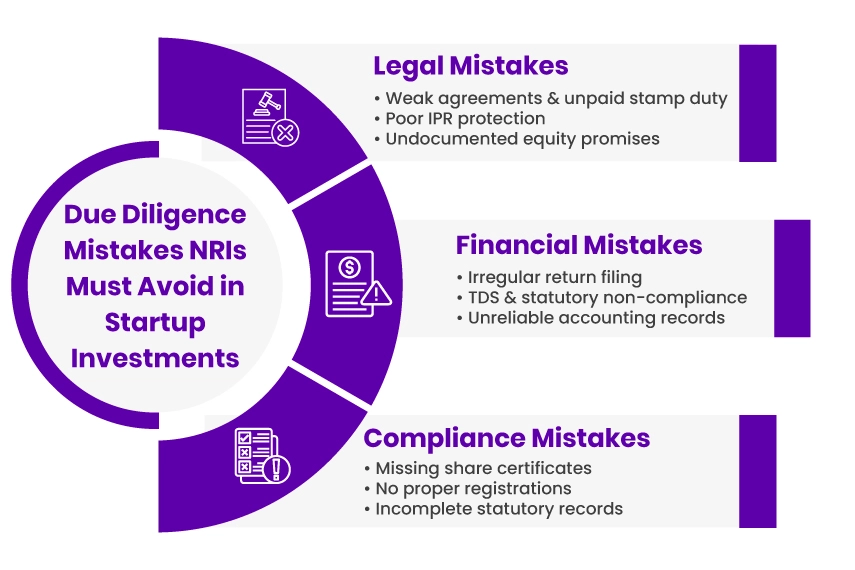
In the context of procurement, a legal due diligence mistake is an important aspect to consider. It identifies any legal risks associated with the target company or sector that you are purchasing. It focuses on various things, such as government rules and regulatory compliance, and covers many subjects like contract compliance, litigation risk, intellectual diligence, etc. Here are the factors involved in legal due diligence:
Firms must be informed about the risks, stability, and financial information before completing any deal. Financial due diligence ensures the accuracy of all the financial details mentioned in the confidential information memorandum (CIM). Here are some mistakes involved in financial due diligence:
Compliance due diligence refers to the process of carrying out a detailed examination, audit, or study of a business's compliance with governmental and non-governmental regulatory organizations. The aim behind this is to identify whether a business is complying with the regulations. Here are some compliance due diligence mistakes to consider:
Planning an exit from the investment is as important as choosing the right startup to invest in. Startup investments are inherently illiquid, unlike listed equities. It means capital is generally locked in for several years. An NRI can convert paper gains into real returns with a proper exit strategy while also staying compliant with Indian regulations. Let's discuss some common exit strategies for NRIs investing in Indian startups:
NRIs must comply with FEMA regulations, RBI pricing norms, tax regulations, and repatriation rules, regardless of which exit strategy they choose.
For NRIs, investing in an Indian startup offers a great opportunity to get involved in the rapidly growing Indian market and also acquire decent profits. Although the opportunity is exciting, you must follow the legal, tax, and regulatory framework to ensure compliance. Additionally, regardless of which investment route you choose, seeking professional guidance from an expert can help you structure your investment smartly.
When talking about experts, Savetaxs tops the list. We are a team of experts who can help you make the right investment choice that meets the highest compliance standards. Our team has good knowledge and expertise in various fields and can offer assistance with a wide range of NRI-related services, including NRI banking, taxation, repatriation, investment, and financial issues. Connect with us right away, as we are actively serving our clients 24/7 across the globe.
Note: This guide is for information purposes only. The views expressed in this guide are personal and do not constitute the views of Savetaxs. Savetaxs or the author will not be responsible for any direct or indirect loss incurred by the reader for taking any decision based on the information or the contents. It is advisable to consult either a CA, CS, CPA or a professional tax expert from the Savetaxs team, as they are familiar with the current regulations and help you make accurate decisions and maintain accuracy throughout the whole process.

Mr. Ritesh has 20 years of experience in taxation, accounting, business planning, organizational structuring, international trade financing, acquisitions, legal and secretarial services, MIS development, and a host of other areas. Mr Jain is a powerhouse of all things taxation.
Want to read more? Explore Blogs

_1772196472749.webp&w=828&q=75)
_1772196577537.webp&w=828&q=75)
_1772435083403.webp&w=828&q=75)