
How can NRIs Invest in IPOs in India?
Read More
_1772196577537.webp&w=3840&q=75)
Yes, NRIs can purchase a joint property with a resident Indian, subject to FEMA compliance. The property must be residential or commercial and not agricultural land, a farmhouse, or a plantation property. There are various types of joint ownership in India, such as joint tenancy and tenancy in common, and an NRI must choose the one that best suits their needs.
NRIs must complete all transactions for property purchase through authorized banking channels and clearly state the proportion of ownership. Additionally, each co-owner must comply with FEMA rules. A resident co-owner's bank account must not be used by an NRI, as this may violate FEMA rules. Moreover, the tax liability for a joint property is shared among the co-owners in proportion to their ownership shares. In this blog, we will learn more about an NRI purchasing joint property in India.
Here are some reasons why NRIs choose joint property purchases:
In India, joint ownership can be structured in various legal forms. You must choose the right type as it affects ownership rights, inheritance, and the ability to sell or transfer the property. The main types of joint ownership in India are as follows:
Joint Tenancy: All co-owners have equal rights over the property. When one owner passes away, their share is transferred to the surviving owner automatically. This structure may not be ideal for NRIs who wish to pass their share to their legal heirs.
Tenancy in Common: Each co-owner has a specific and defined share in the property. If one co-owner dies, their share is inherited by their legal heirs. It is the most preferred option for NRIs as ownership shares and inheritance rights are defined clearly.
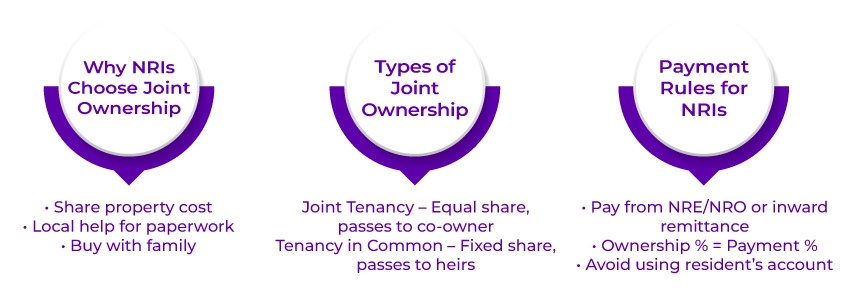
When making payments to purchase property, NRIs must ensure their portion is paid from an NRO or NRE account or via a direct inward remittance. It must be clearly stated in the sale agreement and bank trail, and it must match the ownership percentage reflected in the documents. You must not use a resident co-owner's account, as it can lead to FEMA violations and ownership disputes later.
Here are some common risks that NRIs face in purchasing a joint property:
It is very common that a resident co-owner may occupy the property without consent, permit their extended family to use it, make changes without seeking approval, etc. NRIs often learn about misuse after the damage has already been done while they are staying abroad.
The process might become legally complicated if one co-owner wishes to sell the property and the other does not. Many NRIs often find exiting a joint property easier than entering.
Succession laws apply separately to each owner's share in joint ownership. After the owner's death, disputes might arise in the family, and verbal family understandings often fail legally. Additionally, while securing the rights, NRIs living abroad may face delays and issues.
Resident co-owners often manage the access to property, maintenance decisions, society interactions, local documentation, etc. NRIs may end up losing practical control over their own property shares if they don't possess clear agreements.
Clearly defining the ownership share is important for NRIs to protect their legal and financial interests. Any uncertainties in the ownership structure can create conflicts, issues with taxation, and even loss of control over the asset. NRIs must always ensure the following:
The payment percentage made by each co-owner must match their ownership share. In case an NRI pays 50% of the property cost, but the deed reflects only 30% ownership, the extra 20% may be treated as a gift or loan. This situation can lead to potential tax and legal complications.
Each co-owner's share must be clearly reflected in the sale deed, like 70: 30, or 50:50. The law may treat all owners as equal if the share is not mentioned. This will be a drawback for the NRI who has invested more capital but has no documented proof.
Stamp duty and registration details must be calculated and recorded according to each owner's share. Incorrect reporting can lead to issues during resale, inheritance, or while computing capital gains tax.
Any uncertainty in the terms will benefit the resident co-owners as they will have easier access to the local authorities, courts, and the property itself. They may get more control over possession, rent, or sale decisions, which will put the NRI at a disadvantage.
While granting power of attorney (PoA) to resident co-owners offers additional convenience for NRI property management, it carries significant risks. It includes:
To avoid these issues, NRIs must use specific, time-bound, and professionally drafted documents.
The tax liability for a joint property is shared among the co-owners according to their ownership share. Each co-owner must adhere to their respective tax obligations and comply with all the guidelines under FEMA and RBI.
Additionally, NRIs can repatriate the sale proceeds earned from such properties abroad, subject to FEMA regulations. NRIs must keep separate financial records and keep every document safe for future sale or repatriation.
To avoid any kind of issues in the long-run, NRIs must keep the following things in mind:
As specified under the FEMA regulations, an NRI can legally purchase joint property in India with a resident Indian. The property must be residential or commercial and not agricultural land, plantation property, or farmhouses. Joint property purchase offers various benefits to the NRIs, like shared financial responsibility; it carries some risk as well, which NRIs must be aware of. To ensure a smooth process, the ownership share of both NRI and resident Indian must be clearly mentioned in the sale deeds.
Moreover, for expert assistance and ensuring legal compliance, seek assistance from an expert at Savetaxs. We have a team of experts who can assist you in ensuring you comply with the FEMA regulations and have clearly drafted documents. They will ensure everything is done right to help avoid future disputes and confusion about the ownership status. Contact us right away, and get tailored guidance as per your needs.
Note: This guide is for information purposes only. The views expressed in this guide are personal and do not constitute the views of Savetaxs. Savetaxs or the author will not be responsible for any direct or indirect loss incurred by the reader for taking any decision based on the information or the contents. It is advisable to consult either a CA, CS, CPA or a professional tax expert from the Savetaxs team, as they are familiar with the current regulations and help you make accurate decisions and maintain accuracy throughout the whole process.

Mr Shaw brings 8 years of experience in auditing and taxation. He has a deep understanding of disciplinary regulations and delivers comprehensive auditing services to businesses and individuals. From financial auditing to tax planning, risk assessment, and financial reporting. Mr Shaw's expertise is impeccable.
Want to read more? Explore Blogs
_1769861757488.webp&w=828&q=75)
_1770022119096.webp&w=828&q=75)
_1770034387593.png&w=828&q=75)