Everything You Need to Know About FCNR (B) Account
Read More
Every second, millions of digital transactions are made from small money transfers to hefty amounts. Each of these transactions requires a unique alphanumeric code to track and verify it. This is when the transaction reference number (TRN) comes into the picture. TRN helps resolve financial disputes, track payments, and conduct financial audits. Moreover, for NRIs who deal with both the Indian and international financial systems, a TRN is an essential tool.
In this blog, we will explore the concept of the transaction reference number (TRN), including its benefits, importance, the challenges associated with it, how to find a TRN number, and more.
TRN stands for transaction reference number. It is a unique alphanumeric code assigned to each digital financial transaction. The code acts as a digital footprint for your transaction, enabling verification, tracking, and future reference.
The transaction reference number (TRN) is quite beneficial for resolving financial disputes, auditing for financial fraud, record-keeping, and compliance. Furthermore, the role of TRN is crucial in ensuring proper tax treatment of transactions; hence, it is a necessity for NRIs engaged in frequent cross-border transactions.
For NRIs managing finances across countries, it usually means navigating different tax systems and financial regulations. The transaction reference number becomes a key tool in such situations. The following are some ways a TRN benefits NRIs.
Financial Dispute Resolution: The transaction reference number helps in resolving NRI financial disputes by providing verifiable proof of the transaction. Such proofs are required when challenges arise.
Responding to Tax Notices: If any transaction has been incorrectly flagged by the tax authorities, NRIs can use TRN as proof of the transaction as TRNs track financial transactions. This number is quite useful under the Indian Income-tax Act 1961, as it requires clear proof of the source of income and the tax paid.
Avoid Double Taxation: With the transaction reference number, NRIs can avoid double taxation under the DTAA. This helps NRIs avoid paying taxes on the same income in different jurisdictions.
Recordkeeping: The Transaction Reference Number is essential for accurate financial records and bookkeeping, ensuring there are no duplicate or incorrect entries.
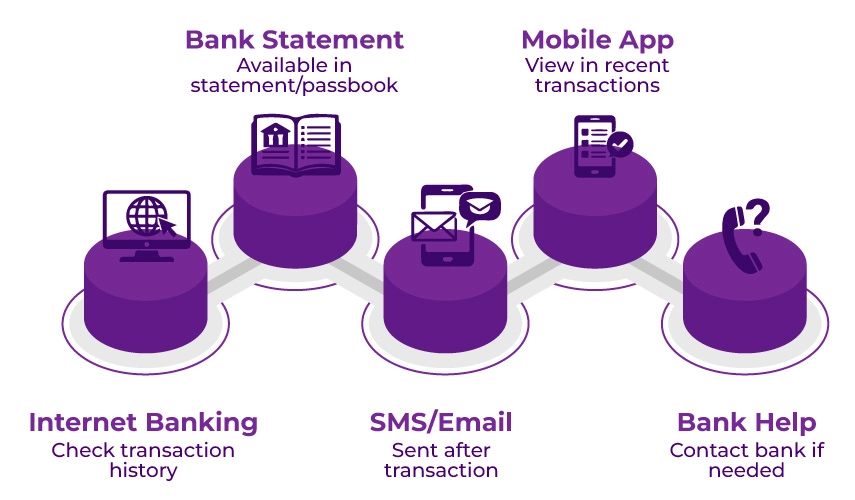
There are several ways to access the transaction reference number (TRN).
Internet Banking: In the respective online banking portal, NRIs can view the transaction history. Each transaction includes a TRN for reference.
Account Statements: Transaction reference numbers are printed on monthly account statements or passbooks, making it easy to track previously made transactions.
SMS and Email Notifications: Most banks send the reference number via SMS or email after the transaction is completed. This ensures that both the sender and the recipient have a record of the transaction.
Mobile Banking Apps: By checking the recent transaction tab in the respective banking app, users can quickly retrieve the TRN.
Direct Bank Inquiry: For NRIs who require additional support, visiting the bank's branch to request the TRN is an option, especially when a technical issue arises.
The transaction reference number is of immense importance within the financial framework for NRIs.
Better Transaction Security: Every digital transaction becomes unique the moment it is associated with a TRN, further enhancing the security of the financial framework.
The Tax Compliance: TRN helps in NRI tax compliance. Under the Income Tax Act 1961, every financial transaction an NRI makes digitally affects their tax liability, and these transactions can be easily tracked using TRN. Henceforth, this compliance is crucial while managing taxes across borders.
Anti-Corruption and Anti-Fraud Efforts: The transaction reference number helps verify and track any digital transaction. Hence, by tracking financial flows, the TRN can help the Income Tax Department monitor large-scale transactions, thereby reducing the risk of fraud and illegitimate financial activities.
Generally, NRIs rely on transaction reference numbers for various activities.
Remittances: TRN simplifies the sending and receiving of funds between India and abroad. This has also made it easier to comply with the Foreign Exchange Management Act (FEMA) and India's Liberalized Remittance Scheme (LRS).
Real Estate Transactions: TRN number helps NRIs track their payments and TDS deductions when buying or selling any property in India. Furthermore, TRN helps maintain tax compliance under the Real Estate (Regulation & Development) Act, 2016.
International Payment for Travel: The transaction reference number provides a record of payments for flights, visa fees, and other travel expenses. This helps support any claims for reimbursement or deductions, if applicable.
Apart from these activities, the transaction reference number also helps NRIs with tax filing, compliance for large wire transfers, and more.
Savetaxs experts help NRIs file their ITR in India confidently
There are certain challenges associated with the Transaction Reference Number (TRN). Such as:
Delay In Generation: At times, technical glitches or system outages can delay TRN issuance, further complicating urgent transactions.
TRN Mismatches: Certain errors, such as system miscommunication or typos, can lead to TRN discrepancies, which ultimately create issues in verification processes.
Duplicate TRN: In rare cases, due to technical glitches or faults, multiple TRNs may be assigned to a single digital transaction, or a single TRN may be assigned to multiple transactions, which can confuse the record-keeping process.
There is no lie that managing taxes between India and its country of residence is a critical process.
Cross-Referencing Of Transactions: The transaction reference number helps NRIs cross-reference their financial transactions, which is especially helpful during tax audits or when responding to income tax notices.
Proof Of Deduction At Source (TDS): When making any property purchase in India, NRIs are require to comply with Section 195 of the Income Tax Act, which mandates TDS deduction on certain transactions. TRN tracks financial transactions and these deductions for accurate tax filing.
DTAA: By using a TRN, NRIs can claim benefits under the DTAA and minimize their chances of being taxed twice on the same income.
Our experts help NRIs manage their banking tasks in India.
In the digital financial domain, the transaction reference number (TRN) has become an essential tool, especially for NRIs dealing with cross-border taxation. TRN facilitates efficient financial transaction tracking and verification of digital transactions, ensures tax compliance, helps prevent tax or financial fraud, and supports the overall financial transaction regulatory framework.
In India, as the digital payment ecosystem evolves, the importance of TRN will only grow, making it an indispensable tool for NRIs managing their finances across borders. In a nutshell, TRN offers NRIs reliability and peace of mind by helping them track their complex financial transactions smoothly.
As an NRI, if you are seeking professional guidance to help you file your ITR, Savetaxs is the name to trust. Our experts help NRIs manage their Indian tax obligations, including ITR filing, tax optimization under the Double Taxation Avoidance Agreement, and compliance with FEMA regulations for NRIs. We provide end-to-end assistance with ITR filing, advisory, capital gains, repatriation, compliance, documentation, and much more.
Connect with us as we serve our clients 24/7 across all time zones.
Note: This guide is for information purposes only. The views expressed in this guide are personal and do not constitute the views of Savetaxs. Savetaxs or the author will not be responsible for any direct or indirect loss incurred by the reader for taking any decision based on the information or the contents. It is advisable to consult either a CA, CS, CPA or a professional tax expert from the Savetaxs team, as they are familiar with the current regulations and help you make accurate decisions and maintain accuracy throughout the whole process.

Mr Shaw brings 8 years of experience in auditing and taxation. He has a deep understanding of disciplinary regulations and delivers comprehensive auditing services to businesses and individuals. From financial auditing to tax planning, risk assessment, and financial reporting. Mr Shaw's expertise is impeccable.
Want to read more? Explore Blogs