
Your Expert Guide For OPC to Pvt. Ltd Conversion
Read More
The full form of CIN is Corporate Identification Number (CIN). It is a unique identification number issued by the ROC to every company registered in India. CIN is a 21-digit alphanumeric code that helps authorities track a company's activities post-incorporation, ensuring compliance with the legal framework.
Companies are required to include their CIN on forms they submit to the Ministry of Corporate Affairs, such as reports and audit reports. In this guide, we will cover all aspects of CIN, including why it matters, its structure, abbreviations, and more.
A 21-digit alphanumeric code that is issued by the Registrar Of Companies (ROC) to companies incorporated in India is a Corporate Identification Number. When the company's registration certificate is issued, the CIN is simultaneously allocated to the company.
The types of companies to which a CIN is provided are:
This number serves as an official reference for all the company-centric filings and compliance with the Ministry of Corporate Affairs.
However, please note that a Limited Liability Partnership (LLP) does not receive a CIN; instead, it is issued an LLPIN. LLPIN full form is Limited Liability Partnership Identification Number. This unique number is seven digits long and is specifically for LLPs.
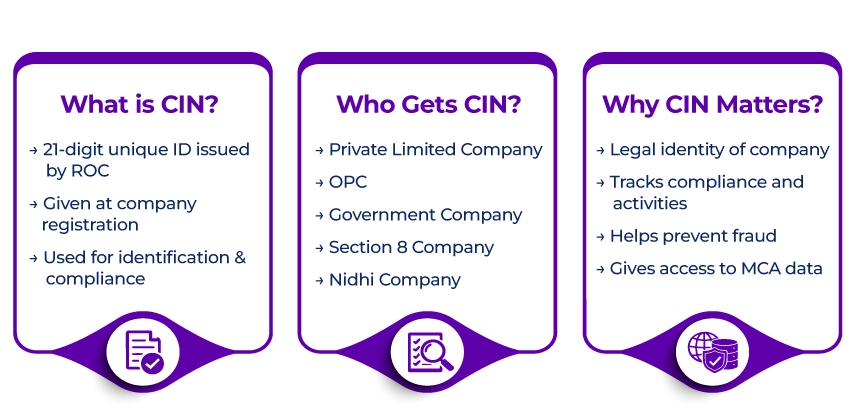
A Corporate Identification number, however, is not just a formality; it has several functions in the business world. Out of many, the following are a few important aspects of a CIN.
Legal Identification: A CIN is the legal identity of a company in India. Every company incorporated in India must obtain a CIN during the business registration process. Without a CIN, a company cannot conduct its business operations or enter into legal contracts.
Regulatory Compliance: A CIN helps track the activities of the respective business, which, in turn, helps the authorities ensure that companies adhere to the legal framework.
The 21-digit CIN is an alphanumeric code, and these 21 digits have a clear meaning that is easy to translate and helps in filing basic information about the company. It is generally used to obtain the primary details of a company registered with the MCA.
Prevent Fraud: Since CIN ensures that companies operate within their designated legal structure, and business services. This way, CIN helps in eliminating fraudulent activities proactively.
Corporate Data Access: CIN is the key to corporate data. It provides seamless access to the company's official documents, financial statements, and other important information through the MCA portal. This access is crucial for competitors, investors, and the regulatory bodies.
As noted above, the 21 digits of the CIN provide crucial information about the company. The CIN is generally broken into six sections, as follows.
An Example Of A Unique CIN: L01631KA2010PTC096843.
Let us see what information each section of the CIN denotes.
The first letter of the CIN indicates whether the company is listed or unlisted on the Indian stock market. If the company is listed, the CIN will start with L; if it is not listed on the Indian Stock Exchange, it will start with U.
Section two is the set of five numbers that denote the economic activity of the company or the particular industry to which it belongs. These numbers typically reflect the nature of the company's economic activities, which it would carry out. The MCA (Ministry of Corporate Affairs) has issued a number to every industry or category.
Section three lists the next two letters indicating which state the company is registered in. For example, MH is for Maharashtra, DL for Delhi, and KA for Karnataka. It is similar to the car registration number, denoting the state with two letters.
Section four contains our set of four numbers, which classify the company's year of incorporation.
Section 5 contains the three letters that indicate whether the company is a private limited or a public limited company. If, in the CIN, these three letters are "FTC", it means that the company is operating as a subsidiary of a foreign company. If the letters are "GOI," it means the company is owned by the Government of India.
The remaining six numeric digits denote the company's registration number, issued by the Registrar of Companies (ROC).
Section 5 of the CIN has the abbreviations. The full form of these abbreviations is.
Every company registered in India must quote its Corporate Identification Number on various documents. These documents include.
In cases where the above-mentioned requirements are not met, a penalty of Rs 1,000 per day is imposed on the defaulting company. However, in such cases, the maximum penalty is limited to Rs 1,00,000.
The corporate identification number can be changed in certain cases. These cases are.
Savetaxs experts help you with Business Registration consultation 24/7.
In a nutshell, the Corporate Identification Number (CIN) is an essential component of your business identity. It helps track the company's activity, ensuring regular compliance and transparency. Hence, understanding the Corporate Identification Number (CIN) is important for every registered business in India.
As an NRI, if you are seeking to register a business in India, Savetaxs is the name to trust. Our experts will provide consultation on end-to-end documentation, compliance, and procedural formats for company incorporation. The experts will provide regulatory compliance consultations to ensure that every NRI running a business in India complies with RBI and FEMA guidelines on foreign investments.
Connect with us as we serve our clients 24/7 across all time zones.
Note: This guide is for information purposes only. The views expressed in this guide are personal and do not constitute the views of Savetaxs. Savetaxs or the author will not be responsible for any direct or indirect loss incurred by the reader for taking any decision based on the information or the contents. It is advisable to consult either a CA, CS, CPA or a professional tax expert from the Savetaxs team, as they are familiar with the current regulations and help you make accurate decisions and maintain accuracy throughout the whole process.

Mr. Ritesh has 20 years of experience in taxation, accounting, business planning, organizational structuring, international trade financing, acquisitions, legal and secretarial services, MIS development, and a host of other areas. Mr Jain is a powerhouse of all things taxation.
Want to read more? Explore Blogs