
Business Tax Return Filing - Types, Due Dates & More
Read More
The SPICe+ form stands for Simplified Proforma for Incorporating Company Electronically Plus. It is a digitally integrated 10-service web form for company incorporation services in India. The form simplifies the process of company registration by combining name reservation (Part A), incorporation (Part B), DIN, PAN, TAN, EPFO, ESIC, opening a bank account, and profession tax into a single streamlined process.
In this blog, we will cover all aspects of the SPICe+ form, including who needs to file it, the required documents, the filing process, benefits, and more.
Also known as the INC-32, SPICe+ form is used to incorporate a company in India. This government-led initiative aims to simplify and streamline the company registration process in India. The SPICe+ form has replaced the old SPICe form; hence, all company incorporations (excluding LLPs) are processed through SPICe+.
The form aims to offer 10 services by three Central Government Ministries and Departments. Such as the Ministry of Corporate Affairs, the Department of Revenue in the Ministry of Finance, and the Ministry of Labour. It also involves one state government (Maharashtra).
The SPICe+ form offers multiple services with a single window, enhancing the overall company incorporation process.
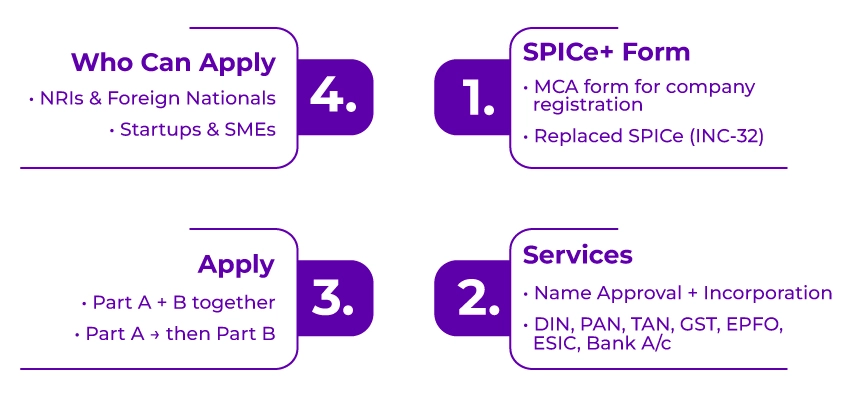
The following are the services offered by the new integrated SPICe+ form:
Part A: Name Reservation (Service intended only for new companies).
Part B:
There are two ways in which the SPICe+ form can be applied.
Under the Companies Act 2013, any body who intends to register a company in India must mandatorily file the SPICe+ form. This includes:
However, Limited Liability Partnerships (LLPs) will use a different web form, such as FiLLiP, rather than SPICe+.
The following is the step-by-step process for new company incorporation under SPICe+:
Step 1: Listed under the "MCA Services", click on the SPICe+ feature.
Step 2: After clicking the SPICe+ form, a screen will open where you must select "New Application Option". The new application opens the page as shown below:
Step 3: Select the "Type of Company" from the options displayed below.
Step 4: Choose the "Class of Company" from the options provided.
Step 5: Select the "Category of Company" from the following options provided:
Step 6: Select the "Sub-Category of Company" that has the following options:
Step 7: Next, you are required to mention the "Main division of industrial activity of the Company" (here mention the code of the industrial activities). For instance, if you choose 01, the description of the relevant business will automatically populate the "Description of the main divisions" section.
Section 8: Now, you are required to give the particulars of the "proposed or approved name". You must also click "Auto Check" to initiate the first level of automated scrutiny of the approved or proposed name, as per the rules governing the name.
You can easily submit Part A for the name reservation or go ahead with the incorporation process. After choosing to go ahead with the incorporation process, Part B of the form is enabled.
Part B has different sections, each with validation to check the form. The required details for registration must be entered. Details also include
Once the Part B is filled, please make sure to carry out a scrutiny check. Once the check is successful, click on the submit.
Post-click, a confirmation of the form's successful submission will be displayed on the screen. You are required to download the PDF of Part B submitted for affixing the Digital Signature Certificate (DSC) and for filing any link forms.
The forms that are linked to SPICe+ are AGILE-PRO, SPICe+ MOA, SPICe+ AOA, URC-1, and INC-9. Part B of the SPICe+ and the linked forms are uploaded to the Ministry of Corporate Affairs (MCA) portal.
A service request number will be generated to make a payment towards the company's incorporation. After the payment is successful, the forms will be processed. In case of any errors, the form must be resubmitted in the same manner.
Generally, the SPICe+ form for registration process is similar for all applicants; NRIs must meet a few additional requirements when incorporating a company in India.
One of the most integral parts of filling out the SPICe+ form is uploading the correct documents to ensure successful registration. The following is a breakdown of the required documents.
The documentation for non-resident Indian (NRIs) for the SPICe plus form is slightly different from that for resident applicants. For an NRI application, additional verification requirements must be met in accordance with FEMA and MCA guidelines.
The key documents are:
Passport (Mandatory): The passport serves as the primary identity proof for NRIs. Hence, it must be valid when submitted as proof of identity, with the details on it clear and visible.
Overseas address proof: NRIs are required to submit valid proof of address from their country of residence. This includes their driving licenses, utility bills, bank statements, and so on.
Notarized and Apostilled: The documents submitted by NRIs must be notarized in their country of residence. In certain cases, the documents must also be apostilled or consularized in accordance with Indian legal requirements.
Director Identification Number (DIN) Documents: If an NRI is applying to become a director in an Indian company, a DIN can be allotted through the SPICe+ form. However, additional documents such as identity proof and address proof are required for DIN allotment.
Director Signature Certificate (DSC): The NRIs are required to obtain a valid DSC to digitally sign the SPICe plus form and other documents of incorporation.
NRIs must ensure that all their documents are properly verified and comply with Indian regulations to avoid any rejection or delay during the incorporation process.
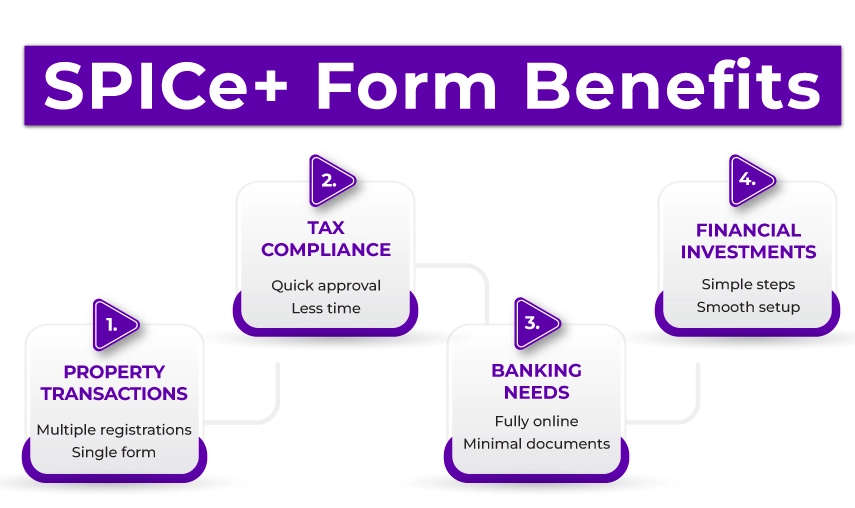
The SPICe+ Form smoothly handles DIN (Director Identification Number) allocation, name reservation, and incorporation formalities (often known as the SPICe form for DIN). The form offers an array of benefits and features that position it apart from the traditional company incorporation process.
The following are some benefits of the SPICe+ form.
Multiple Service Integration: A single form allows multiple registrations for the PAN, TAN, DIN, GSTIN, EPFO, ESIC, and more.
Less Paperwork: All incorporation-related details can be submitted digitally via a single form, reducing reliance on physical documentation.
Enhances Ease in Doing Business: The SPICe+ form aids the government's goals of making India a hub for innovation and startups.
Simple Compliances: The SPICe+ form handles various registrations in a single streamlined process, ensuring all compliance requirements are met once and for all at the time of company incorporation.
The following are some of the most common mistakes applicants make when filing their SPICe+ form. Take note of them so you don't end up in the same position:
1) One of the most common causes of SPICe+ form rejection is that the proposed company name is too similar to any other existing entity or a registered trademark. Hence, before filing Part A, search the MCA database and trademark registration records to ensure that your preferred name is available.
2) Submitting more than two months old address proof. The Registrar of Companies (ROC) is strict about the recentness of the latest bills submitted. Meaning that if there is even a minor date difference, the entire application is halted, and resubmission is required.
3) Wrong NIC code selection. This mistake caused problems with the GST registration leg of AGILE-PRO-S. The code must precisely reflect the company's principal business activity. In the case where you have selected either an incorporated or a generic code, it can delay the entire GST approval and mandate a post-incorporation amendment.
4) Lastly, almost all applications don't know that the Part A name reservation expires in 20 days. Meaning if you did not file Part B of the form within the 20-day window, the name reserved for your company will lapse. Hence, have all documents and DSCs ready before you file Part A.
Savetaxs experts guide you at every step.
From a multi-step maze to a streamlined incorporation process, the SPICe+ form has revolutionized the company incorporation process in India. The form consolidates name reservation, DIN allotment, incorporation, tax registrations, and bank account mandates into one streamlined filing.
As a business owner, understanding the SPICe+ process is essential. This one form single-handedly simplifies everything from documentation to post-incorporation compliance and more. As an NRI, if you are seeking professional guidance on SPICe+ form filing, Savetaxs is the name to trust. Our experts will consult you on SPICe+ Part A and B preparation, assisting with name reservation and company incorporation, document preparation, regulatory compliance, and more.
Connect with us as we serve our clients 24/7 across all time zones.
Note: This guide is for information purposes only. The views expressed in this guide are personal and do not constitute the views of Savetaxs. Savetaxs or the author will not be responsible for any direct or indirect loss incurred by the reader for taking any decision based on the information or the contents. It is advisable to consult either a CA, CS, CPA or a professional tax expert from the Savetaxs team, as they are familiar with the current regulations and help you make accurate decisions and maintain accuracy throughout the whole process.

Mr Varun is a tax expert with over 13 years of experience in US taxation, accounting, bookkeeping, and payroll. Mr Gupta has not prepared and reviewed over 5000 individual and corporate tax returns for CPA firms and businesses.
Want to read more? Explore Blogs