Foreign Liabilities and Assets (FLA) is an annual report submitted by Indian entities, companies, or LLPs to the Reserve Bank of India (RBI). It includes companies that have received foreign direct investments (FDI) or made overseas direct investments (ODI). FLA return must be filed by the 15th of July every year via the FLAIR portal. In case your financial statements are not audited by the due date, file using provisional figures and later revise the return.
Even if the company doesn't have any new transactions during the year, it is mandatory to file a return if there are outstanding foreign investments from previous years. Noncompliance with FLA regulations can result in significant monetary penalties under FEMA. Keep reading further to know more about the FLA return form compliance requirements.
Key Takeaways
- The FLA return is a mandatory annual filing for Indian entities that have received FDI or made ODI, even if there were no new transactions.
- The deadline for filing the FLA return is 15 July each year. If audited accounts are not ready, provisional filing is allowed, but later it must be revised with audited accounts.
- The FLA return must include foreign assets and liabilities as of the 31st of March of the same year.
- Non-compliance with FEMA regulations can lead to significant penalties, such as a fine of up to three times the amount involved in the contravention.
- Providing the wrong or inactive e-mail ID, missing the deadline, not filing a nil return, and not revising provisional returns are some common mistakes in FLA filing.
The Foreign Liabilities and Assets (FLA) return is an important annual filing required by the Reserve Bank of India (RBI). Under the Foreign Exchange Management Act, Indian companies, entities, or LLPs have to report their foreign assets and liabilities with the RBI via the FLA return.
It applies to all Indian entities that have received FDI or made ODI, or have any outstanding foreign assets or liabilities as of the end of the financial year. Every company must mandatorily file an FLA return even if its accounts are unaudited or if no new transactions happened during the reporting period. Failing to comply with the regulation can attract penalties and can create issues in future fundraising, investment structuring, or cross-border transactions.
Who is Required to File the FLA Return?
Indian entities with cross-border investments, either by receiving foreign capital or investing abroad, must file Form FLA. The following types of businesses specifically need to file Form FLA:
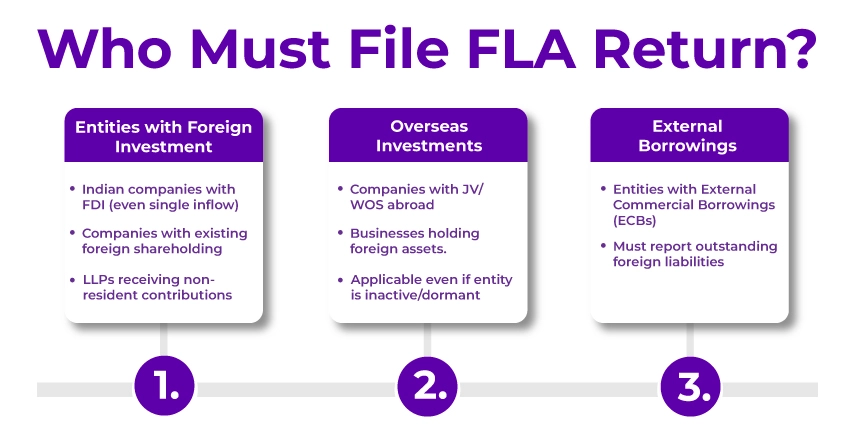
Indian Companies with Foreign Direct Investment
- LLPs that received capital contributions or profit shares from non-residents.
- Indian companies that have received Foreign Direct Investment (FDI) during the financial year, even a single inflow.
- Companies having outstanding foreign shareholding from earlier years, even if there was no fresh inflow.
- It includes equity participation by non-residents, whether active or dormant.
Companies With Overseas Direct Investment
- Indian companies that invested in joint ventures (JV) or wholly owned subsidiaries (WOS) abroad.
- Businesses with any overseas financial assets, including equity and loans.
- If the foreign entity is dormant or not yet generating revenue, the FLA filing is still applicable.
Entities with External Commercial Borrowing (ECBs)
- Companies that borrowed funds from overseas lenders need to report the outstanding liability. This must be done even if the partial repayments have been made.
Start or Expand Your Business in India
Clear advice for your Indian business journey
What are the Due Date and Filing Timeline for the FLA Return?
Here are the due dates and filing timelines for the FLA return:
- The standard FLA return due date is 15 July every year, based on audited or unaudited accounts of the previous financial year.
- If account audits are not available by July 15, file provisional returns, followed by a revised return by the 30th of September.
- The return must include foreign assets and liabilities as on the 31st of March of the same year.
- The RBI will treat the company as non-compliant if they don't file by the 15th of July deadline, regardless of the company's audit status.
How to File FLA Return?
Follow the steps below to file the FLA return:
Step 1: Log in to the FLAIR Portal
- Use your credentials issued by the RBI to log in to the FLAIR portal.
- Fill in the OTP received on your registered email address and mobile number.
- After logging in, on the dashboard, find the 'FLA Online Form' section.
- Select the relevant financial year and click on 'Start Filing FLA Form'.
Step 2: File the Return
- Check the auto-filled details, like PAN, CIN/LLPIN, and registered address.
- Fill in key financial figures, such as:
- Paid-up capital
- Sales or turnover
- Reserves and surplus
- Choose the relevant NIC-2008 industry code that best aligns with your core activity.
- Mention whether the filing is based on audited or provisional (unaudited) accounts.
Step 3: Reporting Foreign Assets and Liabilities
- Declare FDI details for foreign shareholding or capital contribution in India.
- Fill in ODI details for overseas joint ventures or subsidiaries.
- Report other capital, such as receivables or intercompany loans.
- Cross-check all figures with your balance sheet as of the 31st of March.
Step 4: Validation and Submission
- Click on 'Validate' to find out if there are any missing fields or data mismatches.
- Solve any errors identified by the system for validation.
- After validation, click on 'Submit Return' to complete the filing.
- Download and save the acknowledgment along with a PDF copy for future reference.
Here are some legal frameworks and FEMA provisions to consider while filing the FLA return form:
- Foreign Exchange Regulation Basis: The FLA form filing requirement arises under the Foreign Exchange Management Act (FEMA), 1999, which regulates foreign exchange transactions and cross-border investments in India.
- Regulated by the Reserve Bank of India: The Reserve Bank of India (RBI) is responsible for tracking and implementing FLA reporting. They collect this data annually from companies and LLPs that have foreign financial exposure.
- FLA Reporting Purpose: The main aim of FLA form filing is to collect statistical data on foreign liabilities and foreign assets of Indian entities. This information helps the RBI in tracking foreign capital inflows and outflows.
- Monitoring International Investment Position (IIP): The RBI utilised the data submitted through the FLA return to compile India's international investment position. The IIP reflects the country's financial relationship with the rest of the world.
- Mandatory Annual Reporting: The return must be filed if foreign investment balances exist on the company's balance sheet, regardless of whether there are no new foreign transactions during the year.
- Compliance and Penalty Provisions: Non-submission or delayed submission of the FLA form filing may be treated as a FEMA compliance violation. This can attract regulatory penalties or compounding proceedings.
- Transparency in Foreign Investment Reporting: The legal framework ensures transparency in cross-border transactions. It also helps regulators in maintaining stability in India's foreign exchange and investment ecosystem.
- Applicability Under FEMA Regulations: Entities must complete the FLA form filing if they have:
- Received foreign direct investment (FDI)
- Made overseas direct investment (ODI)
- Outstanding foreign assets or liabilities as of 31st March
What are the Common Errors in FLA Filing?
Here are some common mistakes to avoid while filing an FLA return:
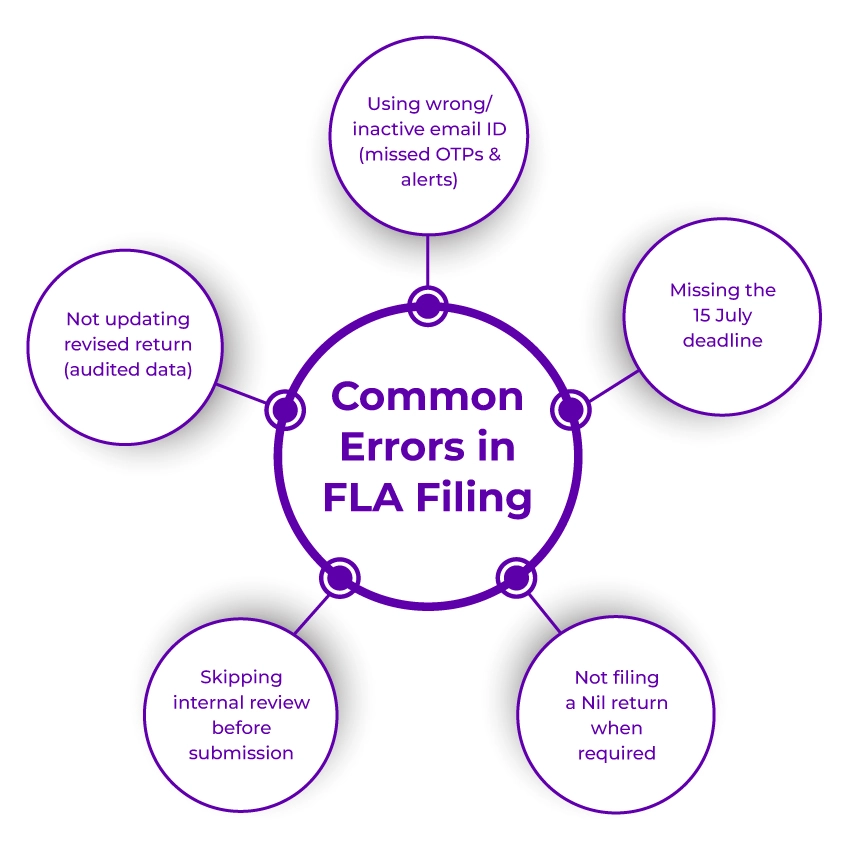
- Providing a wrong or inactive email address: You will receive the OTPs and system alerts on the registered email. Providing a wrong ID can block access near the deadline.
- Missing the Deadline: Don't wait until the last minute as it increases the risk of errors and technical issues. Missing the 15 July deadline can attract FEMA penalties and create issues related to capital account transactions in the future.
- Not Filing a Nil Return: If there are no new transactions, companies often skip filing. However, if you have any outstanding foreign investment or ODI, even from the previous year, you must file a return, even if it's nil. Failing to do the same may be treated as non-compliance by the RBI.
- Internal Review Requirement: The FLA return is sometimes prepared and filed by a single individual or team without getting it reviewed by someone else. Before submitting the return, get a second review by someone familiar to identify mistakes and prevent misreporting or potential technical errors.
- Not Revising Provisional Returns: If you file with provisional (unaudited) numbers, you must file a revised return with the audited figures when available. Many companies forget to revise the return, which leads to incomplete compliance.
What are the Penalties for Non-Compliance?
Under the Foreign Exchange Management Act (FEMA), 1999, non-compliance with the FLA filing requirement may attract penalties. Here are the penalties you will face for non-compliance with the FLA:
- Monetary Penalties: The maximum penalty can be up to 300% of the amount involved in the contravention. However, the RBI may often levy lower penalties via its compounding mechanism.
- Late Submission Fee (LSF): According to RBI, a late submission fee of Rs. 7500 is imposed for filing beyond the 15 July deadline.
- Penalties for Continuing Offense: An additional penalty of Rs. 5000 is imposed every day as long as the non-compliance continues.
- Fixed Penalty for Non-Quantifiable Violations: A Penalty of up to Rs. 200000 is charged to the company if the amount of the violation cannot be identified.
- Violating FEMA Regulations: Filing late or not filing is considered a violation of FEMA regulations. This can lead to further regulatory verifications and even restrictions on future foreign investment transactions.
Consider the following tips while filing the FLA return to ensure compliance and accuracy and prevent penalties:
- Start Early and Monitor Deadlines: Try to start working on your FLA return early before the deadline. This will help you gather all the information, review it, and resolve any system challenges. If audited accounts aren't available, file a return based on provisional data. Later, file a revised return using the audited figures by the 30th of September.
- Maintain Detailed Records: Record information on all foreign assets and liabilities, as well as ODI and FDI transactions, annually. This will help you have accurate data while reporting and address any questions from the RBI easily.
- Register and Update Information on the FLAIR Portal: Register your entity on the FLAIR portal at RBI. Use your active registered email address and contact number to receive your login credentials and acknowledgment.
- Check the Information In Detail: Validate all the information clearly, especially related to foreign investment, balances, and loans. Before submitting the return, get it reviewed by a second person to find out any mistakes or missing information.
- Designate Authorized Staff: The company's authorized individuals must ensure that returns have been filed. It includes the company secretary, the CFO, or the director. Ensure that they review the crucial information, documents, and know what is required.
- Regular Monitoring: Visit the RBI website regularly or seek advice from an expert to stay aware of the changes in the RBI regulation or FLA reporting procedures.
Expert NRI Business Tax Solutions
Strategic tax planning for NRI entrepreneurs
To Conclude
The FLA return is more than just an annual return filing; it's a key factor for staying compliant with the FEMA regulations. Filing the FLA return on time can help you prevent penalties, compounding procedures, and uncalled regulatory scrutiny. Keeping the 15 July deadline in mind and planning ahead is important, mainly for businesses that have recurring FDI or overseas investments.
If the final accounts are not ready, file using provisional financials and revise the return later. Consistent and accurate reporting of foreign liabilities and assets also helps in the future while seeking approval or interacting with regulators and banks. Moreover, the process of filing the FLA return can be simplified by seeking assistance from an expert at Savetaxs.
At Savetaxs, we have a team of experts who can make the process easier by offering end-to-end consultation throughout the process. From helping you understand the RBIs requirements to ensuring all the documents are available and ready to file. Whether you are filing for the first time or need assistance with a revised submission, our experts can help you with everything. Contact us today and ensure clarity, speed, and confidence while filing the FLA return.

_1773060689892.webp&w=828&q=75)

_1773147247383.webp&w=828&q=75)
_1773142480787_1773146465792.webp&w=828&q=75)
_1773223986036.webp&w=828&q=75)
_1773319492690.webp&w=828&q=75)