
_1774011785097.webp&w=828&q=75)
What is the Process to Register a Partnership Firm?
Read More
_1772791127967.webp&w=3840&q=75)
There is an array of options for foreigners and NRIs looking to set up a business in India. The options include private limited companies, liaison offices, and limited liability partnerships (LLPs) in India. In 2026, Private Limited Companies remain the most preferred option, as they offer the best blend of 100% ownership, streamlined compliance, seamless fundraising, and flexibility, making them a reliable choice for 90% of foreign investors.
In this blog, we will explore the types of companies that NRIs and foreign investors can open in India, and by the end of it, you will have an idea of which type of company suits your needs and why the choice of city also matters.
Picking up the right type of company is the first strategic move. NRIs in India can register a business under the Foreign Direct Investment (FDI) rules, with no prior government approval required, making India an NRI-friendly destination for starting a business. However, to set up a business in compliance, NRIs need at least one resident director in India, and must comply with sector-specific caps.
The following are the types of companies in India for non-resident Indians (NRIs).
LLP is a hybrid entity structure that blends the benefits of both, combining the partnership flexibility with the corporate limited liability.
Liaison or branch offices are regulated by the RBI under FEMA guidelines, and these offices allow foreign companies to establish their presence in India.
Liaison offices are merely set up for market research. No sales or contracts are executed, and the activities are funded through remittance.
Under branch offices, limited projects in the permitted sectors are allowed, such as exports. Here, profits are repatriated under the RBI regime.
| Option | FDI Ease | Min Members/Directors | Best For | Drawbacks |
|---|---|---|---|---|
| Private Limited | 100% permitted in most sectors without prior government approval. | A minimum of two directors is required, at least one of whom must be a resident of India. | Startups and scaling a business. | Moderate compliance, annual audits, filings, etc. |
| LLP | Automatic in only selected sectors. | A minimum of two designated partners of whom one must be a resident Indian. | Services firms or enterprises. | FDI limits and sector-based restrictions. |
| Liaison Branch | Not automatic - requires RBI approval. | N/A - as it is not a separate legal entity. | Initial market research or liaison without any commercial activities. | No trading only for representational roles. |
| Public Limited | Same as Pvt. Limited. | Minimum three required, out of which one should be a resident of India. | Large-scale operations, stock listing, IPOs, public fundraising, and so on. | High compliance, board committees, and so on. |
Before setting up a business in India, NRIs and foreign nationals must be well-versed in certain Indian company laws and regulations to ensure the smooth execution of their business operations.
The new India now focuses on welcoming the new business and not just regulating them. Here is a list of benefits that you can rely on while incorporating a business in India in 2026 and beyond.
100% Automatic FDI: You need no RBI approval for IT, manufacturing, and renewable energy industries. Invest in them and start your business in no time.
Cloud Services Tax Break: Foreign firms providing cloud services via Indian data centers get a tax holiday until March 2047 ( Budget 25 Extension under Section 80JJAA)
No DTAA: India has signed a double taxation avoidance agreement with 90+ countries, including the USA, UK, Singapore, and others, to prevent paying tax twice on the same income source.
5-year tax exemption for experts: This benefit is new in 2026, which is for foreign specialists on approved projects who skip tax on non Indian income for 5 years.
The following is the standard checklist for foreign company registration.
NRIs must understand that there's no one universal business structure that fits all needs. The right business structure depends on your risk appetite, future plans, and business goals.
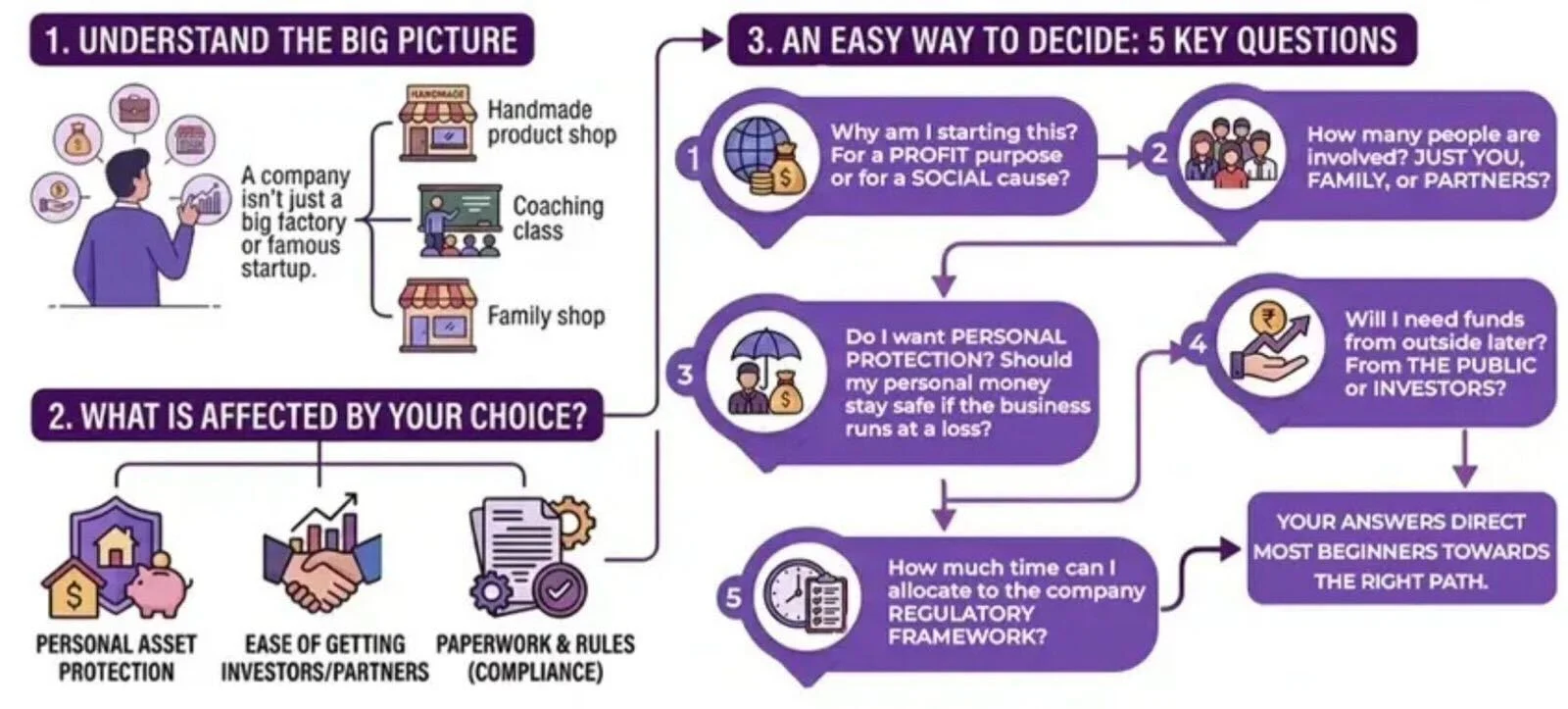
Many NRIs starting businesses in India think that a company is a big factory or a famous startup. Well, that's not the case. Even a small homegrown brand selling handmade products, a coaching class, or even a family shop can choose to form a company.
The type of company you choose affects the most important aspects, such as
The business's purpose and its side predominantly determine the structure. While choosing the structure, ask yourself these five easy questions.
Having a direct answer to these questions guides most beginners towards the right path.
If you are planning to be a single entrepreneur, such as a website designer, freelancer, online seller, or tuition teacher, a One Person Company (OPC).
The type of business that fits the best for family businesses and small startups wanting to grow is a Private Limited Company.
Public Limited Company is generally suitable for large businesses planning to raise funds from the public one day.
The following is a comparison table of business structures to provide you with greater clarity.
| Business Structure | Ideal For | Liability | Compliance | Scalability |
|---|---|---|---|---|
| Sole Proprietorship | Freelancers, solopreneurs. | Unlimited | Low | Limited |
| Partnership Firm | Small Joint Businesses | Unlimited | Medium | Limited |
| LLP | Professionals, SMEs | Limited | Medium | Moderate |
| Private Limited Company | Startups, scale-ups | Limited | High | High |
The following is the FEMA and Banking Checklist that one must consider:
FC-GPR Filing: Ensure to report the initial capital infusion to the Reserve Bank of India within 30 days of issuing the shares.
KYC of Foreign Remitter: Ask your foreign bank to provide a "Know Your Customer" report to your Indian receiving bank.
Capital Inflow Account: A specialized bank account that is intended to receive "Foreign Direct Investment".
PAN/TAN For Foreign Directors: As a director of the company, even if you do not live in India, you need to have an Indian Tax ID (PAN).
The following are some common mistakes that foreign investors unintentionally make when incorporating their companies in India.
The "Assume 100%' Trap: One of the most common mistakes foreign investors make is assuming that every sector allows 100% FDI. Always ensure that you check the DPIIT guidelines first.
The "Late Reporting Penalty": Investors often forget to file the FC-GPR form with the RBI after bringing in the capital. In 2026, the penalties for this are strict and non-negotiable.
Thinking a Liaison Office Is A Shop: Foreign investors must know that using a liaison office to generate revenue is strictly prohibited by the laws.
Underestimating "Resident Director" KYC: Every Indian company must have one director on their board who is an Indian resident, and their KYC must be satisfactory.
Savetaxs investment experts provide investment guidance tailored to your goals.
Previously, setting up a business in India as a foreign investor was a bureaucratic nightmare, but not anymore. As a foreign investor incorporating a company in India, you must first evaluate your goals and decide on your company's structure, as once your business structure is set, you can plan other operations around it.
In a nutshell, analyzing your company's business structure must be your top priority. Now, if you are an NRI seeking professional consultation in setting up a business in India, Savetaxs is the name to trust. We have a dedicated team of professionals to provide expert consultation on registering a company in India. The experts will provide end-to-end consultation on DSCs for subscribers and directors, DINs for directors, company registration fees and stamp duty, certificates of incorporation, the company's PAN or TAN, professional cross-border tax management, GST registers, and so on.
Savetaxs is every NRI's one-stop destination for setting up a business in India seamlessly. Connect with us as we serve our clients 24/7 across all the timezones.
Note: This guide is for information purposes only. The views expressed in this guide are personal and do not constitute the views of Savetaxs. Savetaxs or the author will not be responsible for any direct or indirect loss incurred by the reader for taking any decision based on the information or the contents. It is advisable to consult either a CA, CS, CPA or a professional tax expert from the Savetaxs team, as they are familiar with the current regulations and help you make accurate decisions and maintain accuracy throughout the whole process.

Mr Shaw brings 8 years of experience in auditing and taxation. He has a deep understanding of disciplinary regulations and delivers comprehensive auditing services to businesses and individuals. From financial auditing to tax planning, risk assessment, and financial reporting. Mr Shaw's expertise is impeccable.
Want to read more? Explore Blogs
_1774011857013.webp&w=828&q=75)