
_1773924400414.webp&w=828&q=75)
Legal Pitfalls in Joint Ventures in India for Foreign Investors & NRIs
Read More
_1773147247383.webp&w=3840&q=75)
For NRIs and foreign investors, selecting the right business structure is one vital decision when planning to set up a business in India. In this, the two most famous options are a private limited company and a limited liability partnership (LLP). However, NRIs often remain confused between the two of them.
To help you out, in this blog, we have compared a private limited company vs. an LLP in India, evaluating factors such as compliance requirements, taxation, legal framework, and more. By the end of this blog, you will have a clear understanding of which business structure aligns with your investment goals. So let's start reading and clear all your confusion.
A private limited company (PLC) is regulated by the Ministry of Corporate Affairs (MCA) and is governed by the Companies Act, 2013. In India, it is one of the most investor-friendly and structured business entities in India, making it perfect for NRIs and foreign investors.
The legal considerations for a private limited company are as follows:
This was all about a private limited company for NRIs in India. Moving ahead, let's know about a limited liability partnership (LLP).
An LLP is regulated by the Ministry of Corporate Affairs (MCA) and controlled by the Limited Liability Partnership Act, 2008. LLP with fewer compliance requirements offers a flexible business structure. It makes it a suitable of smaller businesses and professionals.
Here are the legal considerations for LLP for NRIs:
This was all about a limited liability partnership for NRIs in India. Moving further, let's know the key difference between both of them.
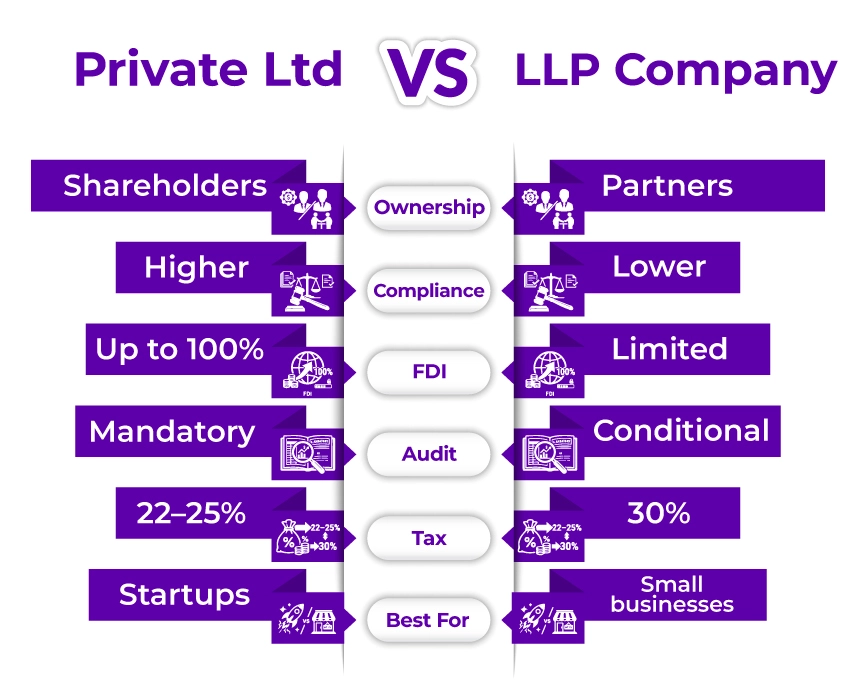
The table-below showcase the key difference between a private limited company and a limited liability partnership:
| Factors | Private Limited Company | Limited Liability Partnership (LLP) |
|---|---|---|
| Legal Status | A private limited company has a separate legal entity from its directors and shareholders. | A limited liability partnership also has a separate legal entity, different from its partners. |
| Ownership | It is owned by the shareholders who hold equity shares of the company. | LLP is owned by partners, each of whom invested in capital. |
| Compliance | PLCs have higher compliance requirements. It includes board meetings, annual filings, and statutory audits. | LLP has lower compliance requirements with fewer regulatory filings. |
| Audit Requirement | Mandatory when the turnover is more than INR 1 crore. | Auditing in LLP is mandatory when the turnover is more than INR 40,00,000, or the capital is more than INR 25,00,000. |
| Liability | PLC is limited to shares held by the shareholders. Additionally, from liabilities, personal assets are protected. | The liability in the LLP is limited to the amount of partnership capital contributed by partners. Additionally, there is no risk of personal liability. |
| Foreign Investment (FDI) | In most sectors, under the automatic route, 100% FDI is allowed. Additionally, for NRIs and foreign investors, there is a preferred structure. | In LLP, FDI is restricted in certain sectors. Additionally, in a specific industry, it is allowed under the automatic route only. |
Further, when choosing between a private company and an LLP, consider the legal structure, ownership, compliance, taxation, audit requirements, liability protections, and foreign investment opportunities. If you are still confused, read the next section for a detailed explanation of the key difference between a private company and an LLP.
Here is a detailed explanation of the key differences between a private limited company and an LLP:
Both private companies and LLPs, from their owners, have a separate legal existence. However, both of them have different ownership models:
Compared to LLP, private limited companies have more regulatory requirements. It includes:
In contrast to this, LLP has fewer compliance requirements. It makes them easier to manage and more flexible for startups and businesses.
The FDI rules for private companies and LLPs in India are as follows:
The audit requirements for private limited companies and LLPs are as follows:
The limited liability protection for private companies and LLPs is as follows:
This was a detailed explanation of the key difference between a private company and an LLP for NRIs in India. Moving ahead, let's know the taxation policy for both business structures.
Taxation policies associated with private companies and LLPs for NRIs are as follows:
Private Limited Company Taxation
A private company in India is subject to corporate and dividend taxation. The applicable tax rates and rules involve:
Due to corporate and dividend tax, private limited companies face higher taxation. It further makes the profit distribution costlier for NRIs and foreign investors.
An LLP follows a partnership model of taxation. This is as follows:
LLP is a good option for simpler and no double taxation for NRIs who prioritize profit distribution.
So, this was all about taxation policy on private companies and LLPs in India. Now, moving further, FEMA and RBI regulations for NRI investors.
To successfully set up a business in India, it is vital for NRIs to follow the FEMA regulations. Additionally, through its established guidelines, all foreign investments are controlled by the Reserve Bank of India (RBI).
Key FEMA compliance points include the following:
Further, if these regulations are not followed under FEMA regulations, it can lead to the imposition of serious penalties.
FDI rules state that if the activity is conducted by a business that has taken prior approval from the MCA, or not. Considering this, important RBI rules include:
To register a company in India, NRIs and foreign investors need to follow the rules and regulations stated by the Ministry of Corporate Affairs. It includes:
Additionally, any document signed outside India needs to have both apostille and notarization verification.
This was all about FEMA and RBI regulations for NRI investors in India. Moving ahead, let's know which among the private companies and LLPs is the best choice for NRI entrepreneurs.
Among private limited companies or LLPs, the best choice for NRI entrepreneurs depends on the goals and nature of your business.
If you have a startup plan to scale, build a brand, or raise investment, then registering a private limited company is a good option for you. It provides long-term benefits and access to funding options. Additionally, it helps you in expanding your business globally or inviting co-investors/ founders.
However, if you focus on flexibility, cost-effectiveness, and ease of doing business, specifically if you are a small consultant, firm, professional service provider, or freelancer, then LLP registration is a good choice.
In short, LLP is the right choice for a stable, smaller business, while a private limited company is a good choice for growth-oriented, ambitious startups. Now, moving further, let's know the common mistakes NRIs make while choosing a business structure.
Due to complex regulatory frameworks like FEMA, many NRIs often face issues in choosing the right business structure. It further led to restricted fund repatriation, severe penalties, and excessive taxation. Here are some of the common mistakes made by NRIs while choosing a business structure in India:
Further, to avoid these common mistakes, it is vital to follow a defined formalism matrix. Additionally, understanding the regulatory rules and taking professional help can also assist NRIs in setting up a successful business structure in India.
Connect with Savetaxs and make smart investment decisions as per your financial goals and risk appetite.
For NRIs and foreign investors, today, setting up a business in India is a smart move. However, success needs the right business structure, correct planning, and strict compliance. Considering this, opting between a private limited company and a limited liability partnership depends on your investment needs, financial goals, and risk appetite. A private company is a good option if you are looking for investment opportunities, growth, and scalability. In contrast, LLP is an ideal option for small consultants, businesses, and professionals who prefer flexibility, tax efficiency, and lower compliance.
Further, for expert legal guidance on investment and tax planning in India, connect with Savetaxs. We have a team of experts who help you in navigating complex business regulations and choose the right investment as per your financial needs.
Note: This guide is for information purposes only. The views expressed in this guide are personal and do not constitute the views of Savetaxs. Savetaxs or the author will not be responsible for any direct or indirect loss incurred by the reader for taking any decision based on the information or the contents. It is advisable to consult either a CA, CS, CPA or a professional tax expert from the Savetaxs team, as they are familiar with the current regulations and help you make accurate decisions and maintain accuracy throughout the whole process.

Mr. Ritesh has 20 years of experience in taxation, accounting, business planning, organizational structuring, international trade financing, acquisitions, legal and secretarial services, MIS development, and a host of other areas. Mr Jain is a powerhouse of all things taxation.
Want to read more? Explore Blogs
-India_1774009994998.webp&w=828&q=75)
_1774011785097.webp&w=828&q=75)
_1774011857013.webp&w=828&q=75)