For international businesses aiming to access the Indian market, cross-border joint ventures are a pivotal strategy. These collaborations help them to leverage market insights, local expertise, and distribution networks. However, legal pitfalls in a joint venture between Indian and foreign partners often create issues. It includes regulatory approvals, foreign direct investment (FDI) rules, intellectual property (IP) protection, tax compliance, and partnership disputes.
Confused? To help you out, this blog contains legal pitfalls in a joint venture that Indian and foreign partners should consider. So read on and clear all your doubts.
Key Takeaways
- A joint venture between an Indian and a foreign partner, or NRI requires strict compliance with FEMA, FDI, corporate, and tax laws.
- Choosing the right joint venture structure, i.e., LLP, Pvt Ltd, or contract, offers legal clarity.
- Strong joint venture agreements help in avoiding legal disputes and conflicts between partners.
- Non-compliance results in penalties, criminal action, and license cancellation.
- Legal risks can be minimized by regular compliance checks and due diligence.
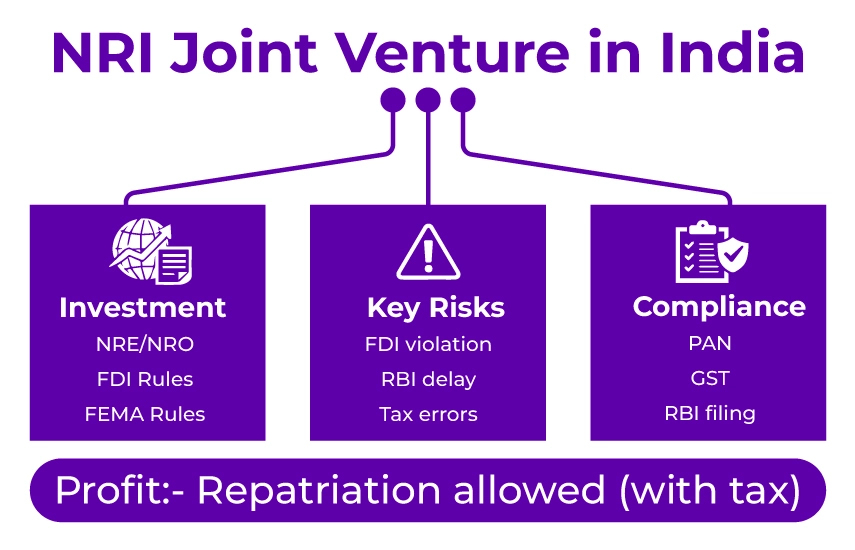
- NRIs must comply with FEMA, FDI rules, and RBI reporting requirements when investing in joint ventures.
Regulatory Approvals Needed for Joint Venture Between Indian and Foreign Partners or NRIs
You need to follow multiple legal and regulatory steps to set up an India-foreign joint venture. Considering this, the primary approval depends on the business areas, investment amount, and the resident country of the foreign investor.
Foreign Direct Investment (FDI) Approvals
Under the FDI policy of India, investments are classified into two main routes:
- Automatic Route: Under the automatic route, foreign investors without prior approval from the Indian government can invest in most sectors. After receiving funds from the foreign investor, by filing Form FC-GPR within 30 days, the Indian company should report the investment to the Reserve Bank of India (RBI). Additionally, the fund reporting via RBI's FIRMS portal should also be done on the Single Master Form (SMF).
- Government Route: Sensitive sectors via the Foreign Investment Facilitation Portal, before investment, need prior approval from the Department for Promotion of Industry and Internal Trade (DPIIT). It includes telecom, satellites, defense, multi-brand retail, and print media.
Companies Act, 2013 Compliance
If you set up a joint venture in India as a private limited company, it should be registered according to the Companies Act, 2013, through the portal of the Ministry of Corporate Affairs (MCA). The act regulates incorporated joint ventures, covering governance, incorporation, disclosures, and shareholder rights. Additionally, through its portal MCA, administrate compliance requirements and statutory filings.
FEMA Regulations
In joint ventures, foreign participation is regulated under the Foreign Exchange Management Act (FEMA). Additionally, related rules are stated by the Reserve Bank of India (RBI). Considering this, all foreign investments should comply with the FEMA guidelines. It regulates:
- Profit repatriation
- Capital account transactions
- Share transfer between residents and non-residents
- Foreign currency borrowings
NRIs investing in joint ventures must ensure compliance with FEMA provisions, particularly for profit repatriation and capital transactions.
Tax Registrations
After incorporation, it is vital for a joint venture to obtain:
- Permanent Account Number (PAN) card from the Income Tax Department of India
- If applicable, also do Goods and Services Tax (GST) registration
Sector-Specific Licenses
Depending on your business activity, you may also need to apply for regulatory licenses such as:
- Financial Services: Securities and Exchange Board of India (SEBI)
- Telecom Ventures: Telecom Regulatory Authority of India (TRAI)
- Insurance Sector: Insurance Regulatory and Development Authority (IRDAI)
This was all about the regulatory approvals needed for the joint ventures between Indian and NRI/foreign partners for business. Moving ahead, now let's know how to structure your JV. These regulatory requirements also apply to NRIs participating in joint ventures in India. This structure is commonly preferred by NRIs due to better regulatory clarity and ease of compliance.
Want to Set Up a Business as an NRI?
Connect with Savetaxs and, with expert guidance, smoothly set up your business in India.
How to Structure Your JV?
Before starting a joint venture, both Indian and foreign partners need to decide how they legally want to work together. Having the right joint venture structure helps in avoiding confusion and problems.
Private Limited Company
In India, a private limited company is one of the most popular choices for setting up a joint venture. It is a separate legal entity. This means:
- It can own a property, enter into contracts, and independently run its business.
- Both Indian and foreign partners are accountable for their invested money and for any debts beyond that they are not accountable.
- In a company, it is easier to raise funds or bring new investors in the future.
- The company needs to follow certain rules like holding board meetings, filing annual returns, and getting the accounts audited.
Limited Liability Partnership (LLP)
A limited liability partnership (LLP) works like a partnership but has limited liability. It is often selected for service-based startups or smaller businesses.
- To start an LLP, there is no need to invest a minimum amount.
- Compared to private limited companies, the rules of LLP are simpler.
- Partners can decide the profit-sharing ratio.
- For foreign partners in LLPs, some sectors may still need approval from the government.
Contractual Joint Venture
In some scenarios, the partners, instead of forming an LLP or a company, sign a contractual joint venture agreement. It is a legal contract between the two sides,
- Contractual joint venture agreements are cheaper and quicker to set up.
- These are generally used for one-time or short-term projects.
- Since there are no new legal entities involved in it, it can create complications around responsibilities, taxes, and legal disputes.
So, according to your investment goals, time horizon, and risk appetite, it is advisable to choose the right joint venture structure. Moving further, let's look at what should be covered in a joint venture agreement between Indian and foreign partners.
What Should a Joint Venture Agreement Cover?
The ground rules for the partnership between the Indian and foreign partners are set up by a joint venture agreement. It certifies that both parties clearly understand their roles, rights, and obligations from the start of the business.
- Roles and Responsibilities: In the joint venture agreement, the roles and responsibilities of both partners should be mentioned clearly. It includes operations, product development, finances, and other business functions. It helps in avoiding confusion and keeps accountability for each task.
- Capital Contribution: The joint venture agreement should also state how many assets, resources, or money each partner will bring in. Additionally, to have a smooth cash flow, the agreement should also state the contribution deadlines.
- Management and Control: The agreement should state the decision-making structure in the business. It includes voting powers and board representation. It helps in maintaining a control balance between Indian and foreign partners.
- Profit and Loss Sharing: Partners, based on their agreed ratios or ownership, should decide among themselves how profits and losses will be shared. This avodis disputes over losses or earnings and certifies financial clarity.
- Exit Options: The agreement should also mention how a partner can exit the joint venture, whether through sale, listings, or buyouts. It further helps without harming the business by having a smooth separation.
- Transfer of Shares: There should be clear rules about how and when shares can be sold or transferred. It helps in avoiding the unauthorized sale of shares to outsiders and protects the interests of both partners.
- Dispute Resolution: The agreement should mention how conflicts among the partners will be settled, whether through courts, arbitration, or mediation. It keeps the business operations stable and helps in avoiding long legal battles.
These things should be covered in a joint venture agreement between Indian and foreign partners. Moving forward, let's know the compliance risks Indian and foreign partners should be aware of in a JV.
Compliance Risks Indian and Foreign Partners Should Be Aware of in Joint Venture
When an NRI invest in startup in India and enters into a joint venture with an Indian partner, they need to comply with Indian laws. Not following the rules and regulations leads to paying heavy penalties, legal disputes, or cancellation of business licenses. Considering this, both investors should stay aware of several compliance risks.
- Foreign Direct Investment (FDI) Violations: FDI rules are strict and sector-specific. Considering this, without the approval of the government, if investments are made in restricted sectors or reporting to the RBI is delayed, penalties are imposed.
- GST Non-Compliance: If GST registration, payments, or returns are incorrect or delayed, the joint venture may face interest charges and financial penalties.
- Taxation Errors: Underreporting income, wrong tax filings, or missing deadlines can lead to fines, prosecution, or notices from the Income Tax Department.
- Intellectual Property Misuse: If patents, copyrights, or trademarks are not registered properly or protected, competitors can create legal conflict. Additionally, they can also misuse your intellectual property.
- Transfer Pricing Issues: When Indian and foreign partners trade goods or services between themselves, the prices should match the rates in the market. In case they do not, then they are answerable to the tax department about their transactions.
- Non-compliance with NRI-specific regulations like FEMA and RBI reporting can result in penalties.
These are some of the compliance risks Indian and foreign partners should be aware of in a joint venture. Moving ahead, let's know how these legal pitfalls in joint venture between Indian and foreign partners can be resolved.
How Can You Mitigate the Legal Pitfalls in Joint Venture Between Indian and Foreign Partners?
The legal pitfalls in joint venture between an Indian and foreign partners can be reduced with proper planning and timely action. Additionally, both parties should take proactive steps to ensure legal safety and smooth operations.
- Conduct Proper Due Diligence: Before forming the joint venture, review the market reputation, financials, and legal standing of each partner. This helps in avoiding surprises. Additionally, it certifies that you start your business with a reliable company.
- Select the Right Business Structure: According to your business goals and legal comfort, choose the right business structure from a Pvt Ltd company, LLP, or contractual JV. With a correct business structure, you improve the functioning of your business and reduce compliance burden.
- Draft a Strong Joint Venture Agreement: In the joint venture agreement, clearly define responsibilities, roles, dispute resolution, profit sharing, and exit options. It is because a strong agreement later helps in preventing misunderstandings.
- Stay Updated on FDI Rules: Regularly check FDI policy updates, RBI notifications, and sectoral caps. This further helps in avoiding unintentional violations that lead to legal actions or penalties.
- Maintain Accurate Financial Records: Have detailed books of account, timely filing of your tax returns, and certify complete transparency in financial dealings. Further, during inspections and audits, it protects the joint venture.
- Implement Internal Compliance Checks: To review whether all regular filings, laws, and deadlines are being followed, or not, create a system. Through internal audits, you can spot errors early and resolve them before they become serious.
With proper planning and using these tips, legal pitfalls in joint venture between Indian and foreign partners can be avoided. Moving further, let's better understand the joint venture with a real-life example.
Consequences of Ignoring Legal Steps
While forming or running a joint venture between Indian and foreign partners, ignoring the legal steps can lead to serious issues. To provide you with an idea, here are some of the key risks associated with it:
- Financial Penalties: For violating FDI rules, corporate regulations, or tax laws, large fines can be imposed by regulators. Further, through these penalties, the financial stability of the joint venture is impacted.
- Criminal Proceedings: Serious non-compliance, such as fraud, tax evasion, or money launding attract criminal charges against directors and key management of the business. It further leads to legal prosecution.
- License Cancellation: Not obtaining the government approvals or sectoral licenses results in cancellation or suspension of business operations. It results in affecting the entire business venture.
- Damage to Business Reputation: Public knowledge of regulatory violations harms the credibility of the company. It further creates issues in attracting customers, investors, or future partners.
- Legal Disputes Between Partners: Lack of proper documentation often results in conflict between the Indian and foreign partners. Additionally, it led to the termination of the joint venture or lengthy and costly court battles.
So, to avoid all these issues, Indian and foreign partners in a joint venture should comply with the Indian legal and regulatory laws.
Simply Manage Your NRI Business Taxes
With Savetaxs, stay compliant with business taxes and pay your returns on time.
Final Thoughs
Lastly, a joint venture between Indian and foreign partners for startups provides great business opportunities to both parties. However, it is vital to follow legal and regulatory requirements associated with it. Considering this, to avoid legal pitfalls in joint venture between Indian and foreign partners, having government approvals, clear agreements, and following tax, FDI, and corporate law is vital.
Furthermore, if you need any assistance in setting up your business in India or choosing the right investment option, connect with Savetaxs. Our financial experts will guide you at every step from business planning to documentation and starting your business. This is particularly important for NRIs looking to invest or expand their business presence in India through joint ventures.

_1773406596699.webp&w=828&q=75)
_1773924400414.webp&w=3840&q=75)

_1773665695371.webp&w=828&q=75)

_1773660628326.webp&w=828&q=75)