
How To Set Up A Business As An OCI Cardholder
Read More
_1773665695371.webp&w=3840&q=75)
A proprietorship firm, otherwise referred to as a sole proprietorship, is a business structure owned, managed, and operated by a single individual. It is the easiest to set up a business in India, as it needs fewer documents and legal requirements. The sole proprietor has complete control over the business, including day-to-day operations and making all the important decisions. The owner can retain all the business profits, but they are also liable to pay off any debts and obligations of the business.
Since there is no separate legal entity, the owner’s assets and the firm’s assets are indistinguishable. There are various types of proprietorship in India based on the ownership structure and registration status. It includes sole proprietorship, one-person company, registered proprietorship, and unregistered proprietorship.
Although there are a lot of benefits of a proprietorship firm, there are some disadvantages also. It includes limited financing options, liability to face all risks and loss, business continuity risk, and a lack of expertise and skills required for business growth and expansion. In this blog, we will learn what is a proprietorship firm.
The types of proprietorship in India may vary based on the ownership structure and registration status, each serving different business requirements. Here are the types of proprietorship firms in India:
It is a business owned and operated by a single individual, granting complete control over all business management, decisions, and profits. However, the owner is personally responsible for settling any debts or losses, which means their personal assets can also be at risk in case the business faces financial losses.
Additionally, setting up a sole proprietorship requires fewer legal and regulatory requirements than other business structures. Registering as an MSME can also help proprietors to avail of government benefits.
It's a business structure that allows a single person to run a business as a legal entity. Unlike a sole proprietorship, OPCs offer limited liability, which means the owner's personal assets are not affected by business liabilities.
It is limited to one shareholder and requires a nominee to succeed in case of the owner's death. It is mandatory to register an One Person Company ( OPC ) with the Ministry of Corporate Affairs and adhere to the annual compliance requirements.
A registered proprietorship means officially registering the business with the local or state authorities to ensure legal recognition and enhance credibility. It helps the owner to open a bank account in the business name, apply for trade licenses, and adhere to the tax obligations.
The registration requirements may vary based on the type of business and location. However, it generally includes acquiring necessary licenses and GST registration.
An unregistered proprietorship is a business that runs without formally registering it. Setting up this type of proprietorship is easier, but it lacks legal recognition. An unregistered proprietorship cannot open a new bank account and have limited access to formal credits or loans. However, they still need to comply with personal income tax obligations.
The key characteristics of a proprietorship firm include sole ownership and control, personal liability for debts, direct profit retention, easy incorporation, and a limited lifespan based on the proprietor's life. Here are the key features of a proprietorship firm:
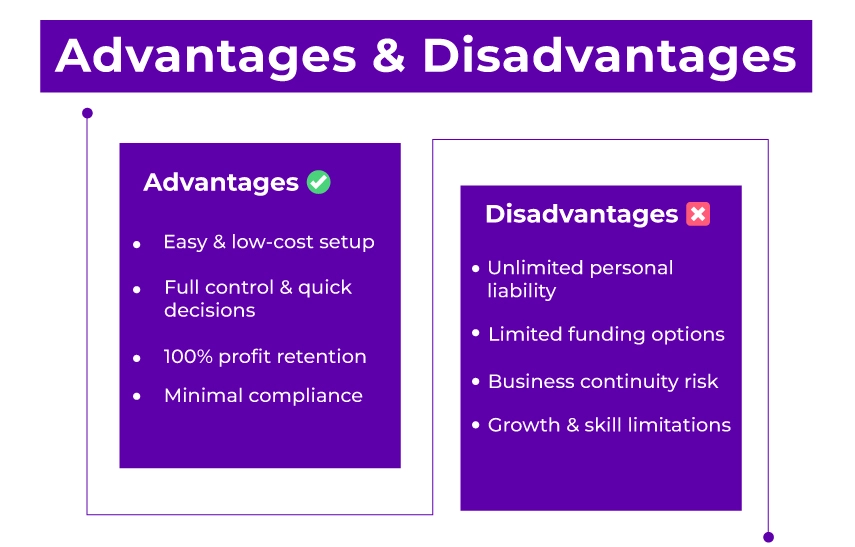
Establishing a proprietorship firm offers several benefits, including quick decision-making power, profit-retention, fewer documentation and legal requirements, and complete control over the day-to-day management and business operations. However, there are some disadvantages to a sole proprietorship firm, such as bearing all the losses and being liable for all the business debts. Here are the advantages and disadvantages of a proprietorship firm:
Apart from all the advantages, there are some disadvantages of a proprietorship firm, which are as follows:
If an NRI wishes to open a sole proprietorship business in India, they need to take prior approval from the government and face complex regulations. They will also have to invest on a non-repatriation basis, meaning the invested funds cannot be transferred outside India, subject to two conditions:
Additionally, if you wish to invest in a sole proprietorship on a repatriation basis, you must seek prior approval from the Reserve Bank of India (RBI). The applications made by an NRI are reviewed by the RBI in consultation with the Indian Government.
Setting up a proprietorship firm offers several advantages, like ease of formation, all profit-retention, fewer legal requirements, flexibility, and decision-making power. However, it also comes with some disadvantages, including unlimited liability, limited capital and resources, less expertise, and potential business continuity risks. You must consider all the factors when choosing a suitable business structure that aligns best with your goals.
Moreover, consider seeking help from an expert at Savetaxs to avoid any legal complications or burdens. At Savetaxs, we have a team of experts who can assist you with selecting the best business structure based on your goals, registering it, and ensuring accuracy throughout. Our experts will guide you through the entire process by offering end-to-end consultation and ensuring compliance with all the legal requirements.
Connect with us now to get expert-backed NRI business solutions.
Note: This guide is for information purposes only. The views expressed in this guide are personal and do not constitute the views of Savetaxs. Savetaxs or the author will not be responsible for any direct or indirect loss incurred by the reader for taking any decision based on the information or the contents. It is advisable to consult either a CA, CS, CPA or a professional tax expert from the Savetaxs team, as they are familiar with the current regulations and help you make accurate decisions and maintain accuracy throughout the whole process.

Mr. Ritesh has 20 years of experience in taxation, accounting, business planning, organizational structuring, international trade financing, acquisitions, legal and secretarial services, MIS development, and a host of other areas. Mr Jain is a powerhouse of all things taxation.
Want to read more? Explore Blogs