
Understanding Everything About Statutory Audit
Read More
The conversion of an LLP to a Private Limited Company is a major shift in any business organization. This shift involves changing the LLP's legal structure from a partnership to a limited liability company, which brings several benefits. One of the main reasons for conversion is to improve the business's operational efficiency and enhance its manageability and flexibility. Furthermore, the conversion helps reduce the tax burden and enhances the company's overall valuation.
In this blog, we will cover the process of conversion of LLP to a private limited company, the required documentation, the benefits, and more.
The following are reasons why NRI business owners must consider switching from an LLP to a private limited company.
These benefits result in the business saving on taxes, improving its financial flexibility, and allowing it to reinvest profits, reward shareholders, and pursue strategic initiatives.
To convert a limited liability corporation into a private limited company, certain criteria must be met.
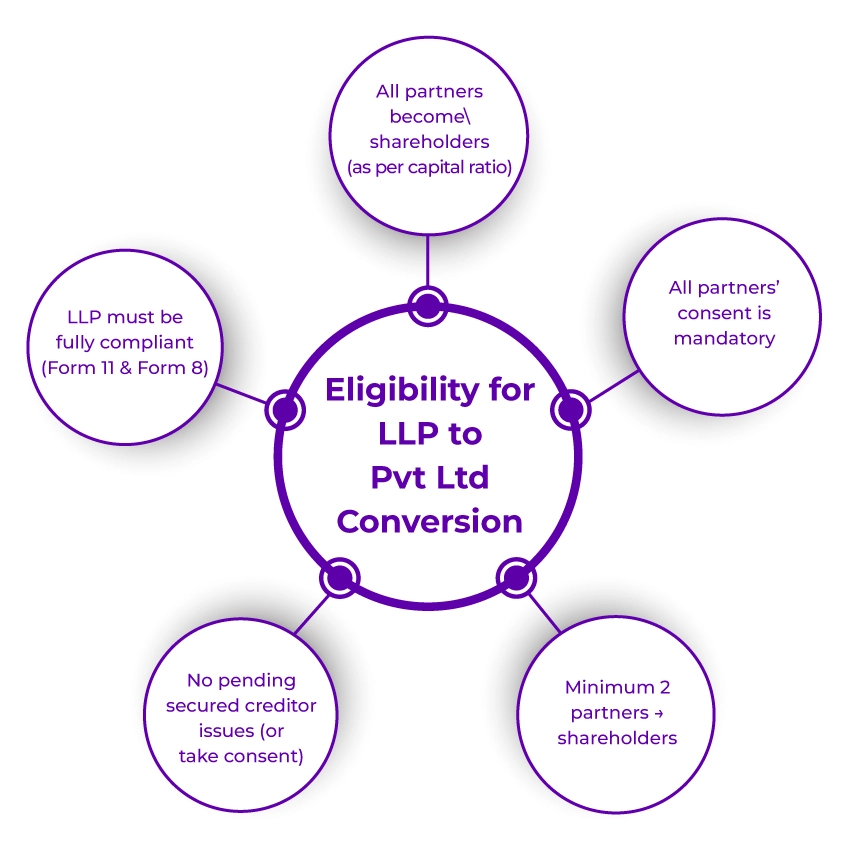
Once all the necessary criteria are met, an LLP may convert into a Private Limited Company in India.
Savetaxs help NRIs file their business taxes with expert assistance.
To convert an LLP into a private company, several legal steps are included; hence, understanding this part is essential. However, it is advisable to seek professional CA assistance when converting an LLP to a Pvt Ltd company to maintain compliance.
For the first step, seek partners' consent. To do so, the firm shall pass a special resolution in a meeting of the LLP's partners agreeing to the conversion. The special resolution must be filed with the ROC (Registrar of Companies) within 30 days of its passing.
Furthermore, every proposed director of the private limited company shall have a DSC and DIN.
The name proposed for the Private Limited company must be applied with the RoC through the SPICe+ (Part A) form or RUN (Reserve Unique Name) service on the MCA portal, and the RoC shall approve it. Once the name is approved, it is valid for 20 days (extendable as per MCA rules), during which the company shall complete its incorporation process.
Once the name is approved, the company shall file the Form URC-1 with the ROC. This form includes all partners' details, the LLP's financial position, the proposed director's name, and a declaration of compliance with relevant laws.
Once the URC form is filed, the firm shall draft the Memorandum of Association (MOA) and Articles of Association (AOA). These documents must outline the objectives of the new company and the regulatory framework governing its operations. These documents must be filed with the ROC.
No objection certificates from all the secured creditors of the LLP must be submitted. This will confirm that these have no objection to the conversion.
The Form INC-32 (SPICe), INC-33, and INC-34 must be filed with the RoC for the incorporation of a new Pvt Ltd company. These forms include information on the company's directors, structure, and registered office.
Once the verified documents are submitted, the ROC issues a certificate of Incorporation to the company. This certificate is your proof of the legal conversion of LLP into a Private Limited Company.
The following is the list of documents required to convert an LLP into a company.
Following the LLP-to-Private Company conversion, the new structure opens the door to exciting growth opportunities; however, it also carries significant compliance and regulatory risks.
The Regulatory & Compliance Framework.
Now that you have converted into a private limited company, you will operate under the Companies Act 2013 regulatory framework. This legislation highlights the various regulators that govern different aspects of your company's operations. The following are some areas to understand.
Corporate Governance: The Companies Act outlines guidelines for holding board meetings at regular intervals, maintaining up-to-date financial records, and adhering to ethical business practices. These corporate governance measures foster accountability and transparency within the company.
Share Capital & Shareholding: The Companies Act 2013 sets out the rules governing the transfer and issuance of company shares. Furthermore, it outlines shareholders' rights, including the right to receive dividends and to vote. There is no minimum paid-up share capital requirement for private limited companies under current regulations.
Filing & Disclosure: Post-conversion, regular annual or event-based filings with the Registrar of Companies (ROC) are mandatory. These filings include the annual financial statement, which provides a transparent overview of the company's financial health, as well as directors' reports and other disclosures.
Taxation: In India, the private limited companies are subject to corporate tax on their profits. However, the applicable tax rate may differ from the individual tax rate that the LLP's partners face. Furthermore, depending on the nature of your business, you may need to comply with other indirect taxes, such as GST (Goods and Services Tax).
There are a range of benefits for converting an LLP into a Private Limited Company.
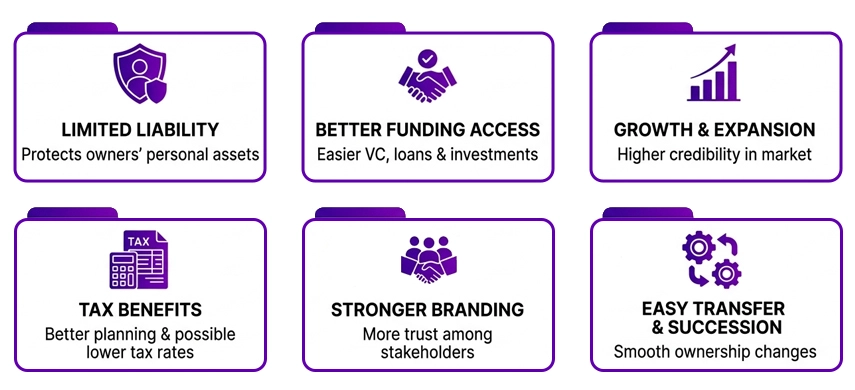
The following scenario-based examples illustrate the need to convert an LLP into a Private Limited Company.
Scenario 1: An NRI entrepreneur is running a tech startup in Mumbai, India, as an LLP. The business is growing well, and the investors are interested.
The problem here is that the LLP cannot issue shares, and the investors want equity participation.
The Solution: The entrepreneur shall proceed to switch from an LLP to a private limited company as an NRI. Post-conversion, the shares can be issued to investors.
In this case, the outcome is that a tech start-up can successfully raise funding and improve its business valuation.
Scenario 2: Expanding The Business Globally. In this case, an NRI entrepreneur owns a consulting LLP serving Indian clients, but now he wants to expand into the US and UAE markets.
The problem here is that the LLP structure isn't preferred globally, and the international clients do prefer the private company structure.
The solution to this problem is for the business partners to switch from an LLP to a private limited company. A Pvt Ltd structure is a well-recognized corporate structure.
The outcome of the case is that, through a private limited structure, the company can gain international clients, improve credibility, and make it easier to handle cross-border contracts.
Scenario 3: Bringing in a Foreign Co-Founder. In this case, an NRI founder wants to onboard a foreign national partner into the business.
The problem here is that LLP, as a business structure, complicates foreign ownership, making overall FEMA compliance difficult.
The solution to this problem is for the NRI founder to initiate a conversion of the Limited Liability Partnership (LLP) into a private limited company. Through a private limited company structure, the NRI can issue equity shares to the foreign co-founder.
The outcome of this case is that, by converting into a private Ltd, the NRI founder can achieve better compliance with FDI rules and create a smooth partnership setup with the foreign national.
Savetaxs helps NRIs avail expert guidance every step of the way.
The conversion of an LLP into a Pvt Ltd company offers an array of advantages for NRI businesses planning to expand their operations or seeking access to new markets. Post-conversion, the business is open to better fundraising opportunities, enhances its credibility in the marketplace, has a flexible ownership structure, and improves corporate governance. Additionally, for NRIs, understanding the differences between an LLP and a private limited company is also important.
The conversion of an LLP into a private limited company also offers tax benefits and improved statutory compliance, helping streamline business operations. However, the conversion involves specific legal steps and documentation requirements; it is advisable for an NRI to seek professional assistance from a CA.
As an NRI, if you are planning to convert your LLP into a private limited company and are seeking expert guidance for the process, Savetaxs is the name to trust. Our team of CA experts provides end-to-end consultation on prerequisites for conversion, the conversion process, document verification, taxation, regulatory compliance, and more.
The experts will ensure a successful conversion and substantial business growth in the future. Connect with us as we serve our clients 24/7 across all time zones.
Note: This guide is for information purposes only. The views expressed in this guide are personal and do not constitute the views of Savetaxs. Savetaxs or the author will not be responsible for any direct or indirect loss incurred by the reader for taking any decision based on the information or the contents. It is advisable to consult either a CA, CS, CPA or a professional tax expert from the Savetaxs team, as they are familiar with the current regulations and help you make accurate decisions and maintain accuracy throughout the whole process.

Mr Shaw brings 8 years of experience in auditing and taxation. He has a deep understanding of disciplinary regulations and delivers comprehensive auditing services to businesses and individuals. From financial auditing to tax planning, risk assessment, and financial reporting. Mr Shaw's expertise is impeccable.
Want to read more? Explore Blogs