India is the fastest-developing economy in the world. It provides several opportunities for entrepreneurs, including NRIs, to set up their business in India. The country offers a perfect blend of economic growth and extensive digital infrastructure, consumer markets, and government support.
Despite this, often NRIs think about whether it is safe for them to start a business in India. Well, yes, for NRIs, it is safe to start a business in India. However, there are certain NRI business rules that they need to follow when starting a business in India. To help you out, this blog discusses the various legal aspects of starting a business in India and managing the funds as an NRI. So read on and gather all the information.
Key Takeaways
- Starting a business in India as an NRI is 100% safe and increasingly attractive, driven by digital infrastructure, favorable government policies, and a growing consumer market.
- NRIs should prepare themselves for different work cultures, including intense competition, managing hiring, and localized marketing needs.
- NRIs can invest in residential and commercial real estate; however, investment in agricultural land, farmhouses, and speculative real estate trading is restricted.
- NRI investments are regulated under FEMA and RBI guidelines. It provides a structured, secure legal structure.
- Investment should be made through NRE/NRO/FCNR accounts. Additionally, the FC-GPR form should be filed with the RBI within 30 days after receiving the funds.
NRI Business Opportunities in India
For an NRI invest in startup in India, there is a plethora of opportunities across various sectors:
- IT and Software Services: Since India is globally popular as an IT powerhouse, this field is highly suitable for NRIs who are inclined towards this stream.
- E-Commerce: In India, the digital marketplace is expanding rapidly. Considering this, many specialized online retailing ventures that NRIs can initiate here successfully.
- Healthcare: In the form of medical tourism, telemedicine, and speciality clinics, there are new opportunities in India to invest in developing healthcare services.
- EdTech: Filling the loopholes of the education system in India using advanced technology tools. Additionally, providing online education applications or platforms.
- Franchise Business: For NRIs who are looking for a proven business model, a franchise business is a safe option. It reduces the risk and offers branding, training, and operational support. It is a good option for NRIs who like structured operations.
- Real Estate and Property Management: Real estate has always remained a strong business sector, specifically in growing cities. Instead of direct selling and buying, NRIs can discover the property management services. With long-term growth, this business provides a steady monthly income.
- Manufacturing Business: Indian government policies such as PLI and Make in India schemes promote the manufacturing sector. NRIs can invest their money in small to medium-sized manufacturing factories. It is an area that offers jobs. Additionally, create assets in the long run.
These are the popular business opportunities available for NRIs in India. However, NRIs are restricted in India from real estate trading, gambling, and agricultural activities. Moving ahead, now let's know the legal framework for NRIs starting a business in India.
Legal Framework for NRIs Starting a Business in India
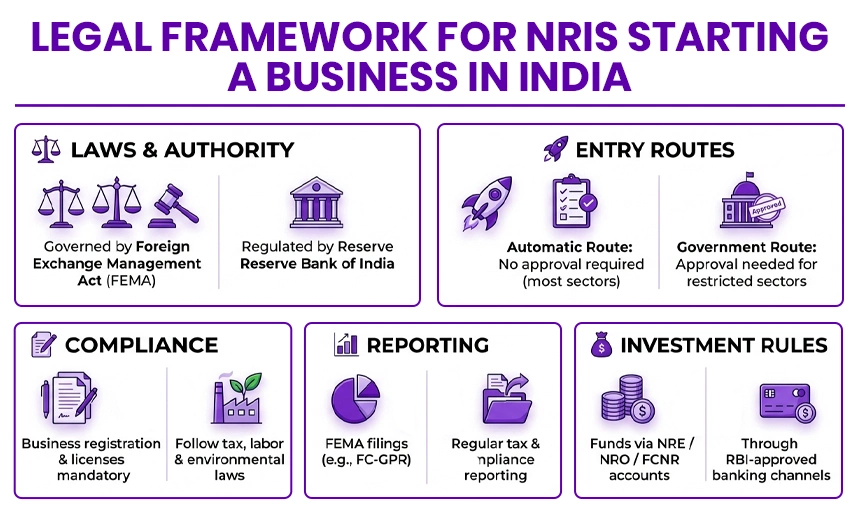
In India, the Foreign Exchange Management Act (FEMA) is considered the centrepiece of NRI business setup in India. Additionally, the Reserve Bank of India (RBI), through its established guidelines, controls all foreign investments. Considering this, some of the key aspects NRIs need to consider while starting a business in India are as follows:
- Entry Routes: It is vital to identify whether the proposed business comes under the following:
- Automatic route where you do not need to take prior approval from the RBI and other regulatory authorities. In e-commerce, 100% FDI is allowed under the automatic route in the marketplace model, while inventory-based models are restricted..
- Government route, where approval from the RBI and other relevant government officials is needed before starting a business. For instance, for infrastructure companies in the securities market, FDI up to 49% is allowed under the automatic route. Additionally, beyond that 49%, NRIs need to take government approval before investment.
- Licenses and Registrations: Before starting a business, NRIs need to obtain a permit and license from the authorities. It will further help in complying with various legislation, including employment, taxation, and environmental laws.
- Reporting Requirements: Depending on the business nature, the relevant startup/business, NRIs need to fulfill various reporting requirements. It includes those under FEMA, tax laws, employment laws, environmental laws, and more.
- Inward Remittance Requirements: All foreign investment transactions in India should be done using Indian banking channels. For instance, funds should come through NRE/NRO/ FCNR bank accounts.
This was all about the legal requirements for NRI business in India. Moving further, let's know the key risks involved for NRI entrepreneurs when starting a business in India.
Key Risks Involved for NRI Entrepreneurs
Here are the NRI business risks to avoid when starting a business in India:
Inadequate Market Research and Business Planning
Entering a new market is more than a general understanding of its economy. It requires an accurate and detailed assessment of market conditions, customer behavior, competition, and regulatory requirements. Without proper market research and business planning, NRIs risk taking incorrect decisions that further lead to wasted resources and time. Considering this, thorough market research allows you to determine regions in India that best match your business idea and tailor your strategy.
Selecting the Wrong Business Structure
When registering a business in India, choosing the right business structure for NRIs is one of the vital decisions. Considering this, some common business structures include:
- Private Limited Company (PLC)
- It is a popular business structure for NRIs seeking a long-term business presence in India.
- Offers limited liability and requires a minimum of two directors (one should be a resident Indian) and two shareholders.
- Ideal for small and medium-sized businesses.
- Limited Liability Partnership (LLP)
- It is a hybrid business structure containing features of companies and partnerships.
- Provide flexibility like a partnership with limited liability.
- Liaison Office
- Generally used for non-commercial activities like coordinating with local vendors, market research, and promoting products of the parent company.
- It cannot generate income in India directly. Additionally, it is limited to communication between the Indian business and the parent company.
- Public Limited Company
- A business that raises business capital from the public.
- It is ideal for larger businesses seeking to go public. Additionally, this business structure has stricter compliance requirements.
- Branch Office
- Allows NRIs to set up a presence in India without setting up a separate entity.
- Primarily, a branch office is used for conducting business activities associated with the operations of the parent company, such as research and liaison.
- It is restricted to engaging in retail or generating revenue alone.
Further, selecting the wrong business structure creates serious legal and financial issues. Additionally, it impacts the ability of the business to efficiently operate and leads to extra costs.
Incorrect or Incomplete Documentation
To comply with both state and central laws, it is vital to have precise documents when incorporating a business in India. Incorrect or missing documentation causes delays in the registration process. Additionally, prevent your business from operating in India. Considering this, the documents required for business generally depend on the business structure.
Overlooking State-Specific Compliance Requirements
India is a diverse and vast country. Additionally, from state to state, the business regulations can vary. Each state has its own licensing requirements, set of rules, and compliance standards. Considering this, some key areas where state-specific compliance is vital include:
- State-Specific Taxation: For local taxes, such as property or stamp duty, every state have their own rules. It further impacts your overall tax obligation.
- GST Registration and Filing: Some states in India have different thresholds and GST registration requirements and filings. Additionally, some regions based on local laws may also have additional rebates or taxes.
- Labor Laws: Across states, regulations surrounding working hours, employee salaries, and benefits may differ. NRIs need to comply with both state and central-level labor laws.
Moreover, non-compliance with state-specific laws can also lead to legal actions, fines, or even business suspension. Additionally, it can also cause delays in construction permits, product launch, or even hiring employees, which further delay entry into the market.
Failing to Obtain Permits and Licenses
Starting a business in India as an NRI requires compliance with several regulatory and licensing requirements. NRIs should ensure they obtain all the vital permits and licenses to avoid legal issues. Considering this, some mandatory permits and licenses include:
- FDI approval: For NRIs looking to invest in India.
- Environmental clearance (if applicable): For business sectors like manufacturing, waste management, or energy.
- GST registration: For any business engaged in the sale of goods or services in India.
- ISO certification (if applicable): Required for industry credibility and compliance for certain sectors, such as in food production.
- Shops and establishments license: Mandatory for businesses that work in a commercial establishment, including offices, retail outlets, and service providers.
- Professional tax registration: Applies to directors or employees of the company in certain states in India.
- Import-Export Code (IEC): If NRIs plan to engage in export or import activities, they need to get an IEC from the Directorate General of Foreign Trade (DGFT).
This was all about the NRI business challenges when starting a business in India. You can avoid all these risks by taking the help of business experts. Moving forward, let's know the benefits of starting a business in India for NRIs.
Benefits of Starting a Business in India for NRIs
The business startup scene of India is on fire. The country has ranked as the third-biggest startup hub in the world. Here is why India is an ideal place for NRIs to start a business:
- Growing Economy: The GDP growth rate of India consistently grows more than the global average.
- Government Support: Initiatives introduced by the government, like "Startup India," provide simple compliance and tax benefits.
- Diverse Market: With around 1.4 billion people, the market of India has almost everything for everyone.
- Familiar Culture: NRIs can leverage their knowledge of both Indian and global markets when starting a business in the country.
- Tech-Savvy Workforce: Offers a large pool of skilled experts.
- Low Operational Cost: The operational cost of India when starting a business is low compared to other countries.
- Simple Tax System: A concessional corporate tax rate of 15% is available for new manufacturing companies, subject to specific conditions. It is for companies setting up a manufacturing base in the country (subject to conditions). Additionally, it has a double taxation avoidance agreement (DTAA) with most countries in the world, which helps in avoiding paying double taxes on the same income.
These are some of the key benefits for NRI businesses in India. Moving ahead, let's know the compliance, taxation, and FEMA regulations for NRI businesses in India.
Compliance, Taxation, and FEMA Regulations
Compliance, Taxation, and FEMA regulations for NRI business in India are as follows:
Key FEMA Compliance Points
Here is the list of FEMA rules for NRI business:
- NRIs are allowed to invest in India under the automatic route or the approval route.
- NRIs should follow sector-specific FDI caps.
- Form FC-GPR filed within 30-days after receiving the funds, with the Reserve Bank of India (RBI).
- Funds should come through NRE/NRO/FCNR accounts.
- Mandatory to file an annual FLA return.
Non-compliance with these rules can lead to serious penalties under FEMA regulations.
Tax Compliance Requirements
Tax compliance is one of the most vital areas that NRIs need to consider when starting a business in India. Additionally, NRIs should consider both Indian tax laws and resident country tax laws. It includes:
- PAN card mandatory for shareholders and directors.
- Advance tax applicability.
- Every year need to file corporate tax.
- Transfer pricing (if applicable).
- Withholding tax (TDS) compliance.
Further, proper tax planning ensures smooth repatriation of profit.
GST Registration and Indirect Tax Compliance Requirements
If your business supplies goods or services in India, it is mandatory to register under GST. Considering this, GST compliance essentials are as follows:
- GST registration within the threshold limits.
- Quarterly or monthly returns.
- Proper input tax credit management.
- For eligible entities, E-invoicing is available.
Non-compliance with GST rules can cause penalties. Additionally, it also blocked working capital.
Final Thoughts
Lastly, from the blog, it is clear that it is safe for NRIs to start a business in India. It provides them with different business opportunities. However, the success of it depends on correct business planning and strict compliance. Considering this, as an NRI to start a business in India, you need to select the right business entity, understand business requirements, and navigate legal and FEMA regulations.
Further, with proper business planning and expert support, NRIs can set up profitable enterprises. Savetaxs works as a reliable partner that helps NRIs navigate complex regulations to achieve success. So connect with us and smoothly start your business journey as an NRI in India.