
What is DIR-3 KYC for Directors and NRI Directors?
Read More
Under Section 8 of the Companies Act 2013, NRIs and foreign citizens can register an NGO in India. When appointing directors, NRIs must include at least one Indian citizen to comply with the Foreign Contribution Regulation Act (FCRA) requirements for obtaining tax exemptions under sections 80G and 12A and to facilitate foreign funding.
In this blog, we will explore how NRIs can register an NGO in India, covering the legal framework for NRIs, a step-by-step approach to NGO registration, an NGO registration checklist, and more.
NRIs who wish to contribute to India's social causes must register an NGO in India. The process for NGO registration involves obtaining approval from the Ministry of Corporate Affairs (MCA), completing documentation, adhering to CSR (corporate social responsibility), and tax compliance rules.
Understanding the process and the legal framework can make your NGO registration process reliable and seamless.
An NGO seeking formal recognition as a non-profit organization in India must follow the route of Section 8 Company Registration. This structure permits them to operate in India without prior distribution, build credibility, and enjoy tax benefits.
Key Law Authorities Involved Here Are:
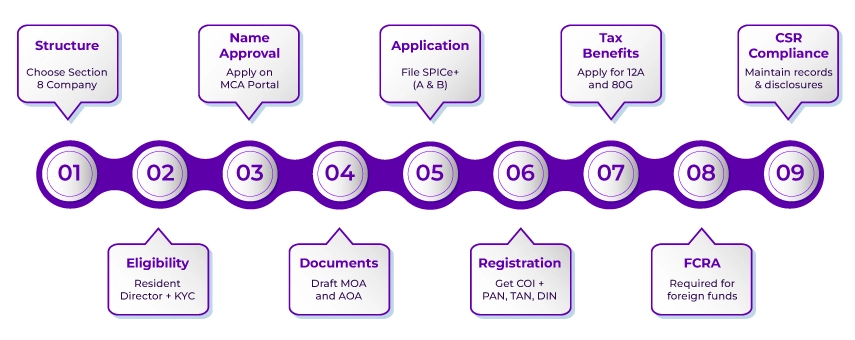
The following is a step-by-step guide to registering an NGO in India as an NRI or foreign national. It is advisable for NRIs to seek assistance from a CA when registering an NGO in India, as they ensure 100% compliance and accuracy throughout the process.
For an NRI seeking to register an NGO in India, a Section 8 company is ideal, as it is recognized nationally and provides better legal clarity than societies and trusts, which can vary from state to state.
As an NRI, you will be required to have at least one resident director is required as per MCA guidelines. Next up, as per the Ministry of Corporate Affairs, provide the valid ID proof, address proof, and additional KYC documents.
To apply for NGO name approval, use the MCA portal. Ensure that the name reflects the organization's charitable objectives and does not resemble any other existing entity.
Next, you will be required to draft the Memorandum of Association (MOA) and Articles of Association (AOA) stating your organization's non-profit goals. Having an MOA and an AOA is mandatory for the MCA review.
Submit the SPICe+ (Part A & Part B) forms along with AGILE-PRO-S and INC-13 for Section 8 company registration.
Once you receive the COI along with Section 8, the license approval will be provided, along with the DIN, TAN, and PAN of the organization's directors.
You can apply under the Income Tax Act for section 12A ( income tax exemption) and the section 80G (donor benefits) registration. This is generally done to attract the corporate donors and the CSR partnerships along the way.
FCRA registration with the Ministry of Home Affairs is mandatory if the NGO is planning to get. This process can generally take several months; it is advisable to apply early.
If the NGO plans to receive CSR (Corporate Social Responsibility) funds, the organization must maintain accurate reports and accounts and disclose in accordance with the CSR regulatory framework set out in the Companies Act.
The following are some avoidable mistakes you might end up committing, which will, in turn, delay the registration process or incur penalties. Henceforth, taking proactive measures here is the key.
The following table demonstrates an NGO registration checklist for NRIs and foreign nationals.
|
Task |
Details |
Tips |
|---|---|---|
|
Indian Resident & Directors |
At least one Indian resident is mandatory |
Choose someone who is trusted and follows compliance. |
|
Name Approval |
Apply via the MCA portal for NGO name approval. |
Check for the already existing names before submission. Pick a name that's unique and reflects the charitable objective of the NGO. |
|
MOA and AOA Drafting |
Draft the MOA and AOA accurately and clearly, and define your NGO objectives here. |
Consult a legal expert to ensure 100% compliance. |
|
Filing of the incorporation Form |
File the incorporation form along with the documentation and declarations. |
Review all the attachments carefully before filing. |
|
12A and 80G and NGO DARPAN portalRegistrations. |
Apply for certain tax benefits with the Income Tax Department. |
Prepare the audited account before the application. |
|
FCRA Registrations |
Having FCRA registration is mandatory if the NGO is receiving foreign donations. |
Apply regularly; approval often takes 6-9 months. |
|
CSR-1 Registration & Compliance. |
Apply for CSR-1 and keep the CSR-related documents for the donors. |
NRIs shall follow the MCA reporting standard for each financial year. |
Get expert consultation on NRI Business Solutions 24/7 across all time zones.
Stating an NGO in India as an NRI is not only legally permissible but also strongly encouraged when done right. However, as an NRI, you must follow the proper registration process and obtain the approval under Section FCRA, Section 8, Section 12A, and Section 80G in a timely manner.
As an NRI, if you are planning to register an NGO in India and seeking professional assistance for the same, Savetaxs is the name to trust. Our experts provide end-to-end consultation on legal, administrative, and compliance matters to operate the NGO formally, on fundraising, and to achieve tax exemption status.
Our CAs will furthermore assist NRI in choosing the appropriate structure for the NGO that is a trust or a section 8 company, provide consultation on drafting the MOA, AOA, bylaws, and trust deeds, along with advisory on regulatory filing, post-registration support, and more.
Note: This guide is for information purposes only. The views expressed in this guide are personal and do not constitute the views of Savetaxs. Savetaxs or the author will not be responsible for any direct or indirect loss incurred by the reader for taking any decision based on the information or the contents. It is advisable to consult either a CA, CS, CPA or a professional tax expert from the Savetaxs team, as they are familiar with the current regulations and help you make accurate decisions and maintain accuracy throughout the whole process.

Mr Manish is a financial professional with over 10 years of experience in strategic financial planning, performance analysis, and compliance across different sectors, including Agriculture, Pharma, Manufacturing, & Oil and Gas. Mr Prajapati has a knack for managing financial accounts, driving business growth by optimizing cost efficiency and regulatory compliance. Additionally, he has expertise in developing financial models, preparing detailed cash flow statements, and closing the balance sheets.
Want to read more? Explore Blogs