
A Compliance Guide for ROC Filings in India: 2025-26
Read More
Passed on 29 August 2013 and coming into effect on 1 April 2014, the Companies Act 2013 brought a major shift in how businesses operate in India. It replaced the old Companies Act, 1956. Additionally, introduced modern corporate governance, accountability, and transparency standards aligned with global best practices.
Further, the Companies Act 2013 also focuses on protecting the interests of all stakeholders and promoting better corporate governance. Also, it makes doing business in India simple and focuses on ethical conduct, investor protection, and sustainable practices. Apart from this, the act has been updated over time to meet evolving global standards and business needs.
Want to know more about the Companies Act 2013 in detail? Read the blog and get all the information.
The Companies Act 2013 is a comprehensive legislation passed by the Indian Parliament. The act was introduced to govern and regulate the incorporation, functioning, and dissolution of companies in India. It replaced the Companies Act of 1956. Additionally, it aims to ensure accountability and enhance transparency within the Indian corporate sector.
It also establishes a legal structure and guidelines on several aspects, such as the rights and duties of shareholders and directors, the incorporation process, mergers and acquisitions, and more. To match modern business practices, it also introduced new concepts like corporate social responsibility (CSR), one-person company (OPC), and stricter compliance requirements.
This was all about the Companies Act 2013. Moving ahead, let's know the key highlights of the act.
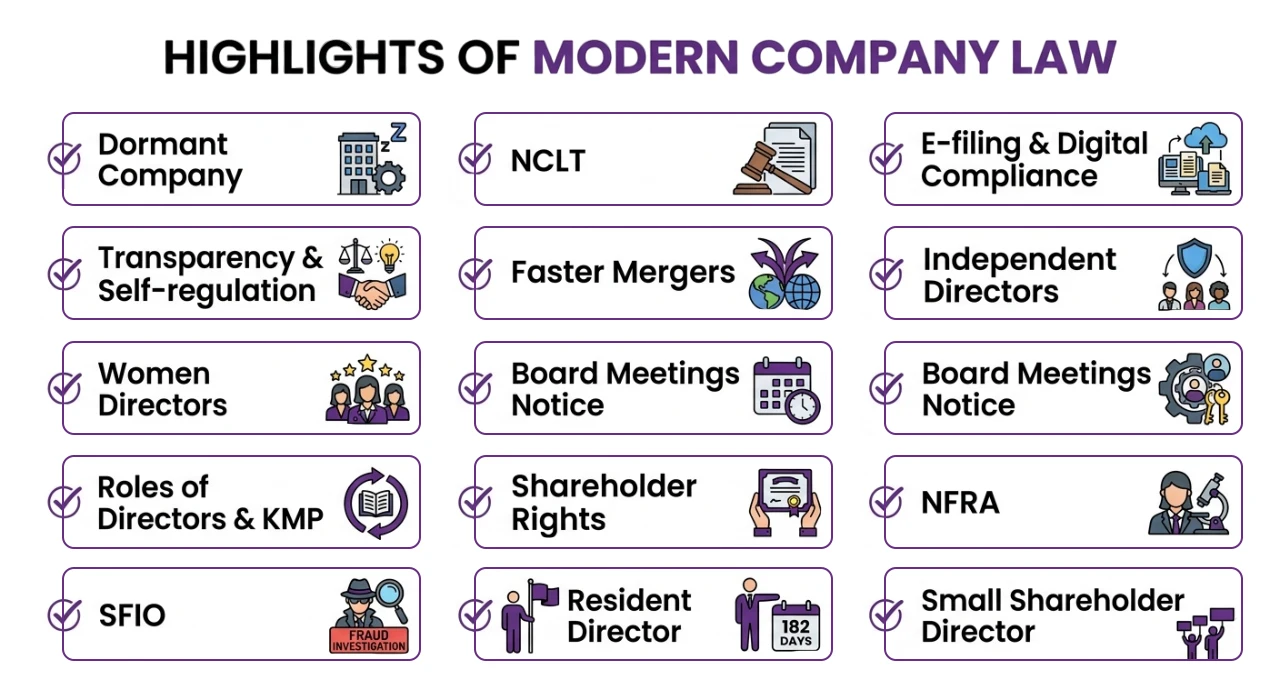
The key highlights of the Companies Act 2013 are as follows:
Moreover, under section 135 of the Companies Act 2013, India is among the first major economies to mandate CSR spending under law.
These are the key highlights of the 2013 Act. Moving further, let's know the salient features of the Companies Act 2013.
The salient features of the Companies Act 2013 are as follows:
These are some of the key features of the act. Moving forward, let's know the types of companies under this act.
Types of Companies under the Companies Act 2013 are as follows:
|
Type of Company |
Key Characteristics |
Minimum Requirements |
|---|---|---|
|
Private Limited Company |
Transfer of shares is restricted, cannot invite public subscription, and is limited to 200 members. |
2 Directors and shareholders |
|
Public Limited Company |
Allow transfer of shares freely, and can also invite the public to subscribe. |
3 Directors and 7 shareholders |
|
One Person Company (OPC) |
It is a single-member company with a nominee. Additionally, provide limited liability benefits. |
1 Director and member |
|
Producer Company |
This company is established for primary producers like artisans and farmers. It engaged in activities such as production, livestock, or associated activities. |
5 Directors, 10 members, or 2 producer institutions |
|
Section 8 Company |
Formed for non-profit or charitable objectives. Additionally, it reinvests the profits to fulfill its objectives, |
2 Directors (private)/ 3 directors (public) |
|
Dormant Company |
An inactive company that holds intellectual property and assets. |
According to the original classification. |
These are the different types of companies stated under the Companies Act 2013. Moving ahead, let's know the difference between the Companies Act 2013 vs. Companies Act 1956.
The table below covers the key differences between the Companies Act 2013 and the Companies Act 1956:
|
Companies Act 2013 |
Companies Act 1956 |
|---|---|
|
The Companies Act 2013 consists of 29 chapters, 470 sections, and 7 schedules. |
The Companies Act 1956 consists of 13 parts, 26 chapters, 658 sections, and 15 schedules. |
|
Under this, the maximum number of shareholders in a private company is 200. |
Previously, under this act, the maximum number of shareholders in a private company was stated at 50. |
|
This act allows a subsidiary in the holding company to hold shares as a trustee. |
This act does not allow a subsidiary to hold shares of a holding company. |
|
This act introduced the concept of a one-person company. |
It does not mention one person company. |
|
Under this act, the Indian government can state the types of companies that can issue a shelf prospectus. |
Only scheduled banks, public financial institutions, or public sector banks were allowed to issue the shelf prospectus. |
These are the key differences between the Companies Act 2013 and the Companies Act 1956. Moving further, let's know the major amendments to the act.
Since 2013, several changes have been made in the Companies Act 2013. The amendments stated in this aim to ease business, improve compliance, and reduce punishments. Further, let's know the major amendments to the act.
These are some of the major amendments made to the Companies Act 2013 in recent years. Now, moving forward, let's know the rules and regulations stated under this act for company incorporation.
The rules and regulations stated under the Companies Act 2013 for the incorporation of a company are as follows:
Further, once you complete the mentioned information, to submit the forms, MOA, and other documents, log in to the web portal.
So, this is how you can incorporate your company under this act. Moving ahead, let's know the important sections stated under this act.
Important sections covered under the Companies Act 2013 are as follows:
|
Sections |
Description |
|---|---|
|
Section 73 |
|
|
Section 135 |
|
|
Section 139 |
|
|
Section 180 |
|
|
Section 185 |
|
|
Section 186 |
|
|
Section 188 |
|
|
Section 189 |
|
|
Section 197 |
|
This was all about the key sections included under the Indian Companies Act, 2013.
With Savetaxs at the touch of a button, get expert NRI business consultancy
Lastly, the Companies Act, 2013, plays an essential role in shaping the Indian business environment. The act certifies that companies operate with responsibility, discipline, and transparency. Additionally, with regular updates, the act continues to support and evolve business growth.
Further, if you are an NRI seeking assistance to set up a company in India, contact Savetaxs. Our experts provide end-to-end consultation on the company for NRI clients, ensuring 100% compliance with MCA, RBI, and FDI regulations. Connect with us and grow your business in India.
Note: This guide is for information purposes only. The views expressed in this guide are personal and do not constitute the views of Savetaxs. Savetaxs or the author will not be responsible for any direct or indirect loss incurred by the reader for taking any decision based on the information or the contents. It is advisable to consult either a CA, CS, CPA or a professional tax expert from the Savetaxs team, as they are familiar with the current regulations and help you make accurate decisions and maintain accuracy throughout the whole process.

Mr Manish is a financial professional with over 10 years of experience in strategic financial planning, performance analysis, and compliance across different sectors, including Agriculture, Pharma, Manufacturing, & Oil and Gas. Mr Prajapati has a knack for managing financial accounts, driving business growth by optimizing cost efficiency and regulatory compliance. Additionally, he has expertise in developing financial models, preparing detailed cash flow statements, and closing the balance sheets.
Want to read more? Explore Blogs