
SPICe+ Form: A Master Guide
Read More
Repatriating business profits from India to NRIs' home country involves tax compliance, repatriation limits, and documentation. While the process is straightforward, NRIs must ensure they can generally repatriate up to USD 1 million per financial year from their NRO account, subject to applicable taxes and documentation requirements.
In this blog, we will discuss all aspects of profit repatriation for NRIs from their Indian business ventures, including the roles of FEMA and RBI in the process, the types of income NRIs can repatriate, step-by-step processes, and more.
NRIs have to adhere to the repatriation limits imposed by the RBI. The limit is that the profits from the NRO account of USD 1 million per fiscal year can be repatriated. An NRE account is fully repatriable with no limits.
Best practices for a seamless repatriation process include NRI maintaining detailed documentation of business operations, planning ahead, understanding the DTAA tax treaty benefits, and taking professional advice.
Key requirements for profit registration include Form 15CA, Form 15CB, documentation of tax payments, and use of an Authorized Dealer.
In simpler terms, repatriation is the process by which companies or individuals transfer their foreign earnings or financial assets (in this case, India) back to their resident or home country. For an NRI business owner, it means transferring the profits earned by their Indian company, proprietorship, or partnership, which are in INR, to their bank account in the UK, UAE, USA, or any other country of residence.
This entire process is governed by the Indian authorities to manage foreign tax revenue and ensure that domestic tax liabilities on the income are settled before it is repatriated.
The Foreign Exchange Management Act (FEMA), 1999, regulates foreign exchange transactions in India to encourage external trade and operations while ensuring and promoting an orderly foreign exchange market.
Governing foreign transactions: FEMA governs all current account transactions, such as trade payments, travel, and education, as well as capital account transactions, including foreign exchange.
Encourages Trade: FEMA helps streamline export, import, and foreign-currency-holding procedures. This helps in easier cross-border business transaction execution.
Compliance: The FEMA Act imposes penalties, including fines up to three times the amount involved, for any non-compliance or contravention. This helps the Act ensure accountability in foreign exchange dealings.
In a nutshell, the Foreign Exchange Management Act (FEMA) is the primary legislation in India that regulates the repatriation of foreign exchange to ensure the seamless movement of funds between foreign and resident countries.
RBI (the Central Bank of India) plays an essential role in regulating and facilitating the repatriation of profits by NRIs under FEMA. The RBI guidelines ensure that all cross-border transfer of business income is legally compliant, transparent, and executed seamlessly.
The Repatriation Limits: NRIs can remit up to USD 1 million per financial year from NRO accounts after tax compliance, while funds in NRE/FCNR accounts are freely and fully repatriable if sourced from foreign income.
Compliance Requirement: NRIs are required to submit Form 15CA and Form 15CB to certify that applicable taxes on business profits, capital gains, and dividends have been duly paid.
Role of Banks: RBI-authorized AD banks often act as intermediaries, verifying documents, ensuring FEMA compliance, and processing international fund transfers seamlessly.
Regulation Framework: The RBI enforces strict KYC and AML guidelines to ensure no illegal transactions happen and that only business earnings are repatriated.
The following are the types of income NRIs can repatriate from India.
Dividend Income: If any NRIs hold shares in an Indian company, they might receive dividends from the same. These dividends can generally be repatriated freely, provided the applicable domestic taxes on them are paid.
Profit From Partnerships Firms & Profits From LLP: NRIs who are partners in partnership firms or limited liability partnerships in India are entitled to receive profit distribution. These profits can be transferred abroad after fulfilling FEMA and tax compliance requirements.
Sale Proceeds From Business Assets: NRIs can repatriate proceeds generated from selling
However, NRIs must ensure that the applicable capital gains taxes for each are paid before repatriation.
Interest or Business Income: Any income earned from business activities, interest, consulting services, or other services provided in India by an NRI can also be transferred abroad, provided the tax on it has been paid.
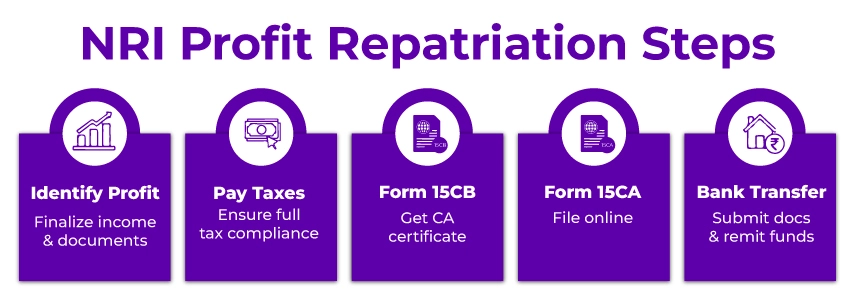
The following are the practical, actionable steps that you must take to repatriate profits from your indian business to your residential country.
To start strong, first you need to clearly determine the funds you want to repatriate. Is it the dividend payment from one of your private limited companies in India, or is it the profit distributions from the LLP or partnership firm? As an NRI, you have to get your business finances finalized, the profit and Loss account, and the balance sheet ready. Such documents will clearly outline the net profit available for you to repatriate and withdraw.
This is one of the most critical and non-negligible steps in the entire profit repatriation process. As an NRI, you aren't permitted to repatriate any amount from India unless all the tax dues on that amount have been fulfilled. This is because the Indian government wants to ensure that, before any money leaves the country, the applicable domestic tax is collected. This process of tax compliance involves multiple tax oblogantion sucha s
Corporate / Business Tax: NRIs must ensure that their company or firm has paid its annual corporate or income tax on the profits earned.
Personal Income Tax: Any profit distributed to you is your income. As an NRI, you are required to file your income tax return in India and pay the tax due on your income.
Tax Deducted At Source (TDS): If any payment made to you is subject to TDS, such as dividends or interest, please ensure that the paying entity has deducted the TDS beforehand and deposited it with the Income Tax Department of India.
GST and other dues: NRI must ensure that their indian business venture is in compliance with all its Goods and Services Tax (GST) and other statutory obligations. For any indian business venture profit repatriation, compliance with GST is a prerequisite, and any outstanding dues regarding the same are a red flag.
Once the taxes on the profits you intend to repatriate are paid, get in touch with a professional CA. You will need the CA to issue Form 15CB. This is an unavoidable step if you remit excess over a set threshold. The CA will conduct due diligence by reviewing legal documents, such as your business financials, your personal tax return, proof of tax payments, declarations, and so on.
The CA issue certificate will validate that the amount that is being remitted has been computed accurately, and applicable taxes have been paid, considering any DTAA benefits.
Step 4: File Form 15CA Online.
Once you get Form 15CB, you will proceed to file for Form 15CA on the income tax e-filing portal. You are required to use the Unique Documents Identification Number (UDIN) generated by the CA for the Form 15CB to fill out Party C of Form 15CA. Once the form is accurately filed, the authorized system will generate an acknowledgment receipt. This receipt is an essential document that you must submit to your Bank. This step is done to formally notify the ITD of your intention to remit funds abroad.
The last step in the profit repatriation process is to approach your bank (which must be an authorized dealer for foreign exchange) to execute the money repatriation. As an NRI, you are required to submit a set of documents to them to process the international wire transfer.
The following is the list of documents that might vary between banks.
The type of bank account they use in India plays a significant role in repatriation. For NRIs, there are two primary types of accounts: Non-Resident Ordinary Account and Non-Resident External Account. Each account has different features and rules regarding repatriability.
| Feature | NRO (Non-Resident Ordinary) Account | NRE (Non-Resident External) Account |
|---|---|---|
| Purpose | To manage any income earned in India, such as business profits, dividends, rent, pensions, and so on. | To park foreign-earned remittances in India. |
| Currency | Maintained in Indian Rupees (INR). | Maintained in Indian Rupees (INR), but the the depsotis ar emade inforeign currency. |
| Taxability | Interest earned is taxable in India (TDS is applicable). | Principal and the interest earned are completely tax-free in India. |
| Repatriablity | The funds are repatriable subject to limits and conditions. | Funds, both the principal and the interest, are freely repatriable. |
| Profit Deposit | This is the account where your Indian business profits will be deposited. | NRIs cannot deposit their INR business profits into an NRE account, as it is exclusively for foreign earnings. |
In a nutshell, for NRI bysjess prfit repatriation, the income is first credited to your NRO account. After the deposit, you can repatriate the funds directly or transfer them to your NRE account (up to a certain limit) for easier repatriation.
Planning to run a business in India? Get expert-backed NRI business solutions from Savetaxs experts.
Running a successful business in India as an NRI, or NRI invest in startup in India, is a big achievement. However, the financial step of this achievement is to ensure that you can access those business profits in your country of residence as well. However, the process to repatriate business profits involves strict adherence to FEMA regulations and applicable indian tax laws.
NRIs must follow the repatriation rules strictly to ensure a seamless process. As an NRI, if you are planning to repatriate your business profits from India to your country of residence and are seeking professional guidance to do the same, Savetaxs is the name to trust. Our experts will consult with you on facilitating an orderly transfer of business profits from India to your country of residence. From documentation and compliance to fund verification and tax advisory, Savetaxs ensures your funds are repatriated smoothly.
Connect with us as we serve our clients 24/7 across all time zones.
Note: This guide is for information purposes only. The views expressed in this guide are personal and do not constitute the views of Savetaxs. Savetaxs or the author will not be responsible for any direct or indirect loss incurred by the reader for taking any decision based on the information or the contents. It is advisable to consult either a CA, CS, CPA or a professional tax expert from the Savetaxs team, as they are familiar with the current regulations and help you make accurate decisions and maintain accuracy throughout the whole process.

Mr Shaw brings 8 years of experience in auditing and taxation. He has a deep understanding of disciplinary regulations and delivers comprehensive auditing services to businesses and individuals. From financial auditing to tax planning, risk assessment, and financial reporting. Mr Shaw's expertise is impeccable.
Want to read more? Explore Blogs