
_1773060834347.webp&w=828&q=75)
Public Company - Types, Benefits, Registration & More
Read More
For any limited liability partnership (LLP) operating in India, filing the LLP annual return is mandatory for maintaining business compliance. Filing the LLP return ensures the business is operating in compliance with its legal obligations, including supporting transactions, registrations, and tax filing practices. Current regulations and statutes in the Indian business sector have made it more important than ever for LLPs to comply with requirements.
In this guide, we will talk about the concept and process for filing LLP returns while keeping the focus on Form 11, including what LLP return filing is, types of returns that an LLP should file, a step-by-step guide to complete the annual return, required documents, penalties, and mistakes to avoid, and so on.
An LLP annual return filing requires LLPs registered in India to submit all financial and management information to the Ministry of Corporate Affairs (MCA). Ensure that all registered LLPs in India are required to file their annual LLP returns, regardless of whether they have incurred losses or generated revenue.
Form 11 is also known as the Annual Return of Limited Liability Partnerships (LLP). It is an essential compliance document required to be filed annually by every LLP registered in India.
Form 11 provides the Ministry of Corporate Affairs (MCA) with essential information about the LLPs.
Every limited liability partnership (LLP) registered in India, regardless of its turnover or business activities, is required to file Form 11 annually. In fact, LLPs that haven't commenced any business operation or have zero turnover are also required to comply with the requirements.
In case of non-compliance and failure to file Form 11, penalties apply; henceforth, timely filing of Form 11 is crucial.
The following are the key sections and information required to be filled in Form 11:
We help NRIs simplify their business tax return filing procedure.
Filing Form 11 isn't a complicated affair if you break it down into simple, systematic steps. The following is a step-by-step approach to Form 11.
Before initiating the filing process for Form 11, prepare all required documents and supporting information. Such as:
While gathering the required details and information, please ensure that all of them are accurate and up to date.
Log in to the Ministry of Corporate Affairs (MCA) portal using your credentials. However, ensure that your LLP registration details are up to date and accurate. Check that your profile and the DSC are active, as both are required to sign and upload the forms.
The Ministry of Corporate Affairs (MCA) portal is an official gateway for all compliance activities related to the annual return filings.
Selecting the right form is important. Hence, for the annual return filing, download Form 11 from the LLP Forms section.
Whereas for the Statement of Account and Solvency, download Form 8.
Please ensure that you use the latest version available on the MCA portal. This way, you will be updated with the current filing rules.
Form 11 (Annual Return)
This includes:
Form 8 (Statement of Account & Solvency)
This includes:
While you are at this step, please be very careful with every detail in order to avoid errors, delays, and penalties.
In the next step, you are required to attach all the necessary documents, such as:
Once all the documents have been uploaded, pay the ROC filing fee depending on your LLP's total capital. It is advisable to check out the total LLP fees before filing.
Once the form is filled, check it thoroughly and verify every piece of information or detail you have entered. The final steps in the process involve you signing the form digitally. To sign the form, ensure that the Digital Signature Certificate (DSC) you have used matches the one registered with the Ministry of Corporate Affairs.
Once the form is signed electronically. The MCA portal will receive an acknowledgment receipt that acknowledges that your return has been filed successfully. Save the receipt as proof of compliance and for your future records.
Form 11 filing due date is 60 days from the closure of the financial year. Now that the financial year ends on March 31, the deadline for filing Form 11 is May 30th each year.
Due to any circumstances, failure to file Form 11 by the due date attracts penalties. With respect to the recent amendments made to the Limited Liability Partnership Act 2008, the penalty for late filing is INR 100 per day, with no upper limit. The penalty is immediately effective from the day after the due date until the date the form is filed.
A small error is enough to reject or delay your LLP return filing process. Hence, here are some common mistakes to avoid.
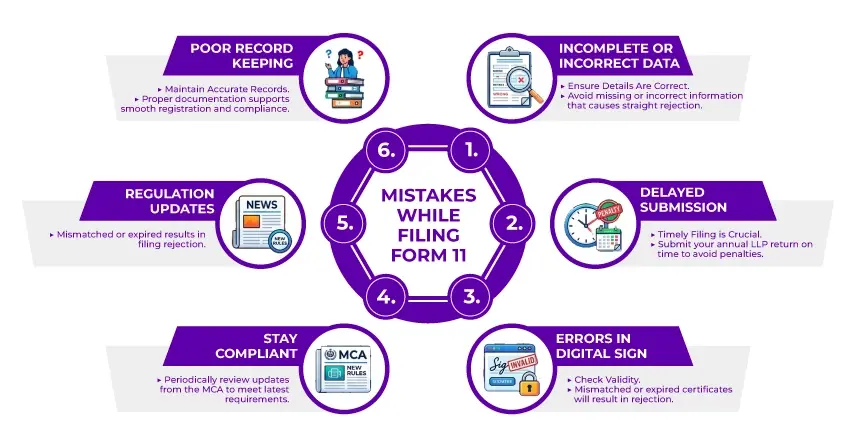
Incomplete or Incorrect Data: Once all the sections of the form are filled, ensure that the details entered are accurate. Missing or incorrect information will result in the return being rejected straight away.
Delayed Submission: This is one of the most common issues. Timely annual LLP return filing is crucial to avoid penalties.
Errors in Digital Signature: Make sure that the digital signature used is valid and correctly applied. Any mismatch found or expired digital signature certificate can result in the rejection of your filing.
Ignoring Regulations Updates: Regulatory guidelines governing the LLP annual filing are subject to change. Hence, it is advisable to periodically review updates from the MCA to ensure your filing process meets the latest requirements.
Poor Record-Keeping: If the firm's financial and the partners' records are not maintained accurately, it can lead to discrepancies during the filing process. Henceforth, proper documentation supports smooth registration and seamless compliance.
As a partner in a limited liability Partnership, being mindful of these common pitfalls is imperative for an error-free annual filing experience and maintaining your LLP's good standing with the authorities.
Savetaxs provides 24/7 expert consultancy tailored for NRIs.
The following are the benefits of accurately and timely filing your returns.
No Penalties: When you file your LLP annual return within the stipulated time, it prevents any imposition of penalties.
Compliance: Timely and accurate filing ensures compliance with the Limited Liability Partnership Act, 2008.
Better Corporate Governance: Filing LLP returns in a timely and accurate manner demonstrates good corporate governance practices.
Enhances Credibility: When your returns are accurately filed by the due date, this practice, over time, enhances your limited liability partnership's credibility with stakeholders, including lenders, investors, and customers.
Easy Access to Funding: Facilitates easy access to funding and other financial resources.
Form 11 primarily focuses on the partnership details and the organizational structure; however, it is important to remember the interplay with Goods and Services Tax (GST) compliance. You must ensure that your GST returns are accurately filed and are reconciled with your financial records.
Furthermore, the information reported in your Goods and Services Tax Return should align with the financial data disclosed in Statement of Accounts and Solvency (Form 8), which is a requirement for filing Form 11.
The following table clearly states the difference between Form 8 and Form 11.
| Feature | Form 11 (Annual Return) | Form 8 (Account & Solvency) |
|---|---|---|
| The Purpose | Provides information on the LLP partners, compliance, and contributions. | Declaration of the firm's turnover, assets, liabilities, and financial positions. |
| Due Date | May 30th (within 60 days of financial year end) | October 30th (within 30 days of 6 months from the end of the financial year). |
| Contents | The form contains partner details, body corporate partners, and changes in structure. | Statement of Assets and Liabilities and Expenditure. |
| Applicability | Mandatory for all LLPs | Mandatory For All LLPs. |
| Penalty | Rs 100 per day for the delay. | Rs 100 per day for the delay. |
The following are the important dates of LLP annual return filing
| 30 May | Form 11 (Annual Return) | Summary of management affairs LLP (number of LLP partners along with their names). |
|---|---|---|
| 31 July | Income Tax Return | Applicable for the LLPs that are not required to do an audit. |
| 30 Sep | Income Tax Return | Applicable for LLPs required to do a tax audit. |
| 30 Oct | Form 8 (Accounts) | Details about the profit made and other financial records or data. |
Filing your LLP return using Form 11 is more than a statutory obligation. It is an essential set of requirements aimed at ensuring that an LLP operates in compliance with Indian business law. When you follow the aforementioned steps, maintain the records accurately, stay updated with the LLP regulations changes, and ensure timely and accurate filing, this helps in enhancing the credibility of your business.
As an NRI, if you are planning to be part of an LLP in India and seeking financial guidance, Savetaxs is the name to trust. Our experts provide end-to-end consultation on LLPs for NRI clients, ensuring 100% compliance with the Ministry of Corporate Affairs (MCA), FDI, and RBI regulations. The experts provide consultation on documentation management, name approval, incorporations, compliance support, and FEMA advisory services.
Connect with us as we serve our clients 24/7 across all time zones.
Note: This guide is for information purposes only. The views expressed in this guide are personal and do not constitute the views of Savetaxs. Savetaxs or the author will not be responsible for any direct or indirect loss incurred by the reader for taking any decision based on the information or the contents. It is advisable to consult either a CA, CS, CPA or a professional tax expert from the Savetaxs team, as they are familiar with the current regulations and help you make accurate decisions and maintain accuracy throughout the whole process.

Mr Shaw brings 8 years of experience in auditing and taxation. He has a deep understanding of disciplinary regulations and delivers comprehensive auditing services to businesses and individuals. From financial auditing to tax planning, risk assessment, and financial reporting. Mr Shaw's expertise is impeccable.
Want to read more? Explore Blogs
_1773060689892.webp&w=828&q=75)
_1773147247383.webp&w=828&q=75)
_1773142480787_1773146465792.webp&w=828&q=75)
_1773223986036.webp&w=828&q=75)