
_1773915443674.webp&w=828&q=75)
How to Register a LLP in India?
Read More
_1773406596699.webp&w=3840&q=75)
India is an attractive market for NRIs and foreign nations for investment and business. Considering this, being an NRI, if you are seeking to do business in India, GST is one vital compliance you need to understand. Many NRIs believe that because they live overseas or operate a short-term business in India, they are not liable to pay GST like resident businesses. Well, this assumption is completely wrong.
The GST law, compared to the resident taxpayer, treats NRIs differently and more strictly. Want to know everything about it? Read the blog to know how the GST registration process for NRI businesses works and gather all the information.
Latest Update
17 April, 2025
Regarding the application of GST registrations, new instructions have been introduced by the CBIC. These instructions aim to ease the process and eliminate unnecessary document requests. For proving the principal business place and business constitution, they state the acceptable documents. Additionally, regarding physical verification and timely GST registration approval, they address concerns.
Further, key highlights include:
Under the GST law, any individual, whether as a principal, agent, or in any other capacity, who occasionally engages in transactions includes the supply of goods or services or both, but does not have a fixed business place or reside in India, is known as a "non-resident taxable person" (NRTP).
The above-mentioned GST rule applies to all companies and businesses that supply goods, services, or data from the databases that are situated outside India. The GST registration requirement for a non-resident taxable person is stated under section 24 of the GST law. Considering this, any business or NRI engaged in continuous or occasional taxable transactions to operate their business legally in India should do GST registration.
This was all about who is considered a non-resident taxable person (NRTP) under the GST law. Moving ahead, let's know when NRI GST registration is required in India.
Under the GST law, it does not matter where you live. It focuses on where the supply of goods and services happens. Considering this, if you are supplying goods or services in India permanently or even temporarily, even if you do not reside in the country, you fall in the category of a non-resident taxable person (NRTP). This applies to you if you are:
To commence your business in India five days before, you need to submit the GST REG-09 form to obtain a provisional registration. So, this is when NRI GST registration is required in India. Moving further, let's know the documents required for GST registration for NRIs.
NRIs can do the GST registration online, but the documentation should be precise. You generally need:
In case you do not have your PAN card or a PAN card for the company, using your passport details, you can still register for GST. It is beneficial for a foreign business entity that does not hold an Indian PAN card. Now, after knowing the documents required for GST registration for NRIs, moving ahead, let's know the provisional GST registration.
Here is how NRIs can do provisional GST registration in India:
This was all about provisional GST registration for NRIs in India. Moving forward, let's know the final GST registration process for NRIs in India.
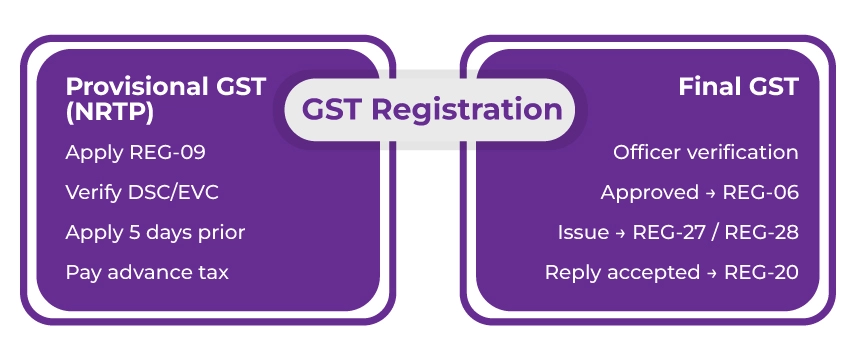
The final GST registration process for NRTP is carried out in the same way as for resident taxpayers in India:
So, this is how NRIs can apply for the final GST registration process in India. Moving further, let's know the GST returns that NRIs need to file in India.
Being an NRI, every month, you need to file GSTR-5. This return showcases your sales, purchases, paid taxes, and tax liability. Considering this, if in a particular month, you do not conduct any transactions, then also you need to file a nil return.
For NRIs, there is no annual GST return requirement in India; however, monthly compliance is monitored strictly. Delays in it lead to late fees and interest, which accumulate faster than you expect.
With Savetaxs, resolve all your doubts associated with NRI business with personalized guidance and begin your business journey in India.
Lastly, being an NRI, if you are planning to start a business in India, it is vital to consider GST implications on an NRI setting up a business in India. Additionally, the GST registration process for NRI businesses is subject to certain compliance and regulatory requirements. Registering early, correctly estimating your tax liability, and filing GST returns on time, you can stay compliant and avoid unnecessary penalties.
Further, if you face any tax complications, connect with Savetaxs. Our financial experts help you in resolving your tax matters and provide you with adequate guidance and support. Additionally, they can also assist you in tax planning in India.
Note: This guide is for information purposes only. The views expressed in this guide are personal and do not constitute the views of Savetaxs. Savetaxs or the author will not be responsible for any direct or indirect loss incurred by the reader for taking any decision based on the information or the contents. It is advisable to consult either a CA, CS, CPA or a professional tax expert from the Savetaxs team, as they are familiar with the current regulations and help you make accurate decisions and maintain accuracy throughout the whole process.

Mr. Ritesh has 20 years of experience in taxation, accounting, business planning, organizational structuring, international trade financing, acquisitions, legal and secretarial services, MIS development, and a host of other areas. Mr Jain is a powerhouse of all things taxation.
Want to read more? Explore Blogs
_1773924400414.webp&w=828&q=75)
-India_1774009994998.webp&w=828&q=75)
_1774011785097.webp&w=828&q=75)
_1774011857013.webp&w=828&q=75)