

Investment & Financial Planning

Impact of Foreign Direct Investment Policies on NRI Property Investment

  • April 2, 2026
  • 20 mins
  • 12.9K Views
 Foreign Direct Investment Policies on NRI Property

Foreign Direct Investment (FDI) is a form of investment that allows NRIs and foreign nationals to hold ownership in businesses and properties in India. It is the term that gives such investments a distinct identity. Over the years, liberalized FDI policies have grown foreign investment in NRI properties. It is because it enhances transparency, improves profitability, and facilitates transactions. 

Further, to help you out, this blog aims to determine the impact of foreign direct investment policies on NRI property investment. It includes determining the benefits and issues, legal constraints, and opportunities in the real estate industry. 

Key Takeaways
  • By liberalizing regulations, allowing 100% FDI in construction development projects, and easing fund repatriation, FDI has significantly increased NRI property investment. 
  • NRIs can freely invest in commercial and residential properties, including large-scale township without taking approval from the RBI. 
  • Additionally, FDI has facilitated infrastructure development, potentially leading to higher income returns for NRIs through increased rental yields and property values. 
  • Although FDIs have created a positive impact on investments, however it also contain the risk of market volatility, economic uncertainties, possible delays in project completion, and more.
  • Further, under FDI policies, the best cities for NRI investment are Mumbai, Delhi-NCR, and Bengaluru. 

Understanding FDI Policies in Indian Real Estate

Understanding the FDI policies in the Indian real estate and the associated legal needs is vital for NRIs looking to grab these opportunities. FDI regulations in India were introduced to create jobs, facilitate economic development, and improve global competitiveness. Considering this, the Indian government has introduced several policies and reforms to grab the attention of foreign investors. 
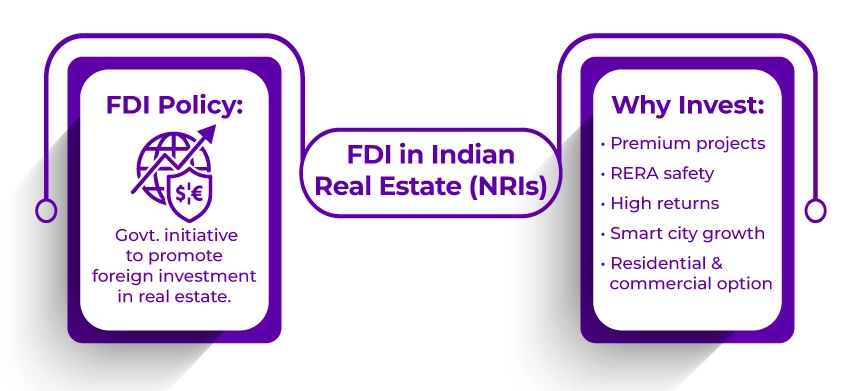
FDI in Indian Real Estate

Explanation of FDI in Real Estate and Its Legal Framework

Investment made by NRIs and foreign investors in the Indian real estate sector is known as FDI. The legal framework associated with these investments consists of the Foreign Exchange Management Act (FEMA) and the Consolidated FDI Policy of the Department of Promotion of Industry and Internal Trade (DPIIT).

Key Government Regulations Governing Foreign Investments in Property

Foreign Investments in Indian Real Estate are impacted by several factors:

  • FEMA Regulations: FEMA provides the primary legal structure for foreign currency deals that involve real estate investments. It states the permitted industries, the invested amount, and other important formalities. 
  • Consolidated FDI Policy: The Department of Promotion of Industry and Internal Trade (DPIIT) issued this policy, which contains all regulations about FDI. It includes those policies that state the investment routes, the sectoral caps, and the conditionalities, which could follow such investments. 
  • Real Estate (Regulation and Development) Act, 2016 (RERA): Although concentrated on FDI, this regulation improves the accountability and transparency of the real estate sector. Developing a more investment-friendly climate, it creates a more indirect effect on foreign investment. 

Evolution of FDI Policies and Their Impact on the Indian Real Estate Market

The evolution of FDI policies in the real estate sector of India has indeed been characterised by growing liberalisation. It further led to increasing foreign investment in India. Here is an overview of it:

  • Pre-2005: With very few options given to foreign investment, FDI in real estate did not exist virtually in pre-2005. 
  • Post-2005: Through automatic route in housing, townships, construction development projects, and built-up infrastructure, the government provide 100% FDI to NRIs and foreign investors. However, it consists of several conditions, such as capitalisation requirements and minimum area of the land.
  • 2014 Revisions: In 2014, there were revisions made in FDI policies. It provided relaxation on the minimum requirements for built-up areas and minimum capitalisation needs. It further assisted in increasing foreign investment.
  • 2017 Onwards: With the introduction of Real Estate Investment Trusts (REITs) by the government, owing to a relaxation in exit norms, there has been an increase in the interest of foreign investment. 

This was all about FDI policies in the Indian real estate market. Moving ahead, let's know about the benefits of FDI policies for NRI property investors. 

Benefits of FDI Policies for NRI Property Investors

The improvements in FDI policy have made the real estate market of India more attractive for NRIs. The following are the benefits of FDI policies for NRI property investors.

  • With liberalised FDI policies, providing more opportunities in prime locations, the investment process of NRIs in the luxury real estate market has been simplified. 
  • Regulations like RERA have improved transparency. By certifying accountability and decreasing the risk of fraud, it further makes the investment process safer for NRIs. 
  • Due to increased rental yields and property values, FDI has simplified the development of high-quality infrastructure. For investors, it further leads to potentially higher returns.
  • In the development of premium residential projects and smart cities, FDI has played a vital role. Modern living options it offers NRIs with advanced amenities.
  • Offering NRIs a range of investment options, the influx of foreign capital has resulted in the development of co-living spaces and commercial real estate. 

These are some of the benefits of FDI policies for NRI property investors in India. Moving further, let's know the challenges and risks of NRI property investment under FDI regulations. 

Challenges and Risks of NRI Property Investment Under FDI Regulations

While FDI policies have made property investment easy for NRIs in India. However, before making a decision, NRIs should consider regulatory, financial, and market-related challenges.

Challenges in Property Repatriation and Taxation

Here is the list of challenges included in property repartition and taxation:

  • Repatriation of sale proceeds from the property transactions is subject to RBI guidelines. Additionally, you need documented proof of original investment.
  • When selling a property in India, NRIs are subject to capital gains taxes:
  • Short-term capital gains (if held for less than 24 months) are taxed according to your income slab rate.
  • Long-term capital gains (if held for more than 24 months) are taxed at 20% with indexation.
  • Additionallym depending on your resident country, you should comply with the Double Taxation Avoidance Agreement (DTAA).

Market Volatility and Economic Uncertainties

The market volatility and economic uncertainties faced by NRIs in the real estate market are as follows:

  • The prices of real estate are influenced by global interest rates, economic trends, and demand-supply dynamics. 
  • Real estate cycles mean that in some locations, impacting short-term returns, the property appreciation take longer time. 
  • Factors like interest rate, currency fluctuations, inflation, or demographics can affect rental yields and property value. 

Possible Delays in Project Completion Due to Policy Fluctuations

Due to changes in the FDI policy, the project completion is delayed. Here is how it gets impacted by FDI regulations:

  • Real estate projects rely on foreign investments. Considering this, due to funding issues or policy changes may face delays.
  • Additionally, developers may face regulatory issues, construction challenges, or licensing delays, impacting the project timeline.
  • To mitigate risks, NRIs investing in under properties first check the track record of the builder and RERA registration. 

These are the key challenges and risks NRIs face under FDI regulations while investing in the real estate market in India. Moving ahead, let's know the best cities for NRI investment under FDI policies. 

Facing Issues in Choosing the Right NRI Investment?

With the investment and portfolio manager of Savetaxs, choose the right investment options as per your financial goals.

Schedule A Call Today

Final Thoughts

Lastly, the impact of foreign direct investment policies on NRI property investment is positive. It has significantly improved the investment opportunities for NRIs looking to invest in real estate. With high-growth urban markets, liberalised regulations, and increased transparency, with long-term appreciation and strong returns, NRIs can boost their income.

Furthermore, being an NRI, if you are facing issues in selecting the right investment in India, connect with Savetaxs. We have a team of financial experts who can help you in choosing the perfect investment as per your financial needs and investment goals. 

Disclaimer

Note: This guide is for information purposes only. The views expressed in this guide are personal and do not constitute the views of Savetaxs. Savetaxs or the author will not be responsible for any direct or indirect loss incurred by the reader for taking any decision based on the information or the contents. It is advisable to consult either a CA, CS, CPA or a professional tax expert from the Savetaxs team, as they are familiar with the current regulations and help you make accurate decisions and maintain accuracy throughout the whole process.

Note: This guide is for information purposes only. The views expressed in this guide are personal and do not constitute the views of Savetaxs. Savetaxs or the author will not be responsible for any direct or indirect loss incurred by the reader for taking any decision based on the information or the contents. It is advisable to consult either a CA, CS, CPA or a professional tax expert from the Savetaxs team, as they are familiar with the current regulations and help you make accurate decisions and maintain accuracy throughout the whole process.

Manish Prajapat
Manish Prajapat(Tax Expert)

Mr Manish is a financial professional with over 10 years of experience in strategic financial planning, performance analysis, and compliance across different sectors, including Agriculture, Pharma, Manufacturing, & Oil and Gas. Mr Prajapati has a knack for managing financial accounts, driving business growth by optimizing cost efficiency and regulatory compliance. Additionally, he has expertise in developing financial models, preparing detailed cash flow statements, and closing the balance sheets.

Recent Post

Want to read more? Explore Blogs

Frequently Asked Questions

FDI policies by simplifying regulations, allowing higher foreign participation, and improving transparency in the property sector make it simple for foreign and NRI investors to invest in Indian real estate.

Yes, NRIs under FEMA and RBI guidelines can buy both residential and commercial properties in India. However, they are not allowed to buy plantation property, agricultural land, or farmhouses in India.

RERA improves accountability and transparency in the real estate sector. It protect NRIs investors from fraud and ensures the timely delivery of the project, which further increases the confidence of investors.

Yes, FDI in real estate impacts property prices in India. The inflows in FDI can increase demand for real estate, especially in BIG cities. It overtime lead to price appreciation, particularly in commercial and premium segments.

Yes, NRIs are subject to capital gains tax, repatriation rules, and TDS on property sale. However, the DTAA benefits, depending on your resident country, help in reducing double taxation imposed on the same income.