
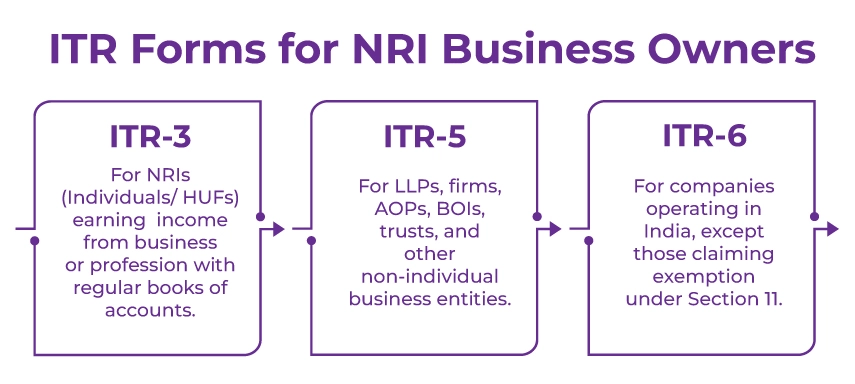
As an NRI business owner in India, you generally should file ITR-3 if you have income from a profession or business as an individual or an HUF. However, the income tax department has various ITR forms, each serving a different type of taxpayer with business income. Choosing the right ITR form as a business owner is essential as it ensures a fast process, accurate tax compliance, and avoids unnecessary notices from the department.
In this blog, we will understand which ITR form you should file for business income in India
- NRI business owners in India typically file ITR-3 for income from business or profession. Furthermore, if the business's legal structure is a company, firm, or partnership, ITR-5 and ITR-6 apply.
- For NRIs, only income earned, received, or accrued in India is taxable.
- The new tax regime is the default, offering lower rates but fewer deductions.
- Individuals with professional or business income can switch their tax regime only once in their lifetime.
- For NRIs, if their income is taxed in both countries, they can claim relief under the DTAA (Double Taxation Avoidance Agreement) by providing a Tax Residency Certificate (TRC) and Form 10F.
ITR Forms For NRI Business Owners
The following are the ITR forms for NRI business owners.
ITR-3 For Business Income
ITR-3 is the income tax return form for individuals and HUFs with income from a business or profession. This form is applicable when the concerned NRI taxpayer maintains the regular books of account and the total business income exceeds the threshold of Rs 50 lakhs.
Who Shall File ITR-3
- Individuals and HUFs (Hindu Undivided Family)
- Carrying out business under the presumptive scheme.
- Carrying on a profession.
- Income from dividends/Interest.
- Income from consultancy or freelancing.
- Income from F&O trading/ Intraday/ Share trading.
- The return may include income from house property, salary/pension, capital gains, and other sources.
- Remuneration received from a partnership firm (Not from LLPs).

ITR-5 For Firms & LLPs
The income tax filing form ITR-5 is used by LLPs (Limited Liability Partnerships), AOPs (Associations of Persons), BOIs (Bodies of Individuals), AJP (Artificial Juridical Person), Estates of deceased and insolvent persons, Business trusts, and investment funds.
Who Shall File the ITR-5 Form
- Firm
- Limited Liability Partnership (LLP).
- Association Of Persons (AOP)
- Body of Individuals (BOI)
- Artificial Juridical Person (AJP) referred to in clause (vii) of Section 2(31).
- Local authority referred to in clause (vi) of Section 2(31),
- Representative assessee referred to in Section 160(1)(iii) or (iv).
- Cooperative Society.
- Society is registered under the Societies Registration Act 1860 or under any other law of any state.
- Trusts other than those eligible to file Form ITR-7.
- Estate of Deceased Person.
- Estate of an insolvent.
- Business trust referred to in Section 139(4E).
- Investment fund referred to in Section 139(4F).
ITR-6 For Companies
ITR Form 6 is specifically for companies. However, ITR-6 is not applicable for a company engaged in charitable activities or eligible for exemption under section 11.
Who Shall File ITR-6
Companies registered under the Companies Act 2013 or the earlier Companies Act 1956 must file the ITR 6 form. But if the company incurs or receives proceeds from property that is held for religious or charitable purposes, it shall not be liable for ITR 6.
How To Choose the Right ITR Form For NRI Business Owner
The following table outlines the criteria, situations, and the applicable ITR form for NRI business owners.
|
Criteria |
Situation |
Applicable ITR Form For NRI Business Owner |
|---|---|---|
|
Nature of Income |
Business or professional income |
ITR-3 |
|
No business income (only capital gains, rent, or interest) |
ITR-2 |
|
|
Business Structure |
Individual/ Sole Proprietor. |
ITR-3 |
|
Partnership Firm/LLP |
ITR-5 (filed by entity) |
|
|
Company (Private Ltd / One Person Company (OPC)) |
ITR-6 (filed by company) |
|
|
Income Complexity |
Multiple income sources + business income. |
ITR-3 |
|
Simple income without a business. |
ITR-2 |
|
|
Compliance Requirement |
Tax audit applicable |
ITR- 3 (with an audit report) |
|
No audit requirement |
ITR-2 or ITR-3 (based on income type) |
Compliance Requirement For NRI Business Owners
Compliance requirements in India go beyond merely filing the ITR form for an NRI business owner. This involves maintaining proper financial discipline, adhering to regulatory timelines, and ensuring accurate income reporting.
The following is the key compliance requirement that every NRI business owner should follow.
- Maintain Proper Books of Account: As a business owner in India, you must keep detailed records of business income, expenses, bank transactions, and invoices to ensure accurate financial reporting.
- File the Correct Form: Selecting the right ITR form for an NRI business owner, such as ITR-3 for business income, is essential to avoid defective returns.
- Tax Audit (if applicable): If the business turnover exceeds the threshold, a tax audit is mandatory and must be paid in advance tax installments to avoid any interest penalties.
- TDS Reconciliation (Form 24AS and AIS): As an NRI business owner, you must ensure that all TDS deductions match with Form 26AS and AIS to avoid tax notices.
- Claim DTAA Benefits: To avoid double taxation, an NRI must claim DTAA benefits accurately by submitting a valid TRC (tax residency certificate).
- Timely ITR Filing: Filing the income tax return by the stipulated date is important to avoid late-filing fees, interest, and so on.
- Proper Disclosure of Income: All income sources must be fully disclosed.
- Maintain Supporting Documents: NRI business owners shall maintain all supporting documents, including bank statements, audit reports, agreements, and related documents.
Common Mistakes To Avoid While Filing ITR
The following are the common mistakes NRI business owners must avoid while filing their returns.
- Wrong ITR Form Selection: Choosing the wrong ITR form for NRIs can lead to an income tax notice and return rejection.
- Not Reporting Business Income: NRI business owners are generally required to disclose all business or professional income earned in India, which can trigger income tax scrutiny.
- Ignoring Capital Gains: Income from mutual funds, property, or shares is often missed or calculated inaccurately, leading to income tax mismatches.
- Mismatch with Form 26AS/AIS: Please ensure that the reported income matches the TDS deducted details in Form 26AS, as any mismatch can increase the risk of receiving a tax notice.
- Not Disclosing Foreign Assets or Income: As an NRI business owner, if you fail to report any foreign assets or overseas income, it can lead to complications under Indian tax laws.
- Incomplete Financial Details in ITR-3: In ITR-3, some of the most common errors include missing balance sheet and profit-and-loss details as a business owner.
- Not Claiming DTAA Benefited Properly: Failing to submit the tax residency certificate (TRC) or incorrectly claiming DTAA relief can result in higher tax liability.
- Incorrect Personal or Bank Details: Errors in personal or bank details, such as bank account or contact details, or PAN details, may cause rejection of the return.
- Not Maintaining Proper Documentation: Failing to maintain accurate financial reports, proof of income, or invoices can cause issues during audits or assessments.
- Late Filing Of ITR: And lastly, filing returns late can result in the loss of tax benefits, interest, and penalties.
Savetaxs experts provide clear guidance for your Indian business journey.
The Bottom Line
Filing ITR as an NRI business owner isn't complex as long as you have chosen the right ITR form and maintain compliance throughout the ITR filing process. Using the correct ITR form ensures faster refunds and easy compliance.
As an NRI business owner in India, if you are seeking professional guidance in filing an income tax return, Savetaxs is the name to trust. We provided tax advisory and planning services to NRIs and OCIs earning professional business or entrepreneurial income in India.
From residential status determination to income tax return filing, TDS and AIS/Form 26AS reconciliation, double taxation avoidance agreement advisory, FEMA/RBI compliance, and more, our team of experts helps you with every aspect of your ITR filing as an NRI business owner.
Connect with us as we serve our clients 24/7 across all time zones.
- Double Taxation Avoidance Agreement (DTAA): DTAA, an Agreement Signed Between the Countries to Avoid Double Taxation.
- HUF: HUF, a Legal Unit of Family Members, Formed for Tax Purposes, and Claims Benefits.
- ITR Form: Income Tax Return form, a form to report annual income and taxes, used by taxpayers.
- Permanent Account Number: Understand PAN, its full form, meaning, and benefits. Learn why a PAN card is essential for tax filing and financial transactions in India.
- Tax Deducted at Source (TDS): The Full form of TDS is Tax Deducted at Source, which is a way to collect the income tax.
- Expenses Allowed for Deductions Under Section 36 of the IT Act for NRIs
- Audit Requirements for NRIs: A Complete Guide to Tax and Compliance Obligations
- What are the Penalties for Non-Compliance for NRIs in India?
- Tax Year in Income Tax: Meaning, Changes & Example
- Advance Tax e-Campaign Emails for AY 2026-27
- How Much Money Can NRI Take To India - NRI Rules Explained
- A Full List of Documents Required for Income Tax Audit
Note: This guide is for information purposes only. The views expressed in this guide are personal and do not constitute the views of Savetaxs. Savetaxs or the author will not be responsible for any direct or indirect loss incurred by the reader for taking any decision based on the information or the contents. It is advisable to consult either a CA, CS, CPA or a professional tax expert from the Savetaxs team, as they are familiar with the current regulations and help you make accurate decisions and maintain accuracy throughout the whole process.

Mr. Ritesh has 20 years of experience in taxation, accounting, business planning, organizational structuring, international trade financing, acquisitions, legal and secretarial services, MIS development, and a host of other areas. Mr Jain is a powerhouse of all things taxation.
Want to read more? Explore Blogs