
PIS vs. Non-PIS: The Best Stock Investment Options for NRIs in India
Read More
_1772801423285.webp&w=3840&q=75)
An NRI can legally choose between two ownership structures, which are sole ownership and joint ownership. In sole ownership, only one person's name is mentioned on the property title, sale deed, and tax records. They have complete control over everything, including the sale, transfer, mortgage, or lease of the property. They don't need to take consent from anyone else, and it also reduces the need for additional documentation. It is preferable for NRIs who want no inheritance issues, have only one person funding the property, and need complete authority over decision-making.
Conversely, in joint ownership, the property's ownership, taxability, and responsibilities are shared between two or more individuals. It can be set up either as joint tenancy or tenancy in common. It is preferable for NRIs who would want to share financial responsibilities for a high-value asset and wish to have someone manage the paperwork.
However, the choice of ownership depends completely on the NRI's personal choice, goals, fund source, tax considerations, and other factors. In this blog, we will learn more about the difference between joint ownership and sole ownership.
An NRI can purchase most types of immovable property in India, except agricultural land, plantation property, and farmhouses, as per FEMA and RBI regulations for real estate. They are allowed to legally structure the ownership in two main ways: sole ownership and joint ownership. Sole ownership is when one individual holds the full right of ownership, while joint ownership is when two or more individuals share the legal ownership.
Both the ownership structures are recognized under the Transfer of Property Act, 1882, the Indian Contract Act, 1872, the Registration Act, 1908, and relevant tax laws like the Income Tax Act, 1961.
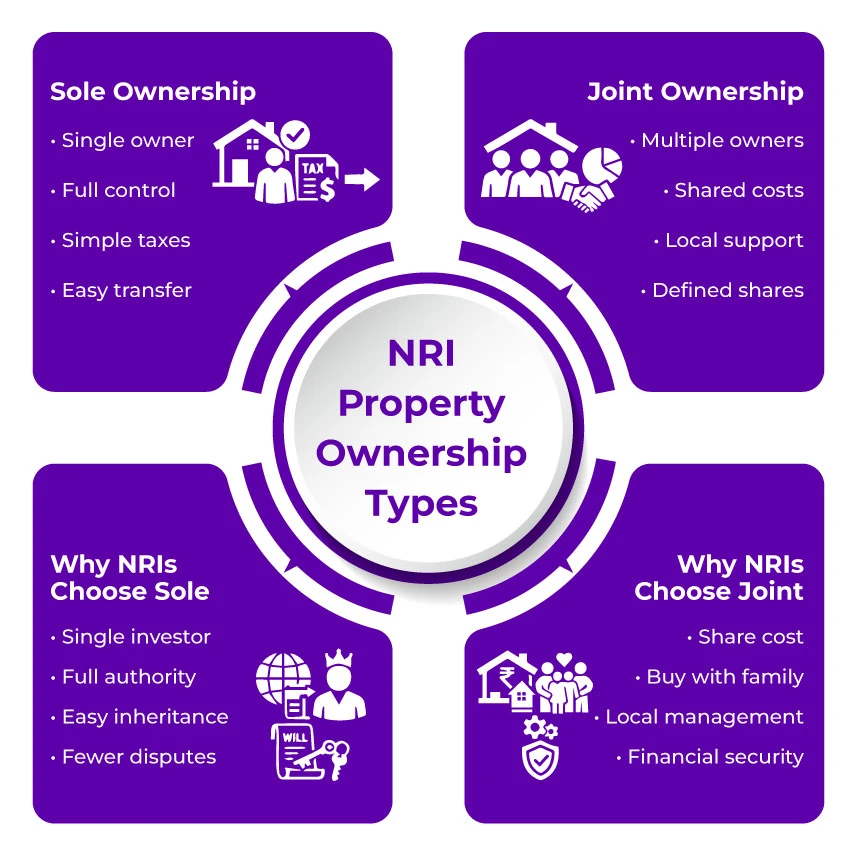
Sole ownership is when only one individual holds the property title and has exclusive rights over everything. Only one name appears on the sale deed, tax records, and municipal documents. They can either sell, transfer, mortgage, or lease the property without asking for consent from others. It reduces the need for additional documentation and compliance.
Additionally, it permits direct inheritance under personal law, like Hindu law, Muslilm personal law, etc. The tax responsibility in sole ownership lies fully on one owner.
An NRI opts for sole ownership of a property when:
Joint ownership refers to two or more individuals sharing legal ownership of a property as co-owners. It reduces the burden on a single individual as the costs, taxes, and responsibilities are divided among the co-owners. It can either be set up as joint tenancy or tenancy in common:
An NRI opts for joint property ownership when:
The table below lists the differences between joint ownership vs sole ownership for NRIs
| Particulars | Sole Ownership | Joint Ownership |
|---|---|---|
| Succession and Inheritance | Property is transferred entirely according to the owner's personal law, like Hindu law, Muslim law, etc. However, a will is advised to avoid conflicts among legal heirs |
|
| Risk Distribution | The sole owner faces all legal, financial, and maintenance-related risks. | Liability, loan obligations, and maintenance risk are divided among the co-owners. |
| Family Dispute Risks | Avoids the risk of family disputes regarding decisions or responsibilities | Conflicts may arise over expense, maintenance, or sale. Owners may need a partition suit to resolve disputes. |
| Property Loans and Mortgages | Only one owner is responsible for paying all the EMIs | All co-owners must be co-applicants. It increases interdependency but enhances loan eligibility (combined income). |
| Registration and Compliance | Sole ownership has a faster registration process and fewer KYC and FEMA compliance checks | All co-owners need to be present physically or via PoA (Power of Attorney) for registration. It needs additional documentation and verification. |
| Capital Gains Tax | Only the sole owner is liable to pay the entire capital gains tax on the sale proceeds | Joint owners pay capital gains tax based on the proportion of their share in the property |
| Financial Contribution and Documentation |
|
|
| Ownership Rights and Control | One owner gets complete authority over the sale, mortgage, lease, or renovation. | Every co-owner's consent is required for major decisions, including the sale or mortgage. |
It's completely the choice of the NRIs which ownership they wish to opt for. However, while choosing a property ownership structure, they must consider several factors, such as:
However, some general considerations must be kept in mind:
Sole Ownership May Be Preferable When:
An NRI must not make the following mistakes while purchasing a property:
An NRI can choose to purchase a property in any ownership structure that best suits their goal, tax considerations, decision-making requirements, and inheritance goals. Sole ownership can be ideal for NRIs who wish to inherit the property to their heirs, don't want any family disputes in the future, and need quick decision-making powers. Conversely, a joint ownership structure can be ideal for NRIs who can share risk and future liabilities.
After choosing the ownership structure, understanding your tax liability is crucial. To ensure compliance and avoid any taxation issues, connect with an expert at Savetaxs. At Savetaxs, we have a team of professionals carrying years of expertise and knowledge in NRI-related matters. They can help you determine your tax liability to ensure you don't face any penalties or legal issues. They can also guide you with NRI investment, repatriation, banking, and financial issues. Connect with the team right away without waiting any further, as we are actively working 24/7 across the globe.
Note: This guide is for information purposes only. The views expressed in this guide are personal and do not constitute the views of Savetaxs. Savetaxs or the author will not be responsible for any direct or indirect loss incurred by the reader for taking any decision based on the information or the contents. It is advisable to consult either a CA, CS, CPA or a professional tax expert from the Savetaxs team, as they are familiar with the current regulations and help you make accurate decisions and maintain accuracy throughout the whole process.

Mr Manish is a financial professional with over 10 years of experience in strategic financial planning, performance analysis, and compliance across different sectors, including Agriculture, Pharma, Manufacturing, & Oil and Gas. Mr Prajapati has a knack for managing financial accounts, driving business growth by optimizing cost efficiency and regulatory compliance. Additionally, he has expertise in developing financial models, preparing detailed cash flow statements, and closing the balance sheets.
Want to read more? Explore Blogs