_1767164087.webp&w=828&q=75)
What are the Crypto Tax Rates in Various Countries?
Read More
_1772801146646.webp&w=3840&q=75)
In recent years, with technological advancements and infrastructure development, India has emerged as a hub for foreign investments. From cutting-edge healthtech ventures to fintech unicorns, investment options are brimming across different sectors. For NRIs, this developing ecosystem offers a chance to participate in India's growth story, not just emotionally but strategically.
In particular, India's private equity (PE) market, with a wide range of investment options available to NRIs, has seen steady growth. Additionally, this development has also opened several alternative investment options for NRIs.
Still have some confusion about private equity investment for NRIs? Let's know more about the perspective of NRI investors in the growing private equity market and alternative investment options in India.
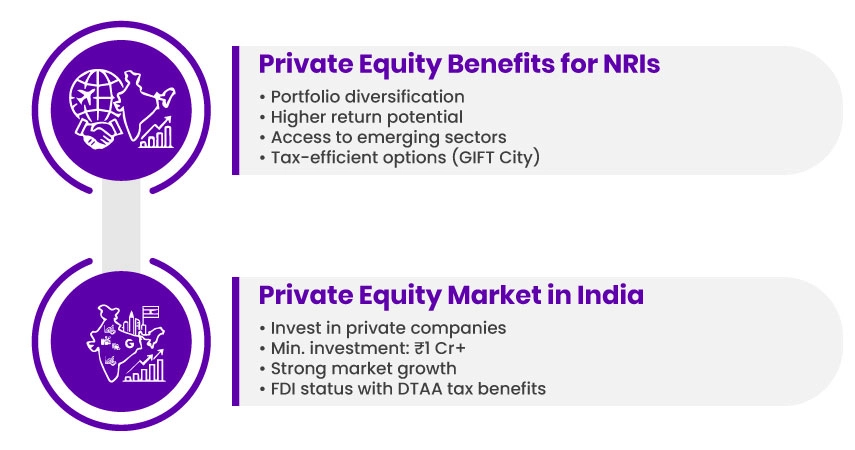
Private equity (PE) can be defined as investments in privately held businesses or companies that are not publicly traded. Private equity investment typically includes larger funds or mature companies that pool money from several investors. These investments generally require INR 1 crore+ and target companies with proven business models in India.
Considering this, the Indian private equity market has seen rapid growth, with a 27% CAGR from 2015 to 2020. Apart from this, its market size stands at USD 84.5 billion in 2025 and is on track to swell to USD 232.7 billion by 2030, compounding at an 18.22% CAGR annually. This market expansion underscores India's appeal as a capital destination, combining regulatory modernization and macroeconomic resilience.
Further, under Indian law, these investments by NRIs are considered Foreign Direct Investment (FDI). Over regular Foreign Portfolio Investment (FPI), it provides certain benefits.
Additionally, the Income Tax Bill 2025 introduced Clause 72(6), which was a revolutionary step by the Indian government for NRI startup investors. Under this clause, capital gains are now calculated in NRIs' original foreign currency. NRIs may reduce tax liability by using DTAA benefits and proper tax planning under Indian tax laws. In recent decades, it has been the single biggest incentive for NRIs investing in private equity in India.
This was all about the private equity market for NRIs in India. Moving ahead, let's know the role of GIFT City in NRI investments.
For NRIs, the emergence of GIFT City as a financial hub has added to the appeal of investing in India's private equity and alternative investment markets. GIFT City, situated in Gujarat, is India's first international financial service center. The city has been empowered to attract global investors seeking to invest in India's growing economy.
Considering this, it offers several investment benefits to NRIs and other foreign investors. It includes a business-friendly environment, world-class infrastructure, and a simplified tax regime. Additionally, the GIFT City is assigned to offer a one-stop shop for all financial services like asset management, banking, and insurance.
Apart from this, GIFT City has a separate regulatory framework that aims at simplifying the investment process globally. Considering this, the city has its own regulator, i.e., the International Financial Services Centre Authority (IFSCA). It regulates and oversees all financial activites taken place in the city.
Also, to attract global investors and NRIs, it has introduced several measures. These include the introduction of a regulatory sandbox to test innovative financial products and the offering of a tax-friendly regime.
So, this is how GIFT City of India works for NRI investors. Moving forward, let's look at the private market and alternative investment options available to NRIs in India.
The Indian private equity market offers several investment opportunities for NRIs in high-growth sectors such as consumer goods, healthcare, and technology. Over the years, these sectors have seen rapid growth and provide high returns on investments. Considering this, private equity firms also invest in early-stage companies and start-ups with the potential to grow.
Through Portfolio Management Services (PMS) and Alternative Investment Funds (AIFs), NRIs can simply invest in the private equity market. Both PMS and AIFs are controlled by the Securities and Exchange Board of India (SEBI). Additionally, AIFs are investment vehicles that take part in non-traditional asset classes.
Considering this, they can be divided into three categories, i.e., Category I, Category II, and Category III. Let's know about them in detail.
Additionally, through FPI, NRIs can invest in alternative investment funds (AIFs). The FPI investment route allows NRIs through a registered FPI to invest in the capital market of India. Considering this, it should follow the SEBI regulations and file reports with the regulator.
In contrast, PMS is an investment service that is offered by portfolio managers to institutional investors and high-net-worth individuals (HNIs). Based on risk appetite and investment objectives, it offers customized investment options to NRIs and other investors. Further, it invests in non-traditional asset classes such as real estate, private equity, debt, and others.
Moreover, through an NRE or NRO account, NRIs can simply invest in PMS. Both of these accounts are Indian rupee-dominated accounts that allow NRIs to transfer funds to India and invest in several instruments.
This was all about the private equity market and alternative investments in India. Moving ahead, let's know the benefits of private equity investments for NRIs.
Here are some of the benefits of private equity investments for NRIs:
Additionally, NRIs get a unique benefit in the private equity market of India and alternative investment options. Considering this, NRIs investing in private equity across various sectors have several investment options that are tax-efficient through the IFSC in GIFT City. Apart from this, the AIFs and PMSs in India also offer customized investment solutions and offer higher income returns on investments.
With financial experts by your side, choose the right investment and maximize your returns.
Lastly, as India is constantly one of the fastest-developing economies in the world, it offers the best investment options for NRIs. It provides NRIs the opportunity to increase their capital by investing in private equity and alternative investments. However, it is also vital for them to carefully go through their investment options as per their preferences and financial goals.
Further, if you are confused and seeking professional financial advice, connect with Savetaxs. Our team of financial experts will help you in choosing the right investment as per your risk appetite and financial goals. Additionally, they can also assist you in planning your taxes in India.
Note: This guide is for information purposes only. The views expressed in this guide are personal and do not constitute the views of Savetaxs. Savetaxs or the author will not be responsible for any direct or indirect loss incurred by the reader for taking any decision based on the information or the contents. It is advisable to consult either a CA, CS, CPA or a professional tax expert from the Savetaxs team, as they are familiar with the current regulations and help you make accurate decisions and maintain accuracy throughout the whole process.
Note: This guide is for information purposes only. The views expressed in this guide are personal and do not constitute the views of Savetaxs. Savetaxs or the author will not be responsible for any direct or indirect loss incurred by the reader for taking any decision based on the information or the contents. It is advisable to consult either a CA, CS, CPA or a professional tax expert from the Savetaxs team, as they are familiar with the current regulations and help you make accurate decisions and maintain accuracy throughout the whole process.

Mr. Ritesh has 20 years of experience in taxation, accounting, business planning, organizational structuring, international trade financing, acquisitions, legal and secretarial services, MIS development, and a host of other areas. Mr Jain is a powerhouse of all things taxation.
Want to read more? Explore Blogs
_1767170479.png&w=828&q=75)
_1767333184.png&w=828&q=75)