
_1771591706438.webp&w=828&q=75)
RBI Guidelines for NRI investment in Real Estate
Read More
_1772455397236.webp&w=3840&q=75)
In 2025, India's commercial real estate market was roughly valued at around $49.30 billion. By 2030, this number is expected to grow to USD 128.40 billion. This expected growth rate reflects a compounded annual growth rate of more than 21.1%, well above average for most long-term investments.
In addition to an excellent CAGR, commercial properties can offer good returns, high rental yields, and consistent tenancies, making them a lucrative investment option for NRIs.
In this blog, we will explore the concerns around NRIs investing in commercial property in India, including the types of properties they can invest in, the risks and benefits, and more.
The indian real estate industry offers NRIs with an array of investment options. However, when discussing commercial property investments in India, NRIs should be aware of the following types of commercial properties they can invest in, depending on their future goals.
The rising Indian economy and a fast-developing service sector are driving demand for Grade A office spaces to an all-time high. Henceforth, NRIs investing in office buildings, spaces, ornament sites, and future commercial areas have the potential to offer strong rental returns and solid capital appreciation.
As India's middle class grows, increased disposable income is directly boosting retail expansion. Shopping malls, convenience stores, great streets, and other real estate assets are in high demand, and this demand is expected to continue, making such assets a strong investment option for NRIs looking to invest in the Indian real estate market.
The demand for modern storage warehouses and associated infrastructure is primarily being driven by the rise of e-commerce and the Make in India initiative by the Indian government. NRIs investing in the Indian market can strategically allocate their capital to industrial parks and modern warehouses that may yield consistent, long-term returns.
Industrial and warehouse investments are a lucrative option for NRIs seeking to invest in various types of commercial properties.
The coworking space concept was not very well known until a few years ago. Still, its rapid growth has increased demand in various cities, making coworking spaces a great investment option for NRIs seeking to invest in commercial properties in India.
For NRIs, the aforementioned list of commercial property types provides a starting point; however, before investing, you must conduct thorough research to identify the best commercial properties to invest in India. Along with this, also assess the types of property you want to invest in and the risk tolerance associated with this, along with the long-term capital appreciation.
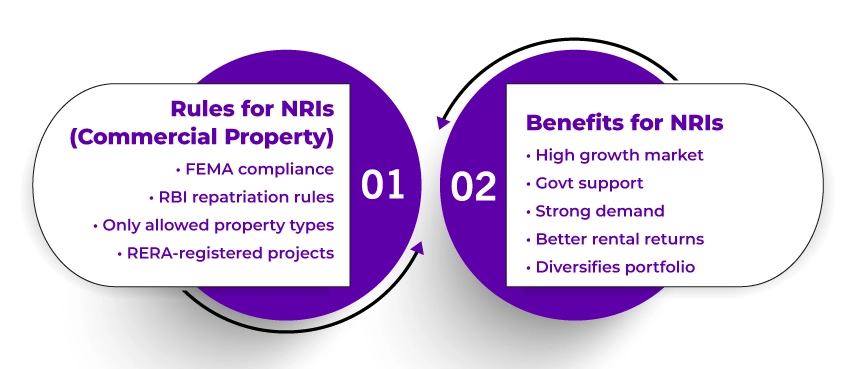
Once you know what type of commercial property you will want to invest in, now is the time to understand the legal framework, rules, and regulations for NRI commercial property investment.
As an NRI, here are some points that you need to keep in mind while making real estate investments in India.
Non-resident Indians (NRIs) must comply with FEMA regulations when investing in the Indian real estate market. FEMA's regulatory guidelines specify which types of properties NRIs can acquire and the various permissible sources of funds.
The RBI's regulatory framework generally governs the repatriation of funds when an NRI invests in commercial property in India. As an NRI, understanding the repatriation regulations is important to ensure a smooth repatriation process of sale proceeds or rental income.
The RERA Act aims to protect consumer rights, and when investing in India, NRIs must ensure they are RERA-registered to safeguard their interests.
The following are some of the amazing benefits NRIs can reap from investing in commercial real estate in India.
The popularity of commercial properties in India is at an all-time high, and it is expected to continue to expand as the business sector grows and consumer spending rises. It gives NRIs a chance to invest in commercial real estate that might appreciate in the future and generate consistent rental income.
The government of India wants to actively attract foreign capital into commercial real estate by either easing regulations or providing incentives. This makes it feasible for NRIs to invest in the Indian commercial market and benefit from the market's strong potential returns.
The millennial generation in India is rapidly adapting to start-ups and entrepreneurship, accelerating demand for commercial real estate. Apart from this, the rapid expansion of IT hubs, logistics and distribution, and e-commerce ventures also contributes to the increased demand for commercial property.
In India, residential units usually have lower rental income than commercial properties. Hence, investing in commercial property, such as storage facilities, office complexes, retail centers, and other types of properties, can be a profitable source of rental income.
NRI expanding your investment opportunities across diverse assets maximizes your returns while sharing risk. Furthermore, the commercial real estate of India is growing rapidly. Henceforth, this investment, any which way, is promising for your portfolio if you are seeking to invest in properties.
There's no room for doubt that commercial real estate tends to provide more stable returns than other investments; however, all this glitter is not without risks. Investing in commercial properties also involves risks; some you can anticipate, such as those related to property location and regulatory compliance. At the same time, other risks aren't as easy to predict, such as market fluctuations and inflation.
However, knowing all the potential risks that can come your way will help you evaluate the investment opportunity more effectively and practice proactive risk management.
Commercial property's location contributes heavily to its operational and financial success. Finding the property in the right location at the right spot that aligns with your goals, market saturation, population trends, and environmental concerns will help you maximize your returns.
Here are some of the location risks that will affect the performance of your commercial property.
Cities either grow or decline in response to regional and national economic influences; hence, the current economic and social landscape may change over time.
Inflation is one of the biggest risks to operations, as an increase can immediately jack up your operating costs. This results in tight profit margins. And if we add other utility expenses to operational costs when inflation is high, you might even struggle to generate decent revenue.
Vacancy is another factor that increases operational costs. Empty units do not generate income on their own, and this affects the long-term profitability of your investment. To fill the gaps, you will need to spend more on advertising. Henceforth, it is important to maintain some good relationships with your tenants.
Liquidity: NRIs commercial real estate market is an illiquid asset; it is natural for it to take time and resources to sell if the property is not performing well. If you want to liquidate your commercial property investment quickly, you will have to negotiate at the sale price.
Variations and fluctuations in expenses, income, and market conditions can directly influence the financial viability of a commercial property. Henceforth, it is essential to account for labor and material costs if you plan to renovate your space.
Other financial risks related to commercial property investment include.
To invest in commercial real estate, NRIs require the following documents.
Please note that these are the standard documents, and NRIs must consult a legal professional for all document requirements. Furthermore, these professionals will ensure that all legal requirements are met.
Taxes have a direct impact on your returns; understanding the tax implications under the Income Tax Act is essential for NRIs.
Taxable: The rental income earned by an NRI is taxable in India at the applicable tax rate, subject to a 30% statndard eduction for maintenance.
TDS: It is the tenant's responsibility to deduct 30% TDS (Tax Deducted at Source) from the rent before paying it. However, NRIs can claim it as a credit while filing their returns.
India has signed tax treaties with more than 100 countries, including the US, UK, and UAE, allowing NRIs to avoid double taxation on the same income. However, to claim benefits under the DTAA, NRIs must submit a Tax Residency Certificate. However, to understand DTAA on NRI property income and reap the DTAA benefits, taking expert help is recommended.
Get in touch with Savetaxs to find the right investment for your financial goals.
For an NRI, the investment in commercial property goes just beyond good returns and capital appreciation. It's about the feeling of being connected to your motherland again. There's no denying that the Indian commercial real estate market is booming, making commercial property investment lucrative for NRIs.
Investing in commercial properties in India is a great way for NRIs to build a secure financial future in the country, which is home to the world's third-largest economy. As an NRI, if you are seeking professional consultation on how to invest in commercial property in India, Savetaxs is the name to trust.
Our experts will advise you on buying, selling, and managing your commercial property in India while residing abroad. Our real estate investment experts will advise you on the best type of commercial real estate investment based on the market trends and your financial goals. Furthermore, we will consult with you on documentation and legal compliance associated with property investment and provide end-to-end assistance with the repatriation process.
NRIs, Savetaxs aim to bridge the gap between NRI investors and the Indian real estate market. Connect with us as we serve our clients 24/7 across all time zones.
Note: This guide is for information purposes only. The views expressed in this guide are personal and do not constitute the views of Savetaxs. Savetaxs or the author will not be responsible for any direct or indirect loss incurred by the reader for taking any decision based on the information or the contents. It is advisable to consult either a CA, CS, CPA or a professional tax expert from the Savetaxs team, as they are familiar with the current regulations and help you make accurate decisions and maintain accuracy throughout the whole process.

Mr Shaw brings 8 years of experience in auditing and taxation. He has a deep understanding of disciplinary regulations and delivers comprehensive auditing services to businesses and individuals. From financial auditing to tax planning, risk assessment, and financial reporting. Mr Shaw's expertise is impeccable.
Want to read more? Explore Blogs
_1771591552802.webp&w=828&q=75)

_1771668170925.webp&w=828&q=75)