

NRI Jointly Owned Property in India: Legal Rights and Options
Read More
_1771668170925.webp&w=3840&q=75)
A 'Will' is a written legal document used to specify how the assets and property of an individual will be distributed after their demise. An NRI creating a Will in India needs to follow some specific legal steps. Some key tips include maintaining a detailed inventory of Indian assets, appointing a trusted executor in India, and ensuring the Will is signed in the presence of two witnesses.
Although there is no specific inheritance tax in India, different tax implications may apply while transferring an inherited property. Additionally, NRIs who have significant assets in India can create a trust to offer more structured asset distribution. Being distant from India can create problems in managing the documents and legal requirements of creating a Will. However, careful planning and regular reviews can help create an effective and relevant Will. In this blog, we will learn some tips for an NRI creating a property Will in India, including tax implications, errors, strategies, and the steps to create a Will in India.
Creating a property will in India is complex, as India's legal system considers personal laws based on religious faith. Inheritance for Hindus, Buddhists, Jains, and Sikhs is governed under the Hindu Succession Act, while Muslims follow the principles of Islamic law.
For example, Hindu law offers more flexibility in the distribution of assets by allowing wills to overrule standard succession. Muslim law restricts testamentary disposition to one-third of the estate. NRIs must ensure that Indian laws align with those in their country of residence, often with professional assistance.
A Will must be clear, specific, and legally sound to be considered valid. Some important components are:
Execution requirements include signing the Will in the presence of two witnesses, accurate dating, and registering it legally for extra security.
An NRI must stay aware of the tax implications while inheriting a property. Although India doesn't have any specific inheritance tax, various tax implications come along when transferring or managing inherited property.
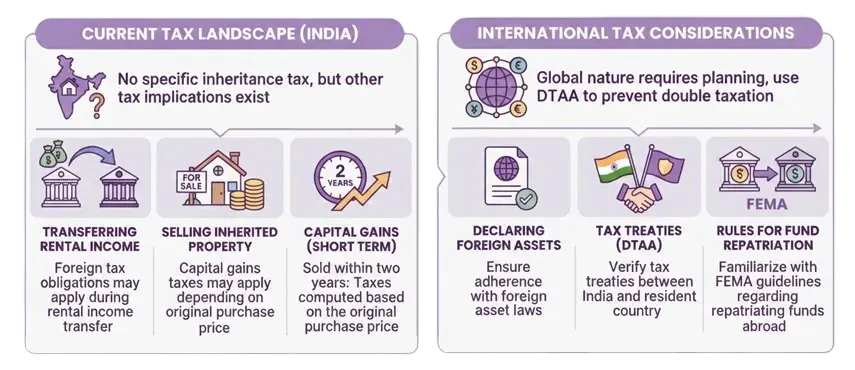
Even though there is no inheritance tax in India, NRIs face tax obligations in both India and their resident countries. Some important tax considerations for NRIs include:
NRI assets require careful planning for international tax treaties due to their global nature. They can prevent double taxation by claiming the DTAA (Double Taxation Avoidance Agreement), but specific terms may differ based on the country. Here are some key points to consider:
Here are some planning strategies for NRIs seeking to create a property Will:
NRIs who have significant assets in India, creating trust is a practical option as it offers structured asset distribution and tax benefits. Some trust options include:
Effective estate planning requires proper documentation. Apart from the Will, several supporting documents are important to ensure a smooth property transfer. Some of the essential documents include:
Ensure to keep these documents systematically so that your executor or trustee can access them easily whenever required.
Get expert help from Savetaxs for easy tax filing
Creating a Will for Indian properties as an NRI is important to secure your family's future and avoid any future inheritance disputes. An NRI might face some challenges when creating a Will, mainly in understanding the complex jurisdictional requirements covering multiple countries.
One main challenge is being separated by distance from India, which makes it difficult to manage documents and legal requirements. Here are some other challenges that an NRI faces:
Careful planning is essential to create an effective Will. You can avoid costly errors and ensure your Will fulfill its purpose by staying aware of the following common mistakes:
NRIs often oversee cross-border estate planning complexities, which is one of the most common errors. Below are some areas where NRIs often lack:
Don't think that once you have created a Will, your job is done, as creating a Will is not a one-time activity. It needs regular monitoring, review, and updates to ensure it remains relevant and valid. The Will needs regular revision due to life events, property holding changes, and tax law modifications. Consider reviewing the Will in the following situations:
An NRI must follow proper and complete methods to create a Will. The foundation of creating an effective Will is by starting with gathering all the essential information regarding your assets and beneficiaries. Follow the steps below to create a relevant Will:
Ensure to complete every step with proper care and concentration. For example, while selecting an executor, consider their:
Let Savetaxs help you make smarter investment choices.
As an NRI, creating a Will needs careful consideration of various factors, including legal, personal, and financial. Ensure to list all Indian assets, choose a reliable executor, the document is signed in the presence of two witnesses, and everything is done carefully. Regularly review and update the Will to reflect changing situations.
An NRI can create a Will on their own, but many prefer seeking assistance from a trusted expert like Savetaxs. We have an entire team of experts who are familiar with both Indian and international legal requirements. Our team can help you avoid potential stress by helping you prevent common errors. We are working 24/7 across the globe, so reach out to us right away.
Note: This guide is for information purposes only. The views expressed in this guide are personal and do not constitute the views of Savetaxs. Savetaxs or the author will not be responsible for any direct or indirect loss incurred by the reader for taking any decision based on the information or the contents. It is advisable to consult either a CA, CS, CPA or a professional tax expert from the Savetaxs team, as they are familiar with the current regulations and help you make accurate decisions and maintain accuracy throughout the whole process.

Mr. Ritesh has 20 years of experience in taxation, accounting, business planning, organizational structuring, international trade financing, acquisitions, legal and secretarial services, MIS development, and a host of other areas. Mr Jain is a powerhouse of all things taxation.
Want to read more? Explore Blogs
_1773233466269.png&w=828&q=75)
_1773319924819.webp&w=828&q=75)
_1773751977541.png&w=828&q=75)
_1773838366923.webp&w=828&q=75)