
_1772110430603.webp&w=828&q=75)
Will vs Trust for NRIs
Read More
_1771591706438.webp&w=3840&q=75)
For NRIs, investing in real estate is a significant avenue. It offers them both a connection to their Indian roots and financial growth. However, to handle the complexities of Indian real estate laws and regulations, you need to understand RBI guidelines for NRI investment in real estate. It further helps in ensuring a legal and smooth investment process.
To help you out, this comprehensive blog has covered the key factors of NRI real estate investment in India. It includes eligibility, property types, RBI and FEMA guidelines, and other relevant details. So read on and gather all the information.
Any Indian citizen living overseas and stated as an NRI can purchase property in India. These investments are controlled by specific regulations set forth by the Reserve Bank of India (RBI) and the Foreign Exchange Management Act (FEMA). Considering this, they are not allowed to directly purchase farmhouses, agricultural land, or plantation property. However, they can inherit the properties.
Additionally, NRIs can freely purchase commercial or residential property in India without RBI approval, but under FEMA, they need to get general permission. Apart from this, there is no limit on the number of properties NRIs can purchase in India.
This was all about the eligibility of NRIs to buy property in India. Moving ahead, let's know the types of properties they can purchase in India.
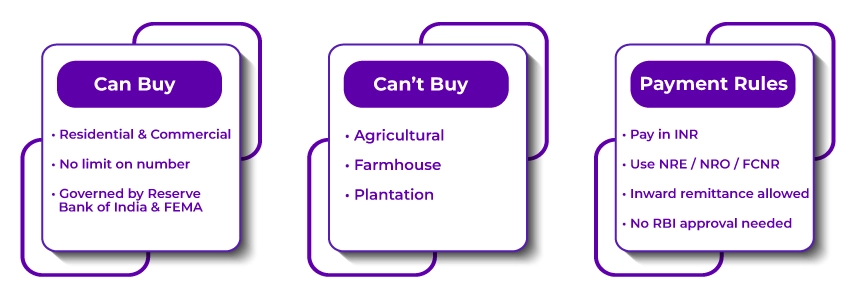
Types of properties NRIs can purchase in India include residential apartments, commercial spaces, and villa plots. However, under the FEMA and RBI guidelines, they are not allowed to buy agricultural land, farmhouses, and plantation property in India. This is because agricultural properties are managed by state-specific laws. Additionally, these properties are generally reserved for resident farmers.
Further, an exception is made if the agricultural property is received by an NRI as a gift or through inheritence he/she can hold it. Also, NRIs for development projects or commercial purposes can invest in non-agricultural land without prior permission from the RBI.
So these are the property types NRIs can purchase in India. Moving further, let's know the RBI & FEMA guidelines for NRI property investment.
According to the RBI's Foreign Exchange Management (Acquisition and Transfer of Immovable Property in India) Regulations, 2018, without taking special permision NRIs can purchase property in India. However, for this, they need to fulfill the following conditions:
This was all about the RBI & FEMA guidelines for NRI property investment in India. Moving ahead, let's know the payment methods used for property purchase in India.
To fund the real estate purchase of NRIs, the RBI provides the following permissible channels:
So, here is how using the above payment methods, NRIs can purchase property in India. Moving further, let's know about the repatriation of sale proceeds.
Through repatriation, after selling a property in India, NRIs can transfer money to their overseas bank account. According to RBI norms:
Further, having proper documentation by your side and inward remittance proof eases the repatriation process and certifies full compliance. Now, moving ahead, let's know the tax implications for NRI property transactions in India.
NRIs, before investing in Indian real estate, first need to know the tax implications. To help you out, here is a breakdown of it:
This was all about the tax implications for NRI property transactions in India. Moving further, let's know about the home loan rules for NRIs in India.
NRIs can simply take a home loan from Indian housing finance institutions and banks. However, for this, they need to fulfill the KYC and income verification criteria. Considering this, the repayment of the home loan can be done through:
Further, leading Indian banks like HDFC, SBI, and ICICI provide customized home loan solutions for NRIs investing in the real estate market of India. Now, moving ahead, let's know the power of attorney for property transactions.
NRIs have the option to appoint a reliable person as their power of attorney to handle their real estate transactions and related matters in India. Considering this, on behalf of an NRI, this authorized individual executes property transactions, representing their interests in several dealings and signing legal documents.
Further, with the power of attorney, NRIs get the flexibility and convenience in managing their real estate investments from overseas.
Get CA-approved NRI investment strategies tailored to your financial goals.
Lastly, for NRIs, understanding the RBI guidelines for NRI investment in real estate is vital. It further provides them with a compliant, profitable, and smooth real estate journey in India. Further, by consulting with financial experts like Savetaxs, you can easily handle the complexities of Indian real estate with clarity and confidence.
Additionally, with the right guidance and knowledge, your investment in real estate in India can serve as a rewarding and lucrative avenue to secure your financial future. Also, have a lasting connection to your homeland. So connect with us today, and begin your investment journey without any issues.
Note: This guide is for information purposes only. The views expressed in this guide are personal and do not constitute the views of Savetaxs. Savetaxs or the author will not be responsible for any direct or indirect loss incurred by the reader for taking any decision based on the information or the contents. It is advisable to consult either a CA, CS, CPA or a professional tax expert from the Savetaxs team, as they are familiar with the current regulations and help you make accurate decisions and maintain accuracy throughout the whole process.

Mr. Ritesh has 20 years of experience in taxation, accounting, business planning, organizational structuring, international trade financing, acquisitions, legal and secretarial services, MIS development, and a host of other areas. Mr Jain is a powerhouse of all things taxation.
Want to read more? Explore Blogs

_1772196472749.webp&w=828&q=75)
_1772196577537.webp&w=828&q=75)
_1772435083403.webp&w=828&q=75)