
How are Foreign Assets Taxed Under the Black Money Act?
Read More
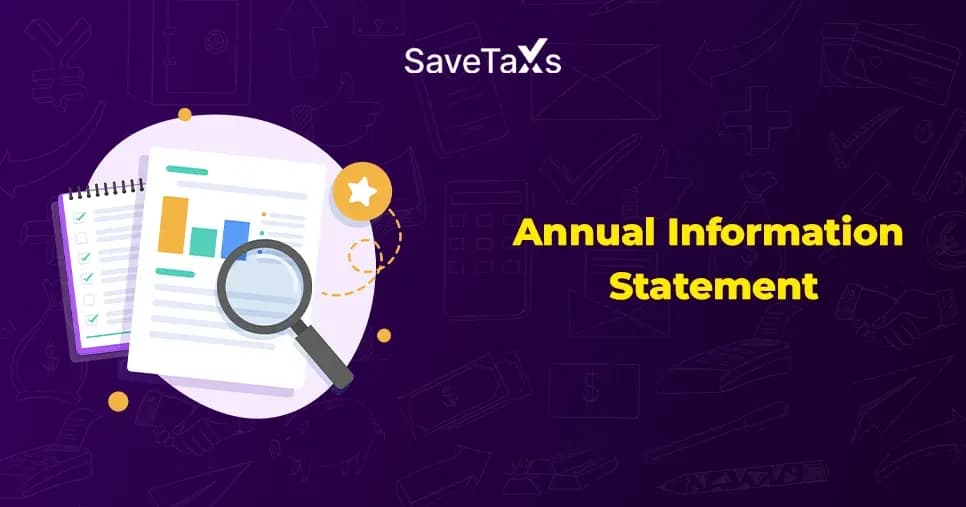
The AIS (Annual Information Statement) is a detailed summary of a taxpayer's financial information available along with Form 26AS. Along with the details of TDS/TCS, AIS also shows details regarding interest, dividends, stock market transactions, mutual fund transactions, etc.
In this comprehensive guide, we will learn what AIS is, how to check your AIS, how to open an AIS PDF, and other important information you should know.
The Annual Information Statement (AIS) is a detailed view of financial information for a taxpayer in addition to Form 26AS. The taxpayer has the option to provide feedback on the information shown in AIS.
It presents both the reported value (submitted by reporting entities) and modified values (adjusted based on taxpayer feedback) for various types of information, including TDS, Statement of Financial Transactions (SFT), and other details.
Taxpayers can check all the transactions reflected in the AIS and provide feedback if required. This information is crucial for filing an ITR.
However, taxpayers cannot directly edit AIS data. Corrections happen only after feedback validation by the reporting entity.
The primary objectives of AIS include:
AIS helps taxpayers file ITRs more accurately. It assists in identifying differences between personal records and department data.
Key features include:
The Taxpayer Information Summary provides an aggregated financial summary for each taxpayer.
It displays processed values (after removing duplicate information) and derived values (after considering taxpayer feedback).
This derived data in TIS is used for pre-filling income tax returns.
Follow these steps to access AIS:
Step 1: Log in to the income tax e-filing portal at www.incometax.gov.in and navigate to the AIS section.
Step 2: Click the “Proceed” button.
Step 3: You will be redirected to the compliance portal, where both TIS and AIS are available.
Step 4: Select the relevant financial year to view TIS or AIS by clicking the appropriate tiles.
Step 5: You can download the files using the download icon. TIS is available in PDF format, while AIS can be downloaded in PDF or JSON formats.
All AIS PDFs are password-protected.
To open the file, enter:
Example:
If PAN is ABCDE1234A and DOB is 25 May 1997, the password will be:
abcde1234a25051997
The AIS information is divided into two parts, which are as follows:
This includes:
This section includes:
Payment of Taxes: Advance tax and self-assessment tax details.
AIS provides a comprehensive record of financial activities during the year, including savings account interest and securities transactions.
The types of incomes and expenses that will be mentioned in AIS are:
| S. No | Particulars | S. No | Particulars |
|---|---|---|---|
| 1. | Salary | 30. | Credit/Debit Card Transactions |
| 2. | Dividend | 31. | Business Trust Distributed Income. |
| 3. | Donations Received | 32. | Investment Fund Distributed Income |
| 4. | Account Balance | 33. | Virtual Digital Assets Transfer Receipt |
| 5. | Foreign Travel | 34. | Securities/Mutual Funds Purchase |
| 6. | Vehicle Purchase | 35. | Lottery/Crossword winnings – Section 115BB |
| 7. | Vehicle Sale | 36. | Lottery Ticket Sales Commission |
| 8. | Cash Deposits | 37. | Horse race winnings – Section 115BB |
| 9. | Cash Withdrawals | 38. | Bonds/Government Securities Interest |
| 10. | Cash Payments | 39. | PF Balance from the Employer u/s 111 |
| 11. | Rent Payment | 40. | Online Game Winnings u/s 115BBJ |
| 12. | Rent Received | 41. | Repurchase of Units by MF/UTI |
| 13. | GST Turnover | 42. | Specific Fund Securities Income u/s 115AD (1)(1) |
| 14. | GST Purchases | 43. | Special Senior Citizen Income |
| 15. | Business Expenses | 44. | Government Payable Sums |
| 16. | Business Receipts | 45. | Life Insurance Policy Receipts |
| 17. | Land/Building Sale | 46. | National Savings Scheme Withdrawal |
| 18. | Time Deposit Purchase | 47. | Securitization Trust Investment Income |
| 19. | Foreign Remittance Receipt | 48. | Immovable Property Transfer Receipts |
| 20. | Immovable Property Purchase | 49. | Securities/Mutual Fund Units Sale |
| 21. | Interest from the Savings Bank | 50. | Infrastructure Debt Fund Interest u/s 115A (1) (a) (ia) |
| 22. | Interest from Deposits | 51. | Interest from the Specified Company (Non-Resident) u/s 115A (1) (a) (aa) |
| 23. | Interest from Others | 52. | Units of Non-Resident Income u/s 115A (1) (a) (ab) |
| 24. | Interest from Income Tax Refund | 53. | Offshore Fund Income/Long-Term Capital Gain u/s 115AB (1) (b) |
| 25. | Insurance Commission | 54. | Foreign Currency Bonds/Share Income u/s 115AC |
| 26. | Miscellaneous Payment | 55. | Foreign Institutional Investors Securities Income u/s 115AD (1) (1) |
| 27. | Off-Market Debit Transactions | 56. | Foreign Remittance/Foreign Currency Purchase |
| 28. | Off-Market Credit Transactions | 57. | Non-resident sportsmen payments – Section 115BBA |
| 29. | Rent on Plant and Machinery |
| Form 26AS | AIS (Annual Information Statement) |
|---|---|
| Currently, Form 26AS mainly reports high-value transactions and TDS/TCS information carried out during the financial year. | AIS (Annual Information Statement) provides a much more extensive overview statement. It includes savings account interest, details of financial transactions, foreign remittances, interest on deposits, and much more. |
| Form 26AS generally shows data in a summarized manner. | AIS presents data in both aggregate and individual transaction formats. |
| If a taxpayer has earned Rs. 1,700 in savings account interest and Rs. 42,000 in interest from deposits with XYZ bank during the financial year, only the Rs. 42,000 interest on which TDS has been deducted will generally be reflected in Form 26AS. | The Annual Information Statement (AIS) may include both transaction details depending on reporting. |
| Limited bank account details are available. | Taxpayers can access bank account details from which they received the income, such as the bank name, bank account number, and account type. |
| Mainly focuses on TDS/TCS, tax credits, and specified high-value transactions. | AIS provides a detailed view of the previous year's financial information, including rent received, salary, dividends, and more. |
| Does not provide extensive financial profiling. | The AIS encompasses TDS/TCS transactions, SFT information, tax payments, demand or refunds, and other related financial data. |
| GST details are not comprehensively reflected. | Some GST-related financial indicators may appear through reporting mechanisms. However, detailed GST turnover verification through Form GSTR-3B should be done separately, as AIS does not provide complete GST return details. |
CBDT has introduced a feature that shows the status of corrections or feedback submitted by taxpayers regarding AIS.
It indicates whether the feedback has been accepted fully, partially, or rejected by the reporting source (the entity responsible for uploading information in AIS).
The status options include:
The AIS (Annual Information Statement) reflects financial information reported to the Income Tax Department by various entities.
The Income Tax Act mandates specific entities to report high-value transactions. Therefore, it is possible that some data for a certain period may not yet have been received or updated.
Taxpayers are advised to verify all relevant information carefully and ensure complete accuracy while submitting their income tax returns.
It is also important to use the AIS feedback mechanism to report any errors or discrepancies.
This step is crucial because discrepancies between AIS data and ITR filings have been identified in several cases by the Income Tax Department.
Such mismatches may lead to notices, penalties, or interest due to possible underreporting of income unless they are rectified promptly.
If there are discrepancies between TDS/TCS data or tax payment details in Form 26AS compared to AIS, taxpayers should generally rely on the information in Form 26AS for tax credit verification while filing their returns.
At the same time, AIS should also be reviewed carefully because it provides a broader view of financial information that may need to be reported in the return.
If taxpayers have already submitted their Income Tax Return and later find additional information reflected in AIS, they may file a revised return if required based on the updated information displayed in AIS.
The Annual Information Statement has transformed the way taxpayers and authorities approach income tax reporting. Its detailed nature, user-oriented features, and feedback option make it a valuable resource for ensuring complete, accurate, and compliant tax filings. Taxpayers should download and review the AIS before filing their ITR to help ensure a smooth and accurate tax filing process by identifying and addressing any discrepancies in advance.
Understanding your AIS (Annual Information Statement) is important for effective tax planning and compliance. Reviewing the statement carefully can help taxpayers avoid discrepancies, ensure accurate reporting of income, and reduce the chances of notices or penalties. If needed, professional guidance may help in interpreting AIS data and maintaining compliance with current tax regulations.
Note: This guide is for information purposes only. The views expressed in this guide are personal and do not constitute the views of Savetaxs. Savetaxs or the author will not be responsible for any direct or indirect loss incurred by the reader for taking any decision based on the information or the contents. It is advisable to consult either a CA, CS, CPA or a professional tax expert from the Savetaxs team, as they are familiar with the current regulations and help you make accurate decisions and maintain accuracy throughout the whole process.

Mr Shaw brings 8 years of experience in auditing and taxation. He has a deep understanding of disciplinary regulations and delivers comprehensive auditing services to businesses and individuals. From financial auditing to tax planning, risk assessment, and financial reporting. Mr Shaw's expertise is impeccable.
Want to read more? Explore Blogs