NRI Banking Services

Tax Implications on NRO Account

  • April 2, 2026
  • 14 mins
  • 12.8K Views
Tax Implications on NRO Account

NRO accounts help NRIs to handle their income earned in India, but they come with certain tax implications, such as TDS on interest and other earnings. Considering this, knowing the account rules, repatriation limits, and minimum balance makes it simple for NRIs to manage their money. Additionally, with proper tax planning, they can reduce their tax burden and get more out of their NRI accounts.

Further, to help you out, this blog explains the tax implications on NRO account for NRIs in India. It includes the types of income taxes, applicable rates of taxes, and how NRIs can benefit from DTAA to claim tax credit. So read on and gather all the information. 

Key Takeaways
  • NRO accounts help NRIs to manage the income they earn in India. It includes current, savings, or fixed deposits in Indian rupees.
  • NRIs are liable to pay taxes on the income they earn in India. It includes capital gains, rent, consulting fess and interest from NRO accounts.
  • According to the Indian Tax Laws, 30% TDS, along with cess and surcharge, is deducted by the bank on interest earned on NRO accounts. 
  • To claim a tax credit in the resident country, NRIs can use the Double Taxation Avoidance Agreement (DTAA).
  • NRIs need to provide a tax residency certificate and a self-declaration to their CA to claim DTAA benefits. 

What Is an NRO Account?

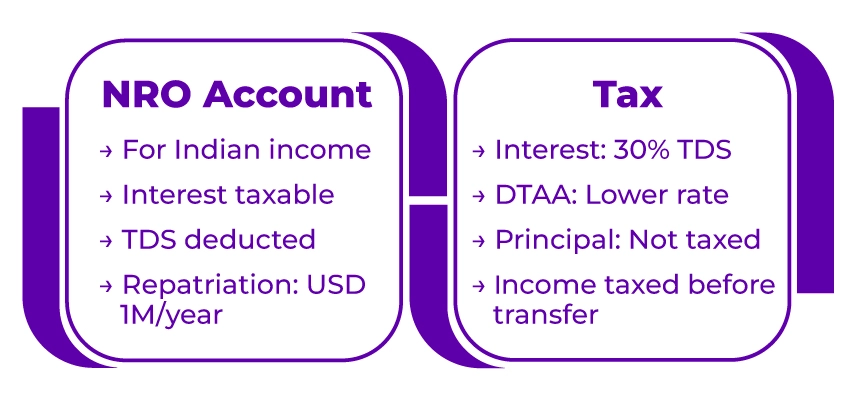
An NRO or Non-Resident Ordinary account is a bank account designed for NRIs to manage earned income in India. It includes pensions, capital gains, rent, or dividends. In this account, NRIs can deposit both funds, i.e., obtained from Indian and foreign sources, making it a flexible savings account. Income deposited in this account is subject to Indian tax laws and is taxable in India. Considering this, the bank deducts Tax Deducted at Source (TDS) on interest and other earnings from the NRO account. 

Apart from this, per financial year, NRIs can repatriate a maximum of USD 1 million from their NRO account. However, before this, NRIs need to pay the necessary taxes. Further, an NRO account is a flexible option for NRIs to manage their Indian income while living overseas.

This was all about the NRO account. Moving ahead, let's know the tax on NRO account. 

Tax Implications on an NRO Account

To maximize savings and avoid surprises, it is vital for NRIs to understand the taxation rules of NRO accounts. To help you out, here is a breakdown of tax implications on an NRO account:

  • Interest Income Taxation: According to Indian tax laws, 30% TDS, along with cess and surcharge, is deducted on the interest earned on NRO accounts.
  • Tax Exemptions: Under section 80TTA of the Income Tax Act, interest income up to INR 10,000 is tax exempt. 
  • DTAA Benefits: Under the Double Taxation Avoidance Agreement (DTAA), NRIs can reduce their tax liabilities. However, to claim the DTAA benefits, NRIs need to submit Form 10F, a Tax Residency Certificate (TRC), and a declaration of no Permanent Establishment in India. 
  • Principal Amount: The principal amount deposited in an NRO account is not taxed.
  • Repatriation Limit: Current income, such as dividends and rents are freely repatriated. However, subject to tax compliance and documentation, capital gains are repatriated USD 1 million per financial year. 

So, this was all about the tax implications of an NRO account. Moving further, let's know the benefits of having an NRO account for an NRI. 
NRO Account Tax

Benefits of Having an NRO Account for an NRI

Here are the benefits of having an NRO account for an NRI:

  • Convenient Management: An NRO account eases the process of managing domestic earnings while living overseas. For instance, NRIs can deposit their rental income received from Indian properties and use the NRO account for local expenses like property maintenance and utility bills. 
  • Flexibility: NRO accounts provide versatility in making local payments, managing income sources, and investing in financial instruments such as recurring deposits and fixed deposits. For instance, for seamless domestic transactions, NRIs can link their NRO bank account to UPI-enabled apps in India.
  • Joint Account: You can open an NRO account jointly with another NRI, PIO, or OCI. Also, the NRO bank account with a resident Indian as a joint holder can be operated on a "former or survivor basis." It offers operational flexibility through a Power of Attorney (PoA).

These are some of the benefits of having an NRO account for an NRI. Moving ahead, let's know the restrictions of an NRO account. 

Restrictions of an NRO Account

Apart from benefits, NRO accounts do have some limitations. These are as follows:

  • Deposits in an NRO account can only be made in Indian rupees. Additionally, foreign currency should be converted to INR. 
  • Tax is imposed on interest income earned from an NRO account, i.e., 30% TDS plus applicable surcharge and cess. 
  • You cannot deposit income earned abroad into an NRO account.
  • Repatriation limits in NRO accounts are restricted to USD 1 million per financial year. 

This was all about the restrictions of an NRO account. Moving further, let's know the documents required to open an NRO account in India. 

Documents Required to Open an NRO Account

NRIs need to submit the following documents to open an NRO account:

  • Accurately filled application form
  • Copy of passport or OCI/ PIO proof
  • Residence permit or visa
  • PAN card or Form 60 (it is mandatory for current accounts)
  • Address proof (for instance, Aadhaar card, driving licence, voter ID, etc.)
  • Details of money remittance
  • Tax Residency Certificate (TRC) to avail DTAA benefits

These are the documents NRIs generally need to open an NRO account. 

From Foreign Income to Compliance

Connect with Savetaxs and, with the expert guidance, simplify your NRI taxes today.

Schedule A Call Today

Final Thoughts

Lastly, to effectively manage your India-based income while living overseas, it is vital to understand the tax implications on the NRO account, its repatriation limits, and associated tax exemptions. It helps you to stay compliant and make the right decisions. 

Further, if you are facing issues in managing your Indian income and seeking guidance, connect with Savetaxs. We have a team of financial experts who can help you make informed and wise decisions. Additionally, assist you in optimizing your financial strategies to manage your NRO accounts. 

Note: This guide is for information purposes only. The views expressed in this guide are personal and do not constitute the views of Savetaxs. Savetaxs or the author will not be responsible for any direct or indirect loss incurred by the reader for taking any decision based on the information or the contents. It is advisable to consult either a CA, CS, CPA or a professional tax expert from the Savetaxs team, as they are familiar with the current regulations and help you make accurate decisions and maintain accuracy throughout the whole process.

Ritesh Jain
Ritesh Jain(Tax Expert)

Mr. Ritesh has 20 years of experience in taxation, accounting, business planning, organizational structuring, international trade financing, acquisitions, legal and secretarial services, MIS development, and a host of other areas. Mr Jain is a powerhouse of all things taxation.

Recent Post

Want to read more? Explore Blogs

Frequently Asked Questions

Yes, you can transfer money from an NRO to an NRE account. However, you should consider the repatriation limit, i.e., USD 1 million per financial year. This process is generally known as fund repartition and needs documents such as Form 15CA/CB, proof of the source funds, and FEMA declaration.

No, interest earned on an NRE account is not taxable in India. Considering this, both the interest income and principal amount are tax-free from income tax. Additionally, no Tax Deducted at Source (TDS) is imposed.

The interest earned on the NRO account is subject to 30% TDA plus applicable surcharge and cess. Additionally, depending on the total income and earned interest, the tax liability can exceed to 34% or more, including surcharge.

Yes, NRIs can claim a refund of excess TDS deducted by the bank on the NRO account interest. For this, NRIs need to file ITR in India.

Yes, DTAA applies to interest earned on NRO accounts. It allows NRIs to reduce their tax liability from the default 30% + surcharge and cess to a lower tax rate, generally 10 to 15%. However, to avail the DTAA benefits, NRIs need to submit a tax residency certificate, Form 10F, and a PAN card.