
The full form of DIN in the company law is Director Identification Number. The Ministry of Corporate Affairs (MCA) introduced the concept of DIN to enhance corporate governance, transparency, and accountability in the corporate sector.
DIN is a unique 8-digit identification number issued by the Central Government to individuals who intend to serve as directors or are existing directors of a company in India.
The DIN was implemented under the Companies Act 2013, by the Companies (Appointment and Qualification of Directors) Rules, 2014.
In this blog, we will explain why a DIN is required, how to obtain a director identification number, what documents are needed, and more.
- Relevant forms related to the director identification number (DIN) application, apart from SPICe+, are DIR-3, DIR-3C, DIR-5, and DIR-6.
- To become a director of an existing company, the applicant must file Form DIR-3 with the Central Government's Office of the Regional Director, Northern Region, Ministry of Corporate Affairs.
- An individual appointed as a director through the SPICe+ form will obtain their DIN from the Central Registration Centre.
- A DIN is unique, and the validity of a DIN is for a lifetime.
- The Companies Act 2013 states that no person can be appointed as a director without a valid DIN.
What Is A Director Identification Number (DIN)?
A Director Identification Number is a unique 8-digit identifier issued by the Government of India. The number is issued to anyone who is, or will be, a director of the company. The directors are required to file a DIN application with the MCA within the specified period.
Under company law, a DIN number is valid for life, even if the person serves as a director in multiple companies. In simpler terms, the DIN number is specific to an individual, not to the company for which it was obtained. Now, since the DIN is individualized, even if the person leaves the company and joins another company as a director, they can use the same DIN.
Why Is A Director Identification Number (DIN) Necessary?
The DIN, or the director identification number, is necessary for the following reasons.
- To Maintain an Accurate Database of Directors: The Director Identification Number (DIN) system enables government authorities to maintain an accurate database of all directors serving on boards of companies in India. This database helps in ensuring accountability and transparency in the corporate sector.
- Fraud Prevention: The DIN system helps prevent fraud by ensuring that only eligible and genuine individuals are appointed as company directors.
- To Simplify The Appointment Process: The Director Identification Number (DIN) system streamlines the appointment process by eliminating the need for repeated verification of directors' personal and professional details.
Eligibility Criteria To Obtain DIN Number
The following is the eligibility criteria for obtaining a Director Identification Number (DIN).
- Indian Citizen or NRI: Both Indian citizens and Non-Resident Indians (NRIs) are eligible to apply for a Director Identification Number.
- Age Limit: To be eligible to apply for a DIN, the applicant must be 18 years old.
- No Prior Conviction: The applicant must not have been convicted for any offence involving moral turpitude or economic offences or any offence punishable with imprisonment for more than six months.
- No Insolvency: The applicant must not be an undischarged insolvent.
- No Disqualification: Under the Companies Act 2013, the applicant must not be disqualified from acting as a director under any provision of the Act.
- Required Documents: The applicant must have a PAN card and an address proof, such as a driving license, passport, voter ID, or any other government-issued ID.

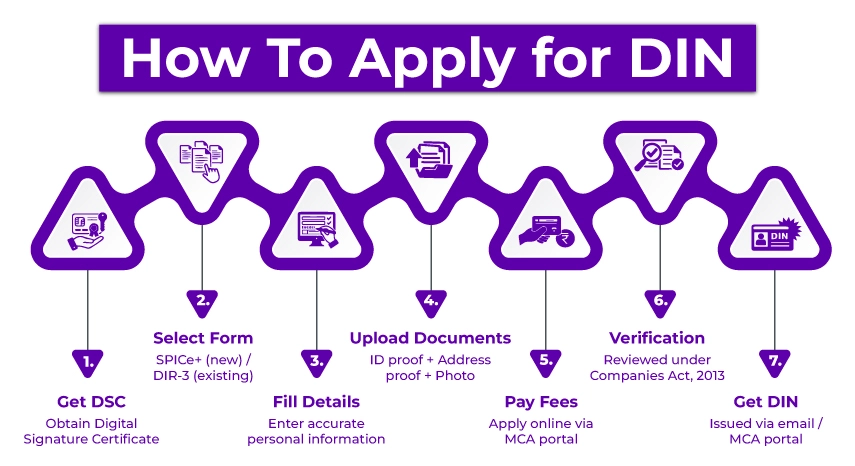
How To Apply For DIN (Director Identification Number)
The following are the steps to obtain a DIN Number (DIN).
Step 1: Obtain the Digital Signature Certificate (DSC):
The first step in obtaining a Digital Identification Number is to obtain a Digital Signature Certificate (DSC) from a Certifying Authority (CA). A DSC is required for online identity verification and to ensure that the information submission is protected.
Step 2: DIN Application Form
Get a DIN application form. You can either download the form from the official Ministry of Corporate Affairs (MCA) website or get a physical copy from any MCA office.
There are two main forms of the DIN. Choose the one suitable for your situation:
1) SPICe+ Form For New Directors:
- The SPICe+ form has the following parts: Part A and Part B, Section 1, and Interview stage III. The form must be completed during the company incorporation process.
2) eForm DIR-3 for the Existing Company Directors:
- Any director of an existing company must complete this form. Furthermore, you will need a board resolution approving the appointment, which is submitted with the application.
Step 3: Fill DIN Application Form
Once you have the form handy, fill in all the required details. Ensure that every piece of information you fill in is accurate and exactly matches the information in your supporting documents.
Step 4: Attach The Supporting Documents
Attach the required supporting documents, such as a passport photograph, proof of identity, educational documents, and proof of address. However, the applicant must ensure that the documents are attested by a notary public or a gazetted officer.
Step 5: Pay The DIN Application Fees
Once the form is filled out accurately, submit it either online or offline at the nearest MCA office, pay the applicable DIN application fees, and note your application number after payment is successful.
Step 6: Application Processing & Verification
You can track your application using the application number to monitor its processing status. The application will be reviewed in accordance with Sections 153 and 154 of the Companies Act 2013.
In the application, if everything is in order, your DIN will be approved. If any discrepancies are found, you will be required to correct them within 15 days.
Step 7: Receive Your DIN
Once your DIN application is approved by the authorities, you will receive the DIN via email, or it will be made available on the MCA portal.
All DIN holders must remember to update their DIN KYC annually using Form DIR-3 KYC to keep their DIN active.
Documents Required To Obtain DIN Number
The following is the list of documents that you are required to attach to the DIN application form:
- For SPICe+ Form: You are required to attach identity proof and address proof.
- For DIR-3 Form: The following are the documents that are required to be attached to the DIR 3 Form:
- Attachments: Residence proof, photo, ID proof, passport.
- Attested documents by CA, CMA, or CS: The ID proof, photo, and address proof must be duly attested by the CA. Documents attested by the consulate of the Foreign Public Notary and the consulate of the Indian embassy.
- Once the DIR-3 form and the required documents have been successfully uploaded, you must pay the fees.
- DIN Generation: Once the payment is done, an application number is generated. The central government oversees the application process and either approves it or rejects it.
- Intimation of DIN: The director is required to intimate the DIN for all companies where he serves as a director within one month of receiving it.
- For DIR 6 Form: The purpose of the DIR 6 form is to update/change any details already mentioned in DIR 3 or the SPICe forms. Along with the DIR 6 form, supporting attest documents are also submitted.
Benefits Of A Director Identification Number
The Director Identification Number has several benefits, out of which a few are mentioned below:
- Prevents Directorship Duplication: DIN (Director Identification Number) helps in preventing directorship duplication. As DIN is a unique identifier, it ensures that no two directors share the same DIN and that no director is issued multiple DINs. This helps reduce the risk of conflicts of interest.
- Better Corporate Governance: A director Identification Number is essential in improving corporate governance. It helps identify and trace the conduct of company directors. DIN ensures that only individuals with strong reputations and conduct are appointed as directors, thereby improving overall corporate governance.
- Protects the Shareholder Interest: Shareholders' interests are safeguarded because DIN ensures that only qualified and trustworthy individuals serve as company directors. When qualified personnel serve on the board of directors, they ensure that decisions are made in the best interests of the company and its shareholders.
Common Reasons For DIN Application Rejection
The following are the common reasons why the DIN application may be rejected. Ensure you don't end up making any of the following.
- Identity proof is not submitted.
- The applicant's father's name has not been submitted.
- The DOB proof is not submitted.
- Address proof is not being submitted.
- Copy of passport not provided.
- Invalid or outdated supporting documents.
- The application is handwritten.
- DIN application does not have an attached photograph.
- Signature is present in the wrong place.
- If the applicant's name provided in the application form is not similar to that in the supporting documents.
- Any difference in the DOB mentioned in the application and the DOB mentioned in the supporting documents.
- The applicant's gender is unclear.
- If the enclosed documents are not self-attested.
Get expert NRI business consultancy at the touch of a button.
The Bottom Line
By now, we understand the importance of a Director Identification Number (DIN) for an individual serving as a director of a company in India. The DIN helps facilitate accountability and better corporate governance. However, when obtaining a DIN, multiple documents and forms are submitted, and even minor errors can derail the process.
However, as an NRI seeking professional assistance with obtaining a Direct Identification number, Savetaxs is the name to trust. Our experts provide end-to-end consultation with DIN application assistance, document verification, DIR-3 KYC filing, MCA portal navigation, compliance, and more.
Connect with us as we serve our clients 24/7 across all time zones.
- Permanent Account Number: Understand PAN, its full form, meaning, and benefits. Learn why a PAN card is essential for tax filing and financial transactions in India.
- Digital Signature Certificate: Digital Signature Certificate, an Online Version of a Signature, Used as Identity Proof and to Verify Itr.
- Document Identification Number: DIN, a Unique Code Assigned to the Documents by Itd, Enhances Security and Efficiency in the Departments of Income Tax.
- Registrar Of Companies (ROC) India: A Complete Guide
- Certificate of Incorporation (COI): What It Is and Why It Matters?
- Memorandum Of Association (MOA): A Master Guide
- What Is Corporate Identification Number (CIN)
- What is Minimum Alternate Tax (MAT)?
- What is the Registrar of Firms (ROF) in India?
- Foreign Direct Investment (FDI): Meaning, Types & Advantages
- Articles Of Association (AOA): A Master Guide
Note: This guide is for information purposes only. The views expressed in this guide are personal and do not constitute the views of Savetaxs. Savetaxs or the author will not be responsible for any direct or indirect loss incurred by the reader for taking any decision based on the information or the contents. It is advisable to consult either a CA, CS, CPA or a professional tax expert from the Savetaxs team, as they are familiar with the current regulations and help you make accurate decisions and maintain accuracy throughout the whole process.

Mr Manish is a financial professional with over 10 years of experience in strategic financial planning, performance analysis, and compliance across different sectors, including Agriculture, Pharma, Manufacturing, & Oil and Gas. Mr Prajapati has a knack for managing financial accounts, driving business growth by optimizing cost efficiency and regulatory compliance. Additionally, he has expertise in developing financial models, preparing detailed cash flow statements, and closing the balance sheets.
Want to read more? Explore Blogs