
_1772455397236.webp&w=828&q=75)
NRIs Investing In Commercial Properties In India
Read More
_1770450284283.webp&w=3840&q=75)
ESG stands for Environmental, Social, and Governance, three non-financial factors used to evaluate the ethical and sustainability impact of a company. ESG funds are ETFs and mutual funds that invest in companies based on Environmental, Social, and Governance (ESG) criteria, in line with SEBI’s disclosure and reporting norms. For NRIs, these investment options provide an opportunity while seeking financial returns, contribute to sustainability goals.
Further, as an environmentally concerned NRI, do you also want to stand beside Indian companies adopting ESG-compliant practices? However, do not know anything about these investments. This blog provides a comprehensive guide for NRIs who want to invest in ESG mutual funds and ETFs.
Environmental, Social, and Governance (ESG) investing offers an investment approach where funds are allocated to businesses and companies that, along with profitability, comply with ethical practices. The criteria of it states how public companies maintain their responsibility towards the environment, and positively contribute to society. Additionally, maintain high standards of corporate governance and management.
Further, let's break down what each letter in ESG means:
Further, for NRIs, investing in ESG provides them the chance to contribute to the sustainability goals of India while getting returns. Additionally, research conducted by the Morgan Stanley Institute for Sustainable Investing states that compared to traditional funds between 2004 and 2018, sustainable funds have a very fewer downside risk. Apart from this, the ESG landscape of India is promisingly developing, with ESG-focused funds in India managing a growing pool of assets. Also, over 5 years, ESG funds have delivered 13 to 17% annualized returns that often exceed or match the traditional benchmarks.
This was all about ESG funds. Moving ahead, let's know why NRIs should consider investing in ESG funds in India.
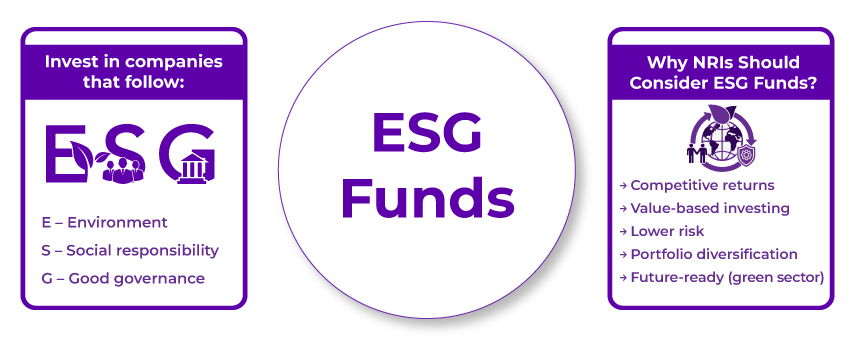
NRIs should consider investing in ESG funds because it provides them with several benefits, such as:
These are some of the key benefits ESG funds offer to NRIs. Moving further, now let's know the different types of these funds.
Many individuals think that all ESG funds are the same. However, it is not like that; each is created differently. Considering this, understanding the types of it helps you choose the one that matches your financial goals and values.
These ESG funds avoid businesses and companies involved in making harmful products or activities. It includes alcohol, tobacco, fossil fuels, or gambling. For example, this approach is followed by Quantum India ESG mutual funds by not working with companies that do not meet its sustainability criteria.
These funds do not exclude the entire sector. However, into their investment analysis actively integrate ESG factors. Fund managers determine how ESG issues may impact the sustainability and long-term performance of the company.
These investment funds focus on ESG-related themes. It includes water conservation, sustainable energy, and clean energy. One example of a thematic ESG strategy is funds focusing on clean energy and sustainability-linked businesses. It invests in companies with social and environmental causes.
These funds invest in companies that, within their industry, have top ESG ratings. They do not exclude the entire sector. However, in terms of ESG compliance, choose the best-performing companies.
The target of these funds is businesses that generate measurable positive social or environmental impact. For instance, microfinance initiatives or energy projects.
These are different types of ESG funds available for NRIs for investments. Moving ahead, let's know the performance, benefits, and risks of these funds.
In recent years, in the global markets, competitive performance has been delivered by ESG funds. In 2023, ESG funds in several global markets recorded higher median returns than some traditional funds, depending on the asset class and region. Across both equity and fixed-income categories, compared to traditional equity, 14.4% sustainable equity funds provide 16.7%.
Over time, ESG investments have proven their investment strength. For example, in December 2018, a $100 investment in ESG funds by June 2024 grew to $135. This investment growth increased because of the commitment of companies to responsible governance, sustainable operations, and long-term value creation.
Compared to some traditional investments, ESG funds have demonstrated relatively lower downside risk during certain market periods. For instance, sustainable equity funds compared to traditional equity funds (-10.6%) showed a median drawdown of -9.9%. This resilience stems from:
This was all about performance, benefits, and risk of ESG funds. Moving further, let's know how NRIs can invest in these funds.
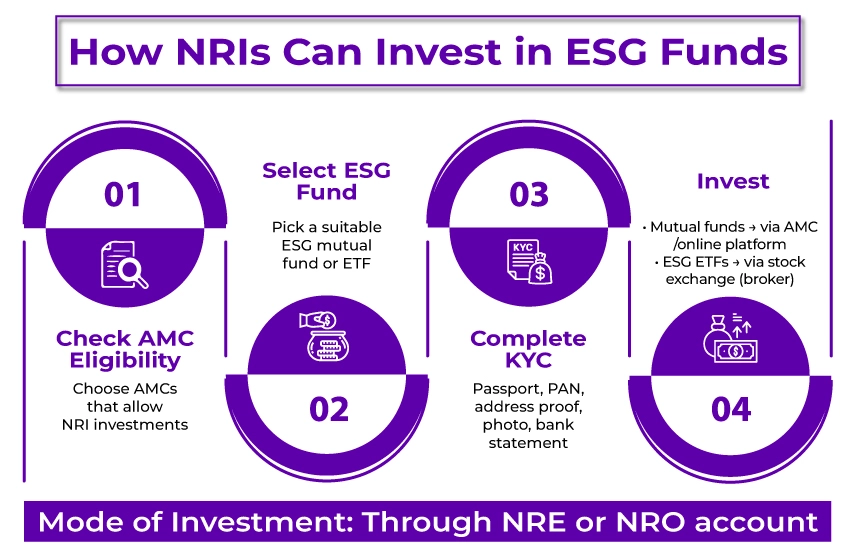
NRIs can invest in ESG mutual funds and ETFs in India using their NRE or NRO accounts, subject to AMC and country-specific restrictions. Here is how they can do so:
So, this is how NRIs can invest in ESG funds. However, there are some country-specific variations, such as in Canada and the USA. They want their residents to report investments obtained from foreign assets. It is commonly known as FATCA or the Foreign Account Tax Compliance Act. Considering this, India signed intergovernmental agreements with Canada and the US.
Moving ahead, let's know the tax treatments of ESG funds for NRIs.
The taxation of ESG equity mutual funds for NRIs follows the same capital gains rules as other equity mutual funds in India:
Further, the latest TDS rates applicable are as follows:
| Fund Type | Redemption Date | Type of Capital Gain | TDS Rate |
| Equity mutual fund | From April 1, 2025, onwards | STCG | 20% |
| Equity mutual fund | From April 1, 2025, onwards | LTCG (> INR 1,25,000) | 12.50% |
| Debt mutual fund | From April 1, 2025, onwards | All capital gains | 30% |
| International/ Hybrid/ Other non-equity funds | On or after July 23, 2025 | STCG | 30% |
| International/ Hybrid/ Other non-equity funds | On or after July 23, 2025 | LTCG | 12.50% |
Additionally, NRIs should also follow the tax laws of their resident country. For instance, NRIs living in the US may need to report capital gains on their Indian investments.
This was all about the tax treatment of ESG funds for NRIs in India. Moving further, let's know about the future outlook of ESG funds in India.
Government policies are moving forward with ESG adoption. To increase renewable energy investments and certify ethical corporate behavior, India has introduced several schemes. Additionally, under the BRSR norms, SEBI has mandated ESG disclosures for the top 1,000 listed companies. It further assists in boosting accountability and transparency.
Global Sustainable Investment Alliance (GSIA) shows that 41 international ESG funds have allocated an average 25% of their investments to Indian equities. This states the growing confidence of India in its sustainable business landscape.
Further, domestically, major players like Quantum Asset Management have launched ESG-focused funds. In 2019, the first open-ended ESG fund was launched by Quantum. Apart from this, the net-zero commitment and renewable energy targets of the Indian government by 2070 for ESG companies create a favorable environment to thrive.
Connect with Savetaxs, plan better with expert support, and choose the investment that matches your financial goals.
Lastly, ESG funds for NRIs have emerged as an attractive investment avenue, providing a balance of sustainable impact and financial returns. With continuous outperformance over traditional mutual funds and good downside protection, these investments are both forward-looking and resilient.
Further, if you are facing issues in investing in India, connect with Savetaxs. We have a team of financial experts who assist you in resolving your queries and choosing the right investment option based on your financial goals, risk profile, and investment horizon as per your financial goals, risk horizon, and preferences.
Note: This guide is for information purposes only. The views expressed in this guide are personal and do not constitute the views of Savetaxs. Savetaxs or the author will not be responsible for any direct or indirect loss incurred by the reader for taking any decision based on the information or the contents. It is advisable to consult either a CA, CS, CPA or a professional tax expert from the Savetaxs team, as they are familiar with the current regulations and help you make accurate decisions and maintain accuracy throughout the whole process.

Mr Manish is a financial professional with over 10 years of experience in strategic financial planning, performance analysis, and compliance across different sectors, including Agriculture, Pharma, Manufacturing, & Oil and Gas. Mr Prajapati has a knack for managing financial accounts, driving business growth by optimizing cost efficiency and regulatory compliance. Additionally, he has expertise in developing financial models, preparing detailed cash flow statements, and closing the balance sheets.
Want to read more? Explore Blogs
_1772530929420.png&w=828&q=75)


_1772801146646.webp&w=828&q=75)