

Top 8 Mistakes NRIs Should Avoid When Buying Property in India
Read More
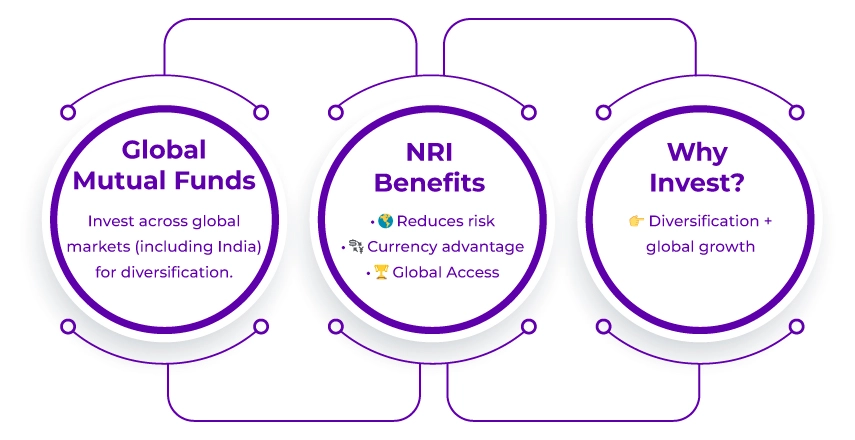
A global mutual fund to buy securities across different countries pools money from investors. Considering this, in India, global mutual funds in India manage tens of thousands of crores in assets, reflecting growing investor interest, driven by the increasing interest of NRIs in global diversification. It helps NRIs to invest beyond the local market, gaining exposure to major global companies such as Microsoft, Apple, and more.
Further, this global reach assist hedge against currency and inflation risks. Additionally, through convenient platforms, NRIs can easily invest in Indian equities. With global mutual funds, NRIs get access to a growing market overseas, often improving long-term returns and portfolio stability.
Want to know more about global mutual funds for NRIs? Read this blog and get all the information.
Global mutual funds are investment vehicles that pool money from investors to buy securities issued by companies worldwide. It also includes the investor's home country. Investing in these funds across industries and geographies offers instant diversification.
Further, global funds can be structured as open-ended, closed-ended, or exchange-traded funds (ETFs). Depending on the scheme, you may invest in debt, equities, or multi-asset portfolios to reduce concentration risks. Additionally, these funds provide investors with access to develop cycles in different economies. It is a benefit impossible to get through individual stock-picking.
This was all about global mutual funds. Moving ahead, let's know the different types of these funds.
There are different types of global mutual funds available for NRI investors. Depending on risk levels and goals, NRIs can invest in various types of global mutual funds. Considering this, the common mutual fund categories include:
However, for NRIs living in Canada or the USA, FATCA compliance means certain fund houses have restrictions. However, with additional documentation and disclosures, leading AMCs such as ICICI Prudential, SBI Mutual Fund, and more accept investments from Canadian/ USA NRIs.
These were different types of global mutual funds available for investment for NRIs. Moving further, let's know the benefits for NRIs investing in these funds.
Here is why NRIs should consider investing in global mutual funds:
These are some of the key benefits that NRIs get when investing in global mutual funds. Moving forward, let's know the tax rules for NRIs in global mutual funds.
For NRIs, global mutual fund taxation depends on the fund type and holding period. Considering this:
Further, international mutual funds focus on non-Indian-listed equities. However, rather than equity taxation rules, they follow debt-fund tax rules.
Additionally, NRIs from countries with Double Taxation Avoidance Agreements (DTAA) such as Oman, the UK, the UAE, and Singapore can benefit from tax treaties. Considering this, Under DTAA, NRIs can avoid double taxation by claiming tax credit or reduced tax rates in one of the countries, rather than full exemption in most cases.
This was all about the taxation rules for NRIs on international mutual funds. Moving ahead, let's know how can NRIs investment in mutual funds in India.
Follow the steps below to invest in global mutual funds:
So, here is how NRIs can invest in international mutual funds. Moving further, let's know the key factors to consider before investing in these funds.
Here are a few things NRIs should consider before investing in global mutual funds:
Additionally, before choosing any global mutual fund, also consider your investment objectives, time horizon, and risk appetite.
Connect with Savetaxs, and with our investment planning services, secure your financial future in India today..
Lastly, there is no doubt that global mutual funds, while providing diversification across market cycles and currencies, offer NRIs exposure to international companies and economies. Additionally, these funds also invest in assets in the local market. It allows NRIs to capitalize on potential growth options globally.
However, before investing in international mutual funds, it is vital to consider several factors. It includes risk profile, investment objectives, time horizon, expense ratio, and performance track record. Further, NRIs can streamline or start their investment journey in India simply with Savetaxs. Our financial experts simplify the KYC and investment process and help you throughout the procedure.
Note: This guide is for information purposes only. The views expressed in this guide are personal and do not constitute the views of Savetaxs. Savetaxs or the author will not be responsible for any direct or indirect loss incurred by the reader for taking any decision based on the information or the contents. It is advisable to consult either a CA, CS, CPA or a professional tax expert from the Savetaxs team, as they are familiar with the current regulations and help you make accurate decisions and maintain accuracy throughout the whole process.

Mr Manish is a financial professional with over 10 years of experience in strategic financial planning, performance analysis, and compliance across different sectors, including Agriculture, Pharma, Manufacturing, & Oil and Gas. Mr Prajapati has a knack for managing financial accounts, driving business growth by optimizing cost efficiency and regulatory compliance. Additionally, he has expertise in developing financial models, preparing detailed cash flow statements, and closing the balance sheets.
Want to read more? Explore Blogs

_1766396437.webp&w=828&q=75)
_1766492717.png&w=828&q=75)
_1766561286.webp&w=828&q=75)